
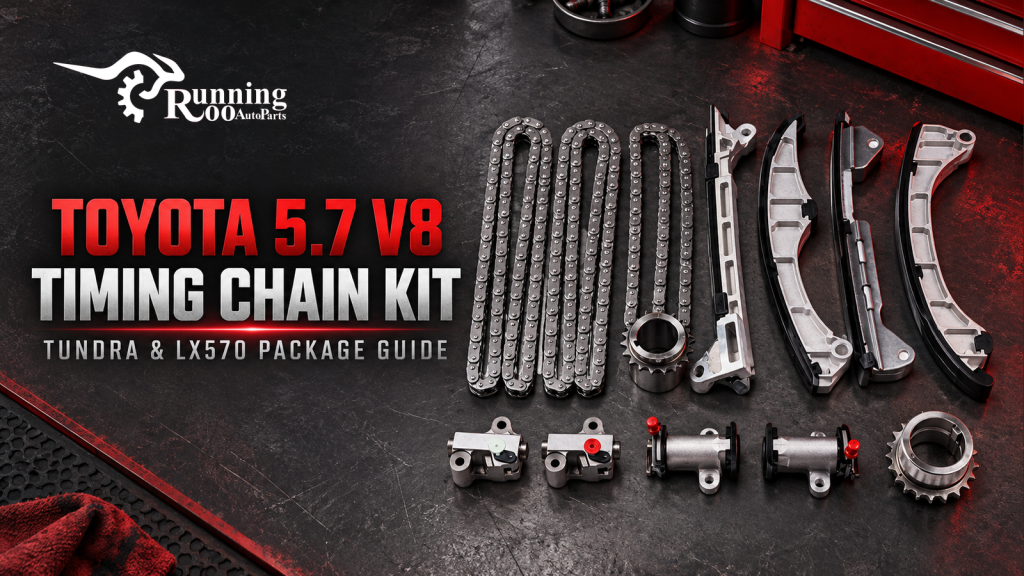
A Toyota 5.7 V8 timing chain kit can contain several chains, tensioners and guides while still excluding important components a particular repair may require. For a Tundra, Sequoia, Land Cruiser or Lexus LX570 enquiry, understanding that package boundary is just as important as recognising the vehicle name in an online listing.
RunningRoo’s selected 5.7-litre package describes four chains, four tensioners, four lower guides and two crankshaft sprockets. It expressly excludes intake and exhaust camshaft sprockets. This guide explains how to compare those contents with a workshop quotation and why imported-vehicle identity, engine code and OE references should be checked before ordering.
Start with the RunningRoo Toyota and Lexus 5.7 V8 chain kit and the corresponding eBay item. Call 0425 890 125 for friendly Australian-operated support in Blackburn, Melbourne. Local pickup is by appointment, with fast dispatch enquiries available once the application, stock and order are confirmed.
VIN · full engine code · OE reference
Workshop diagnosis · required components
Current package · extras · stock
Pickup appointment or dispatch
A 5.7-litre enquiry needs the actual engine identity
Provide the VIN, full engine code, production details and relevant OE references. The vehicle badge is useful context, but the installed engine is what the workshop must identify for an internal-parts order. If the engine has been replaced, supply that history separately from the vehicle’s original specification.
This article does not establish fitment for every V8 Land Cruiser or Lexus, nor for a 4.5-litre diesel, 4.6-litre or 4.7-litre petrol application. The presence of a familiar model name in the merchant title should not override a different engine description in the vehicle’s records.
For an imported Tundra or Sequoia, include the original market and build information where available. Registration year and Australian arrival date may not identify the production specification. Keep those dates labelled accurately rather than selecting whichever one seems closest to the product title’s year range.
What Toyota’s official information establishes
Toyota’s 2011 Tundra specification release describes its 5.7-litre V8 as an aluminium DOHC engine with Dual VVT-i. The same release discusses other engine options, reinforcing that the Tundra model name alone does not identify one engine configuration.
Keep the complete engine designation in the enquiry even when a vehicle brochure groups several options together. Ask the workshop to identify the installed engine and applicable OE references from the correct vehicle information. A brochure is useful background, but it is not an aftermarket timing-kit cross-reference or evidence that every version shares the same internal parts.
For the selected kit, ask the workshop to confirm the actual code and applicable OE references. Do not infer flex-fuel or other variant compatibility from displacement alone. Toyota’s information supplies manufacturer context; RunningRoo must confirm the commercial package, and the technician must use the correct repair information for the specific engine.
Read the four-chain package carefully
The checked merchant description identifies two lower primary chains and two upper secondary chains. It also lists four tensioners, four lower guides and two crankshaft sprockets. Those details describe the advertised supply; they do not form an installation sequence or a bank-identification diagram.
| Advertised component | Quantity or description | Order-planning check |
|---|---|---|
| Lower primary chains | Two | Confirm both references against the workshop request |
| Upper secondary chains | Two | Confirm the paired components are included |
| Tensioners | Four, described by lower and upper positions | Reconcile all four with the required application |
| Lower guides | Four | Confirm positions using applicable parts information |
| Crankshaft sprockets | Two, described as outer-left and inner-right | Verify the actual references rather than photograph placement |
| Intake camshaft sprockets | Expressly not included | Order separately if required by the repair |
| Exhaust camshaft sprockets | Expressly not included | Order separately if required by the repair |
The description also supplies tooth-count information for the crankshaft sprockets. Treat that as a merchant identification detail rather than a stand-alone compatibility test. The mechanic should match the requested references and configuration instead of approving a component simply because a count appears to agree.
Keep the kit’s grouping terminology attached to its source. A supplier may describe lower or upper positions differently from how a photograph is arranged on a page. The correct vehicle-specific information should resolve positions during repair planning and installation.
Camshaft sprockets are an explicit exclusion
The most important boundary in this package is the exclusion of intake and exhaust camshaft sprockets. Do not assume a multi-chain kit contains every gear or variable-timing component simply because it covers several drive components. Ask the workshop whether its repair requires any excluded items.
That does not mean excluded components automatically need replacement. It means the technician must make the assessment independently of the kit’s contents. Mark each relevant item as retained after assessment, separately required or awaiting inspection so the purchasing record remains clear.
If the workshop requests camshaft sprockets or adjustment units, obtain exact references and a separate supply confirmation. Avoid allowing the word complete in a casual conversation to erase an explicit exclusion in the product description. A package can be complete as advertised while still forming only part of a particular repair.
Diagnose the requirement before building the order
Ask the technician to explain what has been found and why the proposed chain-system work is appropriate. A customer report of noise, a warning or previous engine work is useful context, but it does not identify the failed component on its own. The workshop should select the applicable checks and repair information.
Where dismantling is needed before the final scope is known, keep the parts enquiry provisional. You can still ask about availability and package contents without claiming that the kit will resolve an unconfirmed fault. Agree how additional findings and extra parts will be reported and authorised.
For a vehicle used for travel or carrying work equipment, reliable scheduling matters. That is another reason to resolve the diagnosis and package boundary early. A well-organised parts order supports a repair plan; it should not pressure the technician into a scope chosen only because a particular kit is available.
Build a component-by-component workshop comparison
Create a simple comparison between the workshop’s required list and the supplier’s confirmed package. Put each chain group, tensioner group, guide group and sprocket requirement on its own line. Then add separate rows for required sealing materials, fasteners and other repair-specific components.
Ask the workshop to identify which items are definite and which remain dependent on inspection. This makes a quotation more understandable without asking the owner to design the repair. It also gives RunningRoo precise questions to answer about its stock and supplied contents.
Send the 5.7 V8 package page and matching eBay listing to the mechanic, then call 0425 890 125 with the resulting requirements. Friendly Melbourne support can help coordinate local pickup by appointment or fast dispatch after the actual order has been confirmed.
Avoid confusing engine-family context with parts approval
A manufacturer brochure can establish that a vehicle was offered with a particular engine, while the correct vehicle records can help identify engine codes. Neither necessarily tells the buyer which aftermarket chain set fits the individual vehicle. That final step needs the appropriate parts information and supplier confirmation.
The same limitation applies to another owner’s successful repair. Their experience may suggest a useful question, but it does not prove that your vehicle has the same production specification, installed engine or required parts. Keep the enquiry anchored to the actual VIN and engine rather than an apparently similar vehicle online.
This is especially helpful where a vehicle has been imported, converted or rebuilt. Preserve the available records and identify any gaps. If the installed engine cannot be confirmed from existing paperwork, ask the workshop to resolve that uncertainty rather than filling it with an assumption from the vehicle badge.
Compare the total repair scope fairly
A multi-chain package price is only one part of a workshop quotation. Compare labour, additional components, consumables and completion checks separately. If one quote includes camshaft sprockets while another retains them, understand the reason before treating the totals as equivalent offers.
Ask how the workshop handles findings that change the scope after disassembly. A written approval process helps the owner understand the next decision and prevents a provisional estimate from being mistaken for an unconditional final price. The supplier’s availability confirmation should be updated if the required parts change.
Do not use a generic online replacement cost as a promise for your vehicle. The relevant question is what your workshop proposes to do on your identified engine, with which components and checks. A precise quotation is more useful than a broad price range that leaves the excluded parts invisible.
Arrange supply around the receiving workshop
Confirm the delivery destination or pickup appointment before the order is packed. If the parts go directly to a workshop, attach the owner’s name and job reference so the kit is associated with the correct vehicle. Tell the receiver which additional components are expected from other suppliers.
RunningRoo offers Australian-operated support from Blackburn, Melbourne. Local pickup is by appointment, and fast dispatch can be discussed for confirmed stock. Ask about current handling arrangements and distinguish dispatch from the carrier’s delivery estimate when planning the booking.
Where practical, leave time for a received-parts check before dismantling. A package arriving at the workshop does not automatically mean every part required for the repair is present. The explicit camshaft-sprocket exclusion makes that distinction particularly important for this selected set.
Inspect and identify before installation
Compare the received package with the written contents confirmation. Have the workshop check the relevant references and resolve any uncertain component before fitting. Do not infer bank or position solely from where a part appears in the product photograph or editorial cover.
If an item appears missing or different, keep the packaging and contact RunningRoo with the order number and clear photographs. Do not modify or install a questioned part while waiting for clarification. A clean record makes it easier for supplier and workshop to assess the same issue.
The cover is an editorial illustration inspired by the selected product, not proof of the packing list or a mechanical assembly drawing. Its purpose is to make the article recognisable. The commercial description and correct Toyota repair information remain the relevant references for supply and technical work respectively.
Preserve the completed repair scope
Ask the workshop’s final invoice to identify the chain package and any separately fitted components. If camshaft sprockets were retained, that differs from a job in which they were replaced. A detailed record helps future technicians understand what the phrase timing repair actually covered.
Retain the engine identification and any import or replacement-engine records with that invoice. The next owner or workshop can then begin a parts enquiry with reliable information instead of repeating the same badge and model-year questions.
Follow the workshop’s instructions after the repair and report any new concern accurately. Do not assume every later engine symptom must relate to the purchased package. Diagnosis should follow the current evidence, supported by the repair history rather than replaced by it.
Related RunningRoo video
Timing Chain Rattle: Wear Symptoms & When to Replace is a related video from the RunningRoo AutoParts channel. It provides general background, not a demonstration of this exact engine, selected product or installation procedure. Use it to prepare questions for the workshop; the actual repair still needs vehicle-specific manufacturer information and professional diagnosis.
Frequently asked questions
How many timing chains are advertised in this kit?
The checked description lists two lower primary chains and two upper secondary chains, making four advertised chains. It also lists four tensioners, four lower guides and two crankshaft sprockets. Confirm the current package contents and actual application with RunningRoo before ordering.
Are intake and exhaust camshaft sprockets included?
No. The merchant description expressly excludes them. Ask the workshop whether the repair requires separate camshaft sprockets or adjustment units, and obtain the relevant references and supply confirmation. The presence of several chains and crankshaft sprockets does not turn the kit into a complete valve-timing assembly.
Does it fit every V8 Land Cruiser or Lexus?
No universal V8 fitment is established. This enquiry concerns the selected 5.7-litre package, not every petrol or diesel engine offered under those model names. Provide the VIN, full engine code, production details and OE references, especially where the vehicle has import or replacement-engine history.
Can I assume compatibility across different 5.7-litre variants?
Do not assume it from displacement or from several variants appearing in one vehicle brochure. This article does not establish interchangeability between different engine codes or fuel specifications. Have the workshop identify the actual installed engine and confirm the applicable OE references with the supplier before ordering.
Is a four-chain kit enough for the whole repair?
That depends on the workshop’s assessed requirements. The selected package has a defined component list and explicit exclusions; it does not establish inclusion of every seal, fastener or additional part. Compare the confirmed contents with an itemised repair list before deciding the order is complete.
Can I collect in Melbourne or arrange delivery?
RunningRoo offers local pickup by appointment in Blackburn and can discuss fast dispatch for confirmed orders. Call with the engine and product details, then agree the receiving address or collection arrangements. Friendly Australian-operated support can help organise supply after fitment and current stock are checked.
Confirm the package before committing the workshop time
For this 5.7 V8 listing, a sound purchase means confirming the actual engine and understanding both the four-chain contents and the camshaft-sprocket exclusions. Keep the workshop’s repair list and the supplier’s package confirmation together so that additional requirements remain visible.
Review the RunningRoo Toyota 5.7 V8 timing chain kit, view its corresponding eBay offer, and call 0425 890 125. With friendly Australian-operated support, Melbourne pickup by appointment and confirmed fast dispatch arrangements, the supply plan can follow the repair’s real requirements.
Related RunningRoo reading
For the broader purchasing process, see Timing Chain Kit Fitment: How to Match the Right Kit to Your Engine and Timing Chain: Questions to Ask Your Mechanic Before the Repair. Keep the engine and component scope in this article attached to your specific enquiry.
Sources and verification scope
The RunningRoo website product and corresponding eBay Active Listing were checked on 11 October 2026. Stock and descriptions can change; confirm the current order before purchase. Manufacturer sources below support only the stated technical context, not aftermarket approval or universal fitment. Archived copies are identified.
- Toyota: 2011 Tundra engine specification — Official US-market DOHC 5.7 V8 and Dual VVT-i context; not Australian universal fitment.