
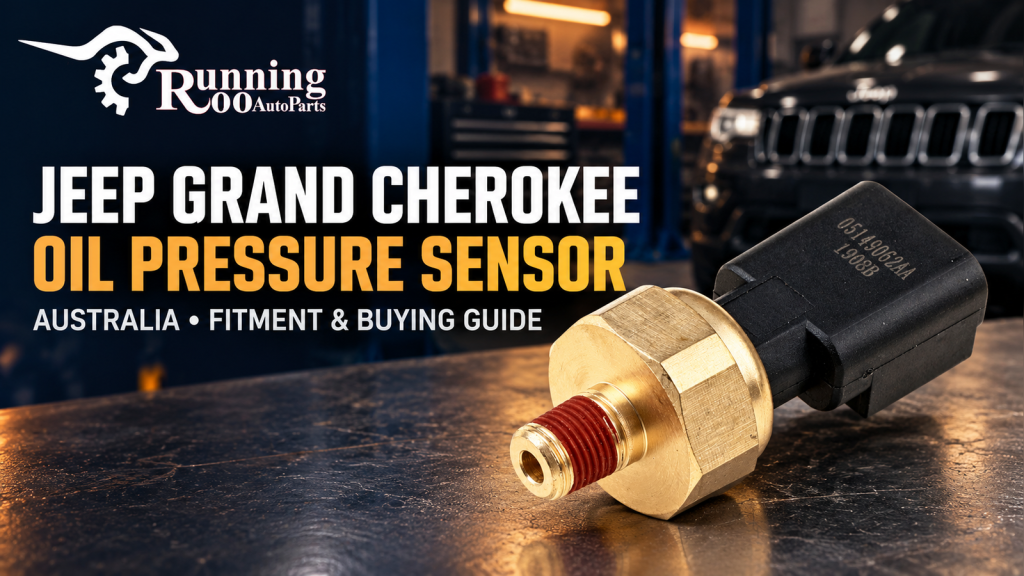
For an Australian Jeep Grand Cherokee WG or WJ owner, finding an oil pressure sensor is not simply a matter of choosing a familiar three-pin plug. The correct vehicle application and the reason for replacement both need to be established. This guide examines the RunningRoo candidate associated with 05149062AA, explains the important inconsistencies in its broad retail application text, and helps turn a general search into a precise parts enquiry.
Check Jeep WJ oil pressure sensor 05149062AA Australia at RunningRoo alongside matching RunningRoo eBay listing, then call 0425 890 125 with the VIN, engine code, old sensor marking and workshop findings. RunningRoo is Australian-operated, with friendly support, Melbourne local pickup in Blackburn by appointment and fast dispatch arrangements for confirmed stock. Start the supply discussion once the required component has been identified; do not use a sensor order as evidence that an unresolved oil-pressure warning is safe.

The first priority is the warning, not the replacement
Mopar: dashboard oil-pressure warning guidance identifies an oil-pressure warning as requiring a safe stop and directs owners to their vehicle-specific manual for complete guidance. If your Jeep indicates a pressure problem, follow its handbook and obtain professional assistance. Do not continue driving on the theory that the sender is probably faulty. A component listing cannot distinguish an electrical indication problem from a condition that needs a different repair.
Record the exact warning or gauge behaviour and explain when it occurred. Include recent service work and any previous sensor replacement, without assuming those events caused the problem. If the vehicle needs recovery or controlled workshop assessment, arrange that first. There is no need to recreate a warning repeatedly simply to improve a parts-enquiry video.
Ask the workshop how it established the replacement requirement. The answer should relate to the actual engine and its diagnostic procedure, including the distinction between pressure assessment and electrical diagnosis where applicable. This guide provides no universal pressure limit for the 4.0 or 4.7 engine and no permission to run the engine for a suggested testing period.
Read the WG/WJ listing with its inconsistencies visible
The website title names Grand Cherokee WG/WJ, 1999–2005 and 4.0/4.7-litre applications, while other parts of the description list different year groups and additional Jeep models. Those sections cannot safely be combined into a promise covering every Grand Cherokee between the earliest and latest dates mentioned. Treat the conflicting material as a prompt for a specific VIN and part-reference check.
The Jeep 2002 Grand Cherokee manufacturer specification sheet, archived by Rockcrawler: engine layout only distinguishes the 4.0-litre inline-six from the 4.7-litre V8. This manufacturer-authored, third-party-archived sheet is cited only for engine layout, not Australian sensor fitment. The 4.0-litre engine should not be described as a V8 simply because the title places “V8” near both capacities. The familiar 4.0 application is an inline-six, while the 4.7 application is a V8; identify your actual engine using the vehicle record. That distinction matters more than copying the entire retail title into a purchase request without reviewing its meaning.
The candidate discussed here uses reference 05149062AA and is advertised with a three-pin oval connection, one sensor supplied. Do not assume that every other number or vehicle name in the broad description is a verified equivalent. If a workshop proposes a different reference, ask for the application to be resolved before purchase rather than selecting whichever number is easiest to find online.
VIN, engine and the old sender should form one record
Provide the complete VIN, build date, model designation and engine code. If the Jeep is an import or has had an engine conversion, state that clearly. The identity of the vehicle as built and the hardware now fitted may both be relevant. A general “Grand Cherokee V8” description leaves too many details unresolved for a confident component enquiry.
Have the existing sensor reference and connector photographed when the repairer can access them safely. Capture the whole marking, including leading zeros and suffix letters. A missing zero or a truncated suffix can turn a useful reference into a different search term. Do not fill in an unreadable section by copying digits from the seller's page; send the photograph and explain the uncertainty.
Also record whether the current sender is original, an earlier aftermarket replacement or of unknown origin. An old invoice may identify it more clearly than a worn marking. If the vehicle has had more than one attempted repair, keep that sequence in the diagnostic history. It can help the workshop decide what evidence is still needed before another component is ordered.
Three pins do not establish the electrical specification
A three-pin oval connector is a useful physical clue, but it does not prove calibration, terminal assignment or compatibility with the vehicle's system. Do not use a wiring diagram for another Jeep generation simply because the plug looks similar. The correct circuit and test procedure must be selected for the actual engine and build.
HELLA: general oil-pressure-switch diagnosis, not this sensor pinout provides general oil-pressure-switch troubleshooting context, including connection, leakage and contamination checks. Its simple-switch operating description must not be transferred directly to this multi-terminal sensor. In particular, this guide does not prescribe a continuity test, terminal bridge or supply voltage based on that generic page. The workshop should use the proper vehicle-specific information for the component being tested.
If a connector or harness problem is found, ask for it to be documented separately from the sensor requirement. The retail package does not automatically include a wiring repair. Confirm what the workshop needs and what the seller will supply, so the arrival of one component is not mistaken for the arrival of everything required to complete the job.
Fitment and diagnosis comparison table
| Area | Evidence to collect | What should be resolved |
|---|---|---|
| Vehicle series | VIN, build date and WG/WJ identification | Which application is actually being checked |
| Engine | Exact code and 4.0 or 4.7 configuration | Avoiding a mixed-capacity or incorrect cylinder-layout description |
| Existing reference | Full marking, including suffix | Whether 05149062AA is a supported candidate |
| Connector | Clear plug and latch photographs | Physical match without assumed terminal functions |
| Warning history | Exact message or gauge observation and conditions | A useful starting point for professional diagnosis |
| Workshop findings | Relevant pressure and electrical conclusions | Whether replacement of the sender is justified |
| Listing conflict | The year or model wording that differs | Written clarification before checkout |
| Contents and supply | One sensor plus any expressly confirmed accessories | A complete, realistic ordering plan |
The table is designed for an owner and workshop to share with the parts supplier. It is not a do-it-yourself diagnostic sequence. If the workshop has not established that the sender requires replacement, keep the enquiry at the identification stage. A stock check can be useful while diagnosis continues, but it should not be represented as approval of the repair.
Separate gauge behaviour from a concluded fault
A gauge reading is an observation. A technician's supported finding about the sender, wiring or engine is a conclusion. Keep those two stages distinct in your notes. An unusual indication may lead to the sensor being investigated, but this article does not diagnose the cause from how quickly the needle moves or how the reading changes at a particular engine speed.
If a scan report is part of the diagnosis, retain the full code, description and relevant test findings. Do not order solely from an informal phrase such as “oil sender issue”. The exact vehicle and the applicable service procedure determine how the report should be interpreted. A code copied from a different Grand Cherokee generation is not a substitute for the evidence on your Jeep.
The same approach applies after a previous replacement. A recurring indication is a reason to review the complete findings and repair history, not automatically to blame the new part or to dismiss the warning. Ask the workshop what has been verified and what remains uncertain. Then select the replacement or additional work that the evidence actually supports.
Do not let a broad title merge different Jeep generations
Search engines may show WG, WJ, WK or Wrangler results together because they share words such as Jeep and oil pressure sensor. That does not make the parts interchangeable. Keep the exact series and reference in the enquiry, and request clarification if a seller's description crosses model boundaries. The fact that an item is found by a broad search is not an application approval.
For a vehicle near a listed year boundary, build information is especially useful. Registration year, model year and the seller's broad date range may not be interchangeable descriptions. Supply the actual records rather than rounding to the nearest year shown in the listing. If the seller needs a catalogue lookup or further photographs, obtain them before treating the part as confirmed.
This guide intentionally does not reproduce the entire mixed application list. Doing so would make the article look comprehensive while leaving the underlying uncertainty unresolved. Its narrower purpose is to help a WG/WJ owner investigate the 05149062AA candidate with reliable identification and a professional diagnosis. Other Jeep applications need their own confirmation.
Establish the package and installation boundary
The current offer is for one sensor. Do not assume that it includes a new connector, a repair harness, an oil service or additional engine parts. Ask the workshop to specify any separate requirements and confirm which items are included in the current retail package. A clear division between supplied parts and workshop consumables makes the quote easier to understand.
The installer should determine the correct access, sealing and tightening requirements from the applicable service information. This article does not provide a generic thread sealant recommendation or a torque copied from a later Jeep engine. A small sensor can still require a precise installation method; the fact that it is sold individually does not make every fitting instruction interchangeable.
Compare the delivered item with the confirmed reference and photographs before installation. If the plug, marking or body differs from what was approved, contact the supplier first. Do not alter the part to make it resemble the old one. Keep the invoice and package until the application and repair outcome have been reviewed with the workshop.
Arrange Australian supply around the confirmed repair
Use Jeep WJ oil pressure sensor 05149062AA Australia at RunningRoo or matching RunningRoo eBay listing once the application is settled. Read the terms on the channel you select and retain any written fitment clarification. If the website's broad description prompted a question, keep the answer with the order so the workshop can see exactly what was confirmed. Avoid relying on a remembered telephone phrase when a specific reference is involved.
For Melbourne local pickup in Blackburn, call 0425 890 125 to arrange an appointment after availability is confirmed. For regional or interstate delivery, provide the postcode and ask about fast dispatch for confirmed stock. RunningRoo's friendly Australian-operated support can help organise the supply details, but carrier transit and workshop booking times should be confirmed separately.
At the end of the repair, ask for a record of the fitted reference and the checks completed. If the warning returns, follow the vehicle's warning guidance and contact the repairer rather than assuming the new sender makes further operation safe. Keep the diagnostic and parts records together so any follow-up can begin with the actual repair history.
Frequently asked questions
Does 05149062AA fit every WG or WJ Grand Cherokee?
No universal fitment claim is made. Confirm VIN, engine, build details and the existing reference. The current seller text contains overlapping model and year descriptions that require clarification for the actual vehicle. Treat the number as a candidate to investigate, not a guarantee covering every variant identified by the WG or WJ name.
Is the 4.0-litre engine a V8?
The 4.0-litre application discussed here is an inline-six, while the 4.7-litre application is a V8. Do not copy ambiguous title wording into a vehicle description. Supply the actual engine code and VIN so the correct application can be checked. If the engine has been changed, explain the conversion rather than relying only on the original badge.
Can I ignore the warning if the gauge seems unreliable?
No. Follow the actual vehicle handbook and obtain professional assessment. Mopar's general warning guidance calls for a safe stop when low oil pressure is indicated. An apparently unreliable gauge or a suspected sender fault does not establish safe engine operation. This article provides no permission to keep driving while the cause remains unresolved.
Does an oval three-pin plug prove compatibility?
It is only one identification detail. The full reference, application and electrical specification must also agree. Do not infer pin functions from an unrelated diagram or use a simple-switch test on a sensor without the correct instructions. Send clear photographs and have the workshop use the service information for the actual vehicle.
Why not include every model listed on the product page?
The retail description contains different year ranges and additional Jeep names. Repeating them as a single compatibility list would imply a level of verification that has not been established. This guide instead highlights the uncertainty and explains how to obtain an application-specific answer. A Wrangler or later Grand Cherokee enquiry should be checked independently.
Can I buy from RunningRoo and collect in Melbourne?
Ask about Blackburn pickup by appointment, with the item and stock confirmed first. Call 0425 890 125 with the reference and vehicle details. Fast dispatch can also be discussed for available stock if delivery is more convenient. RunningRoo's local Australian support can help with the order, while the inspecting workshop remains responsible for the diagnostic and installation decisions.
Keep the final purchase tied to the actual Jeep
Before checkout, make sure the vehicle record, old reference, workshop finding and supplied item agree. Resolve any conflicting year or model wording in writing, and confirm the package and fulfilment arrangement. Those steps make the order reviewable and reduce the chance of buying a visually similar sender for the wrong application.
When the match is confirmed, choose Jeep WJ oil pressure sensor 05149062AA Australia at RunningRoo or matching RunningRoo eBay listing and save the answer with the receipt. The goal is a correctly identified sensor supplied for a defined repair, with the warning handled according to official vehicle guidance and professional findings. Neither a broad online title nor a new part alone can establish that the engine is safe to operate.
Sources and evidence boundaries
Mopar: dashboard oil-pressure warning guidance; HELLA: general oil-pressure-switch diagnosis, not this sensor pinout; Jeep 2002 Grand Cherokee manufacturer specification sheet, archived by Rockcrawler: engine layout only. Manufacturer information supports only the limited context described above. Retail contents and application leads come from the linked seller offers and are not independent OEM certification. Use the applicable complete service information for the actual vehicle and repair.
Review the RunningRoo product and the corresponding eBay offer, or call 0425 890 125. Contact RunningRoo with VIN, engine code and OE details for friendly Australian-operated support. Ask about Melbourne local pickup in Blackburn by appointment and fast dispatch for confirmed available stock; confirm item-specific fulfilment before booking labour.