
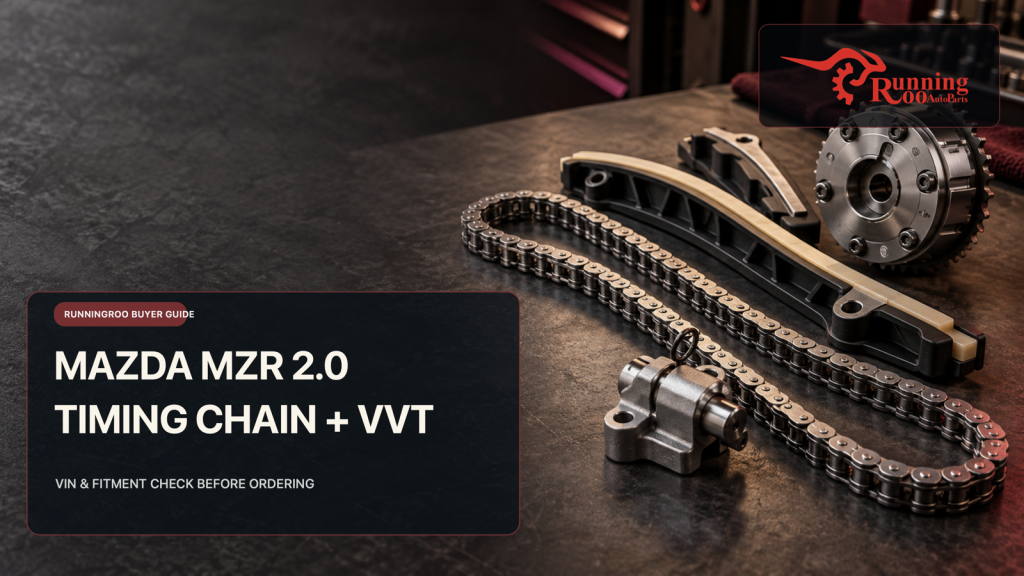
If a Mazda 3, Mazda 5, Mazda 6 or MX-5 is booked in for timing work, buying a “Mazda 2.0 timing chain kit” by badge alone is not a safe shortcut. The same model name can span different engines, markets and years, while timing-system components are determined by the engine family and the physical parts fitted to the vehicle. For a repair that involves a chain, oil-pump chain and VVT phaser, a wrong assumption can turn into duplicated labour rather than a simple return.
This guide covers the RunningRoo kit listed for selected 1.8L and 2.0L MZR petrol applications. It is written for Australian owners and workshops planning a proper, evidence-led purchase. The objective is not to diagnose an engine remotely or publish a generic timing procedure. It is to help the buyer make sure that the vehicle, engine, kit contents and workshop scope agree before the front of the engine is opened.
The live RunningRoo Mazda 2.0L MZR timing kit product page identifies a kit with a main timing chain, oil-pump chain, VVT gear/phaser, tensioner, guides and related sprockets. The matching RunningRoo eBay active listing should be checked alongside the website listing before ordering; stock, price and listing details can change.
RunningRoo Auto Parts – Based in Melbourne, Australia 🇦🇺
Free 24/7 Pickup Available (Contact 0425890125)
Any questions? Message or Call us anytime! We’re here to help.
Why Choose RunningRoo?
Aussie Owned & Operated | Fast Shipping | Friendly Support
Start with engine identity, not a search phrase
The phrase “Mazda 3 2.0 timing chain” is useful for finding a product, but it is not a fitment result. The current RunningRoo listing describes selected 1.8L and 2.0L 16-valve MZR petrol applications. Its application table includes various Mazda 3, Mazda 5, Mazda 6 and MX-5 entries, but it does not convert every vehicle carrying one of those badges into a guaranteed match. Market specification, build year, engine code, emissions configuration and previous engine work still matter.
The practical purchase order is simple: identify the vehicle, identify the engine, identify the original parts, then compare that evidence with the live listing. A VIN is the best place to begin because it allows the workshop and supplier to narrow the original build specification. It should be followed by the engine code, build date, current repair diagnosis and—where the engine is open—photographs or numbers from the removed components. A registration plate or model badge by itself is weaker evidence.
| Evidence to collect | Why it matters | Do not substitute with |
|---|---|---|
| Full VIN | Establishes original vehicle configuration | Model name alone |
| Engine code and displacement | Distinguishes engine families | “2.0 Mazda” |
| Build month/year | Helps resolve production changes | First registration date |
| Original-part photos/numbers | Checks physical revision and layout | A similar online image |
| Workshop diagnosis | Defines whether the chain, phaser or another system is at fault | A noise description alone |
| Current product contents | Confirms what will arrive in the box | Assumption that every kit is identical |
Send that information before paying, particularly when an engine has been replaced or rebuilt in the past. A VIN describes original vehicle build; it cannot prove that a later repair did not change a component. The safer answer is the one where VIN data, engine identity, the original part and the present workshop scope all point to the same kit.
What the listed kit contains—and why each item is relevant
According to the live RunningRoo product description, this kit includes a VVT gear/phaser, a 134-link main timing chain, a 54-link oil-pump chain, a hydraulic tensioner, main-chain guides, oil-pump-chain guides and associated cam, crank and oil-pump gears. That package is valuable because a timing repair often involves more than the visible main chain. The related components share the same oil environment, service history and access labour.
| Listed component | Function in the repair plan | Pre-order question for the installer |
|---|---|---|
| Main timing chain | Synchronises crankshaft and camshaft rotation | Is the chain condition confirmed, or is another cause being investigated? |
| Hydraulic tensioner | Maintains controlled chain tension | Is the tensioner included in the chosen kit and suitable for this engine? |
| Guide rails | Control chain path and vibration | Are all relevant guides being renewed, not only the visibly damaged one? |
| Oil-pump chain | Drives the oil pump on this listed application | Has the secondary chain run been inspected? |
| VVT gear/phaser | Adjusts camshaft timing under engine control | Has the workshop distinguished phaser wear from an oil-control or sensor fault? |
| Gears/sprockets | Provide the toothed drive interface | Are original parts and tooth profiles being compared during assembly? |
That table is a buying checklist, not an installation manual. Correct alignment, locking tools, fastening sequence, sealant, torque values, oil specification and post-repair checks must come from the current Mazda procedure for the exact VIN and engine. Do not use torque figures, timing marks or videos published for another MZR variant as a substitute.
VVT gear, timing chain and oil quality: separate the symptom from the decision
Variable valve timing uses controlled oil flow to alter camshaft position within a designed operating range. The VVT gear or phaser is therefore not a decorative sprocket: it is a moving hydraulic component integrated with the timing system. A rattle, cam-correlation code, rough idle, loss of response or poor fuel use can justify investigation, but none of those signs alone identifies the failed component.
The workshop must first determine whether the complaint relates to mechanical timing, a worn phaser, an oil-control valve, oil condition/level, wiring, sensor information or another engine issue. An online product listing cannot inspect oil pressure, read live scan data or see the chain through the timing cover. Ordering a complete kit may make sense when the repair scope is confirmed, but it should not be used as a substitute for diagnosis.
Mazda’s owner information directs owners to follow the maintenance requirements for their vehicle. For professional work, the installer should use the current Mazda workshop information applicable to the VIN, including the approved oil and service procedures. The same principle is reflected in the Mazda Australia owners and servicing information: service requirements are vehicle-specific, not a universal instruction copied between engines.
| Observation | Possible system involved | Sensible next step |
|---|---|---|
| Brief cold-start noise | Chain/tensioner/phaser or oil-delivery issue | Record the sound cold; inspect oil level/condition and scan the vehicle |
| Cam timing or correlation code | Mechanical timing, phaser, sensor, wiring or oil control | Use the manufacturer diagnostic flow before ordering |
| Persistent rough running | Many ignition, air, fuel and timing causes | Diagnose rather than fitting parts by symptom |
| Visible guide debris or confirmed chain wear | Mechanical timing-system wear | Plan a complete, vehicle-specific repair scope |
| Oil warning or abnormal pressure finding | Lubrication system issue | Stop and investigate according to Mazda procedure |
The responsible wording here matters. It is reasonable to say that the components work together; it is not reasonable to promise that one part will cure every noise or code. A seller can verify a listing against the supplied vehicle evidence. A qualified technician must verify the fault and installation method.
Why a complete timing repair is often better value than repeat access labour
On many engines the major cost of timing work is reaching the components, not the individual chain. Once a qualified workshop has confirmed the scope, replacing related wear items during the same access window can reduce the risk of paying to reopen the engine for an old guide, tensioner or secondary chain. That is the commercial logic behind a kit—not an instruction to replace sound components without inspection.
Ask the workshop to separate the job into three lines: confirmed failed parts, sensible related replacements while access is available, and consumables/one-time-use hardware. This makes it possible to compare the kit contents with the actual work order. It also reveals whether the repair will require items outside the kit, such as seals, fasteners, oil, coolant, cleaning materials or diagnostic/adaptation work.
| Repair-planning question | A clear answer should say |
|---|---|
| What fault has been confirmed? | The test result or inspection finding, not only a generic code |
| Which listed kit components will be fitted? | Main chain, oil-pump chain, guides, tensioner, phaser/gears as applicable |
| What is not included? | Gaskets, seals, fluids, bolts, labour or programming where relevant |
| What official information will be used? | Current Mazda procedure for this VIN/engine |
| What is verified before start-up? | Mechanical timing, fluid level, leak check and diagnostic results |
This discussion also protects the customer if the vehicle is a daily driver. A workshop that has the correct kit, consumables and plan in hand is less likely to leave the car dismantled while a small but essential item is sourced separately.
A practical pre-order message for Australian owners
A helpful fitment request is specific and short. Include: “Mazda [model], [build month/year], 1.8L or 2.0L petrol, engine code if known; VIN [17 characters]; workshop has identified [confirmed repair scope]; original component photos attached; please compare with the current Mazda MZR timing kit listing.” If the engine is still assembled, say so. Do not invent a part number from a search result.
For metro Melbourne customers, local pickup can be arranged after stock and fitment are confirmed. For interstate buyers, it is worth coordinating dispatch with the workshop booking rather than scheduling an engine teardown around an unverified order. Keep the invoice, the workshop diagnosis and photographs of the original components together until the repair is checked.
The current products can be reviewed here: RunningRoo’s Mazda MZR timing kit and the matching RunningRoo eBay listing. Both links point to RunningRoo listings; neither replaces a VIN check.
RunningRoo Auto Parts – Based in Melbourne, Australia 🇦🇺
Free 24/7 Pickup Available (Contact 0425890125)
Any questions? Message or Call us anytime! We’re here to help.
Why Choose RunningRoo?
Aussie Owned & Operated | Fast Shipping | Friendly Support
Receiving the kit: inspect before the old parts are removed
When the order arrives, compare it with the invoice and live listing before installation. Check that the component count corresponds with the description, that the main and secondary chains are present where listed, and that the visible gears, guides and tensioner match the planned repair. The installer should compare the new parts with the removed originals and stop if a material difference appears.
Photograph the parcel label and contents. Retain packaging until the workshop has completed its visual comparison. If the vehicle evidence and the delivered component do not agree, do not force-fit, machine, modify or attempt a trial installation. Contact RunningRoo with the order reference, VIN, engine information, clear images and an explanation of the difference. Protecting the evidence before fitting gives both the customer and supplier the best opportunity to resolve a genuine discrepancy.
Frequently asked questions
Does this kit fit every Mazda 3 2.0L?
No. The product page lists selected MZR petrol applications, not every Mazda 3 sold with a 2.0L badge. Confirm VIN, engine code, build information and original parts before ordering.
Does the kit include an oil-pump chain?
The current RunningRoo product description lists a 54-link oil-pump chain and related guides. Recheck the live page before purchase because listing details and stock can change.
Is the VVT gear included?
The listing identifies one VVT gear/phaser. The workshop must confirm that a phaser is part of the required repair and that the listed kit matches the exact engine.
Can I order because the engine rattles on a cold start?
Not safely on that symptom alone. A cold-start noise can involve multiple systems. Have the vehicle inspected, its oil condition checked and relevant fault data assessed before deciding on parts.
Can I reuse old guides or the old tensioner?
That is a workshop decision based on the exact repair scope. Timing components are commonly assessed together because access labour is significant, but this article does not replace inspection or Mazda’s official procedure.
Does the eBay item represent a different product from the website?
Use the live product title, contents, photos and seller identity to compare the two. Both links in this article are RunningRoo listings; confirm current details before buying.
Is professional installation recommended?
Yes. Timing work affects engine synchronisation and requires vehicle-specific technical information, correct tooling and post-repair verification. Use a suitably qualified workshop.
Source and editorial basis
- RunningRoo Mazda 3/5/6 2.0L MZR timing kit product page — live product contents and listed applications.
- RunningRoo eBay listing — matching RunningRoo active listing, checked before drafting.
- Mazda Australia owners and servicing — official owner-service information; the installer must use the current workshop procedure for the exact vehicle.
Fitment is a guide, not an installation instruction. Confirm the VIN, engine code, original component information, current listing and workshop diagnosis before ordering or fitting.
RunningRoo Auto Parts – Based in Melbourne, Australia 🇦🇺
Free 24/7 Pickup Available (Contact 0425890125)
Any questions? Message or Call us anytime! We’re here to help.
Why Choose RunningRoo?
Aussie Owned & Operated | Fast Shipping | Friendly Support