
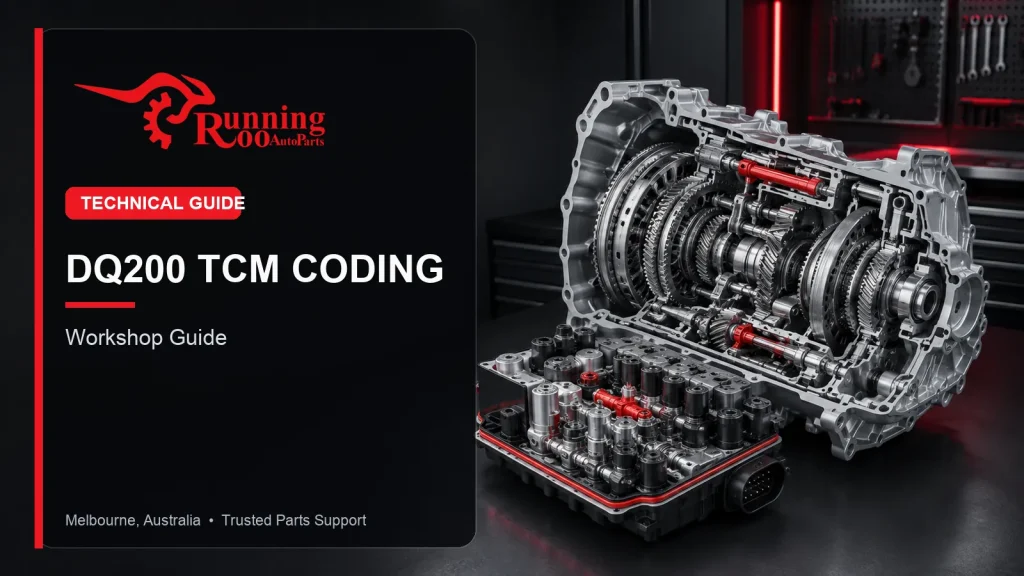
The Volkswagen Group’s DQ200 7-speed dry dual-clutch transmission (DSG/S-Tronic) is one of the most common automatic gearboxes on Australian roads, widely equipped in popular models such as the Volkswagen Golf, Polo, Skoda Octavia, and Audi A3. Due to Australia’s harsh climate and stop-start urban driving conditions, the Mechatronic unit—the brain and muscle of the transmission—often requires servicing, repair, or complete replacement.
When a Transmission Control Module (TCM) is replaced or updated, rigorous programming, coding, and adaptation are strictly required. Failure to perform these steps correctly will result in harsh shifting, clutch slippage, or complete immobilisation of the vehicle.
This authoritative dq200-tcm-coding-programming-guide is designed for automotive technicians and independent specialists. It outlines the precise procedures, safety protocols, and technical theory required to successfully program the DQ200 TCM, complete with official citations from Volkswagen Group’s technical literature and industry-standard diagnostic developers.
1. Understanding the DQ200 Mechatronic Architecture
Before undertaking any transmission-control-unit-programming-steps, it is vital to understand the hardware you are communicating with.
According to the official Volkswagen Group Self-Study Programme (SSP) 390: The 7-Speed Double-Clutch Gearbox 0AM, the DQ200 operates uniquely compared to its wet-clutch siblings (like the DQ250). It relies on a dry dual-clutch system and a self-contained Mechatronic unit. The Mechatronic unit integrates the electronic Transmission Control Unit (TCU/TCM) and the electro-hydraulic control module into a single bolted-on component.
The TCM manages clutch engagement based on complex mathematical models. The torque capacity of a dry clutch is highly sensitive to wear and temperature. The TCM calculates the required clamping force using a fundamental friction equation:
$T = \mu \cdot F_N \cdot R_m \cdot n$
Where:
- $T$ = Torque transferred
- $\mu$ = Coefficient of friction (varies dynamically with temperature and clutch material wear)
- $F_N$ = Normal force (clamping force applied by the Mechatronic hydraulic actuators)
- $R_m$ = Mean friction radius
- $n$ = Number of friction faces (which is 2 per clutch in a dual-clutch setup)
Because $\mu$ (friction coefficient) changes over the lifespan of the clutch pack, the TCM must constantly adapt its hydraulic pressure ($F_N$) to maintain smooth engagement. This is why running vw-dsg-module-adaptation-software is not just an initial setup step, but a crucial maintenance procedure after any major driveline service.
2. Prerequisites, Tooling, and Workshop Safety
Attempting to code a blank or replacement TCM without the correct environmental controls is a guaranteed path to module bricking. Modern VAG (Volkswagen Audi Group) modules are highly sensitive to voltage drops during flash procedures.
Essential Equipment
- Diagnostic Interface: You must use an approved interface. The two industry standards are ODIS (Offboard Diagnostic Information System – VAG’s official dealer tool) and VCDS (VAG-COM Diagnostic System by Ross-Tech, the premium aftermarket standard).
- Constant Voltage Supply: A standard trickle charger is insufficient. You require a clean, stabilised battery maintainer capable of supplying a constant 13.5V to 14.2V at up to 70 Amps (e.g., GYSflash or CTEK PRO). If battery voltage drops below 12.5V during programming, the flash memory can corrupt.
- Network Connection: If using ODIS for online GeKo (Security) access and immobiliser alignment, a stable broadband connection is required.
Tool Comparison Table
| Feature | ODIS (Official VAG) | VCDS (Ross-Tech) |
| Immobiliser/Component Protection | Yes (Requires online GeKo account) | No (Cannot bypass Component Protection) |
| Firmware Flashing (.sgo/.frf) | Yes (Native via ODIS Engineering) | No (VCDS is for coding/adaptation only) |
| Basic Settings & Adaptation | Yes (Guided Fault Finding) | Yes (Highly manual, rapid access) |
| Cost Profile | High (Subscription/Licence based) | Moderate (One-time hardware purchase) |
| Best Suited For | Dealerships, Dealership-level specialists | Independent mechanics, advanced DIYers |
3. Firmware Flashing vs. Module Coding
It is a common misconception that “flashing” and “coding” are identical. They are fundamentally different procedures.
Firmware Flashing
Flashing involves writing the base operating system and shift maps to the TCM. Blank Mechatronic units purchased directly from Volkswagen Group Australia spare parts often arrive without software. These must be flashed using ODIS Engineering with the correct .frf or .sgo file specific to the vehicle’s engine and driveline configuration.
Official Endorsement: According to erWin (Electronic Repair and Workshop Information, Volkswagen’s official portal), firmware files must be matched exactly to the hardware revision of the Mechatronic unit to prevent catastrophic hydraulic over-pressurisation.
Module Coding
Coding is the process of configuring the existing software to understand what car it is installed in. For example, the TCM needs to know if the car has Start-Stop functionality, what ABS module it is communicating with, and the final drive ratio. This is where a gearbox-ecu-coding-vcds-guide becomes invaluable.
4. The gearbox-ecu-coding-vcds-guide: Step-by-Step
This section outlines the exact transmission-control-unit-programming-steps using VCDS.
Disclaimer: This procedure assumes the TCM already contains the correct base firmware and has passed Component Protection (if applicable to the specific vehicle year/platform, such as MQB).
Step 1: Vehicle Preparation
- Ensure the vehicle is parked on a level surface.
- Engage the handbrake.
- Turn the ignition to the ON position (engine OFF).
- Connect the VCDS HEX-V2 or HEX-NET interface to the OBD-II port.
- Connect the battery stabiliser and set it to Supply/Flash mode (13.8V).
Step 2: Module Access
- Launch VCDS and select [Select] beneath Control Modules.
- Navigate to [02 – Auto Trans].
- Verify the VAG Number (Part Number) and Component (Firmware version) match your expectations.
Step 3: Long Coding
- Select [Coding – 07].
- Write down or screenshot the original coding string from the old module if you have it.
- If you are installing a new module, you must input the correct hexadecimal string. Use the VCDS Long Coding Helper.
- Ensure bits for features like Start/Stop (if equipped) are correctly ticked.
- Click [Do It!]. You should receive a “Coding Accepted” message.
Step 4: Clearing DTCs
- Before proceeding to adaptation, you must clear all Diagnostic Trouble Codes.
- Select [Fault Codes – 02] and click [Clear Codes – 05].
- If codes related to “Basic Settings Not Performed” remain, this is normal and will be resolved in the next step.
5. Basic Settings: vw-dsg-module-adaptation-software
Coding merely tells the module what it is; Basic Settings tell the module how to move. The DQ200 uses highly precise electronic actuator arms to move shift forks and engage the dry clutches.
When a Mechatronic unit is new, or when clutch packs are replaced, the TCM does not know the physical distance required to move the fork to engage a gear, nor does it know the exact “kiss point” (bite point) of the clutch.
Official Endorsement: Ross-Tech officially documents that performing Basic Settings on the 0AM/DQ200 transmission is mandatory after replacing the Mechatronic unit, replacing the clutch pack, or performing a software update.
The VCDS Basic Settings Procedure (UDS Protocol – Newer Vehicles)
For modern DQ200 units using the UDS protocol (typically 2010 onwards):
- Start the engine. Ensure the transmission fluid temperature is between 30°C and 60°C. Do not attempt this if the gearbox is cold or overheating.
- In VCDS, go to [02 – Auto Trans] -> [Basic Settings – 04].
- From the drop-down menu, select “Basic Setting of Transmission”.
- Press [Go!].
- During this process, you will hear loud clunking, clicking, and whirring from the gearbox. The engine idle may fluctuate. The TCM is cycling through all gears, finding the synchroniser end stops, and measuring the travel distance of the clutch actuators.
- Look at the “Status” field. It will cycle through various numbers. You are waiting for the system to display “Finished Correctly” or status code 254 / 0 / 0.
- If the status shows an error code (e.g., 254 / X / Y where X or Y are non-zero), the adaptation has failed. (See Troubleshooting section).
- Once complete, press [Stop], then click [Done, Go Back].
- Switch the ignition OFF, wait 10 seconds, then switch it back ON and clear any remaining fault codes.
6. Dynamic Adaptation: The Road Test
Static adaptation in the workshop is only half the battle. The TCM must now learn the dynamic friction coefficient of the clutches under load. This is the final phase of the vw-dsg-module-adaptation-software process.
Failure to perform the defined road test will result in a vehicle that judders upon take-off. Volkswagen Group specifies a highly rigid driving cycle to calibrate the micro-slip of the K1 and K2 clutches.
The Official VAG Drive Cycle for DQ200:
- Preparation: Ensure transmission fluid temperature is above 50°C.
- Stationary Calibration: With the engine running and foot firmly on the brake, shift into D. Hold for 10 seconds. Shift into R. Hold for 10 seconds. Repeat this 5 times. This calibrates the stationary creep torque.
- Tiptronic Drive (K1 and K2 learning):
- Accelerate gently and shift into Tiptronic mode.
- Drive in 3rd Gear (which uses Clutch 1 / K1) at approximately 2000 to 2500 RPM for 3 minutes. Ensure a steady throttle; do not use cruise control.
- Shift into 4th Gear (which uses Clutch 2 / K2) and drive at 2000 to 2500 RPM for 3 minutes.
- Repeat this alternating process (3rd then 4th, or 5th then 6th) twice.
- Wide Open Throttle: Once the steady-state cruising is complete, perform one wide-open throttle (WOT) acceleration from a standstill up to 80 km/h, allowing the gearbox to shift automatically through the gears.
- Cool Down: Drive normally for 5 minutes. The adaptation is complete.
7. Common Pitfalls and Troubleshooting
Even seasoned technicians encounter issues during a dq200-tcm-coding-programming-guide execution. Here is a matrix of common failures and their resolutions.
Basic Settings Abort Codes (VCDS / ODIS)
If the Basic Settings procedure aborts, it will generate an abort code.
- Abort Code 8: Brake pedal not depressed or brake switch faulty. Resolution: Press the brake pedal firmly. Check ABS live data for brake switch operation.
- Abort Code 9: Engine not running or engine speed too low. Resolution: Ensure the engine is idling smoothly. Clear engine ECU codes.
- Abort Code 27: Transmission fluid temperature out of bounds. Resolution: Allow the gearbox to cool down or warm up to the 30°C – 60°C window.
- Abort Code 45: Clutch clearance out of tolerance. Resolution: This is a mechanical failure. The clutch pack is either excessively worn, or the shims installed during clutch replacement are the wrong thickness. The Mechatronic unit cannot mathematically compensate for the physical gap.
Flashing Failures
If ODIS Engineering crashes mid-flash, the Mechatronic unit may enter a “bootloader” state, rendering the car immobilised.
- Cause: Voltage drop, poor quality OBD interface, or interrupted internet connection (if checking immobiliser data).
- Solution: Maintain voltage at 13.8V. Attempt a “force flash” using ODIS Engineering. Never interrupt a flash sequence once initiated.
8. Australian Compliance and Repair Standards
When operating within Australia, automotive technicians must adhere to local standards regarding vehicle modifications and repairs. While replacing a TCM is a standard repair, altering the fundamental shift maps (such as aftermarket DSG tuning) can affect the vehicle’s emissions profile.
According to the guidelines set out by the Victorian Automobile Chamber of Commerce (VACC) and national Australian Design Rules (ADRs), any software applied to a vehicle’s driveline must not increase tailpipe emissions beyond the limits certified at the time of the vehicle’s manufacture.
When sourcing replacement DQ200 TCMs from local suppliers or Volkswagen Group Australia, ensure the hardware revision supersessions are respected. Installing a remarkably older revision Mechatronic unit into a newer vehicle may trigger persistent CAN-bus communication errors with modern ABS and Engine Control Modules. Always utilise the VIN-matched .frf flash file to guarantee ADR compliance and optimal drivability on Australian roads.
9. Conclusion
Mastering the dq200-tcm-coding-programming-guide is a fundamental requirement for modern European automotive specialists. The transition from purely mechanical gearboxes to highly complex, mathematically driven electro-hydraulic systems demands a rigorous approach to software management.
By strictly adhering to the transmission-control-unit-programming-steps, ensuring robust power supply during flashing, correctly utilising the gearbox-ecu-coding-vcds-guide, and executing the vw-dsg-module-adaptation-software and road test meticulously, technicians can ensure a long-lasting, smooth-shifting transmission that meets the original manufacturer’s specifications. Always rely on official documentation like erWin and Ross-Tech to guide your diagnostic processes, and never underestimate the importance of the dynamic road adaptation in finalising the repair.
10. Frequently Asked Questions (FAQ)
Q1: Can I perform DQ200 Basic Settings with the engine off?
A: No. Unlike some older VAG transmissions, the DQ200 requires the engine to be running for the Basic Settings procedure. The Mechatronic unit relies on the engine’s rotation to turn the input shafts and actuate the mechanical hydraulic pump to build sufficient pressure (up to 60 bar) to cycle the shift forks.
Q2: I swapped a used TCM from another Golf into my car. The car starts, but the gearbox won’t engage. Why?
A: This is due to Component Protection (Immobiliser). In MQB platform vehicles (approx. 2013 onwards), the TCM is part of the immobiliser network (Immo 4 or Immo 5). A used TCM cannot simply be coded via VCDS; it must be adapted to the car’s security system using ODIS online with a registered GeKo account. VCDS cannot bypass Component Protection.
Q3: How long does the firmware flashing process take on a DQ200?
A: Using an authentic ODIS interface, flashing a factory .frf file typically takes between 15 to 30 minutes, depending on the CAN-bus speed of the specific vehicle gateway. During this entire period, the battery voltage must be strictly maintained.
Q4: My VCDS shows a negative value for clutch travel adaptation. Is this a problem?
A: Not necessarily. The adaptation values (measured in millimetres) represent the offset from the factory-calibrated zero point. Over time, as the dry clutch plates wear down, the Mechatronic actuator rod must travel further to reach the bite point, which can result in negative or positive offset values depending on the specific measuring block. However, if the value exceeds the manufacturer’s specified tolerance limits, the TCM will throw a mechanical clearance fault, indicating the clutch pack requires physical replacement.
Q5: Do I need to program the TCM if I am only replacing the dual-clutch pack, not the Mechatronic unit?
A: You do not need to perform firmware flashing or long coding. However, you must perform the Basic Settings (Adaptation) procedure. The TCM still holds the memory of the old, worn clutches. If you do not run the adaptation, the TCM will apply incorrect hydraulic pressure to the new clutches, leading to instant glazing, severe shuddering, and premature failure.
Q6: What fluid goes into the DQ200, and does it affect programming?
A: The DQ200 has two separate fluid circuits. The gearbox housing takes approximately 1.7 to 1.9 litres of standard manual gear oil. The Mechatronic unit itself holds a separate, specialised hydraulic fluid (approx. 1 litre). Incorrect fluid in the Mechatronic unit will change the hydraulic viscosity, causing the adaptation programming to miscalculate actuator travel times, leading to shift delays. Always use the genuine VAG specified fluids for both sections.
If you have any questions regarding any DQ200 gearbox-related issues, please feel free to contact us at any time.
We are based in Blackburn South, Melbourne, and provide 24/7 free pickup service (by appointment only) for your convenience.
📞 Phone: 0425 890 125
🛒 eBay Store: https://www.ebay.com.au/itm/365819799559?_skw=dq200&itmmeta=01KTGWC00ZCHGVEPKYYAZ4QXV0&hash=item552c8f2807:g:np8AAeSwNI1pRHw3
At RunningRoo Auto Parts, we are here to help with any DQ200 diagnostics, parts, or technical enquiries—don’t hesitate to reach out.
Great communications and very helpful – thanks!