
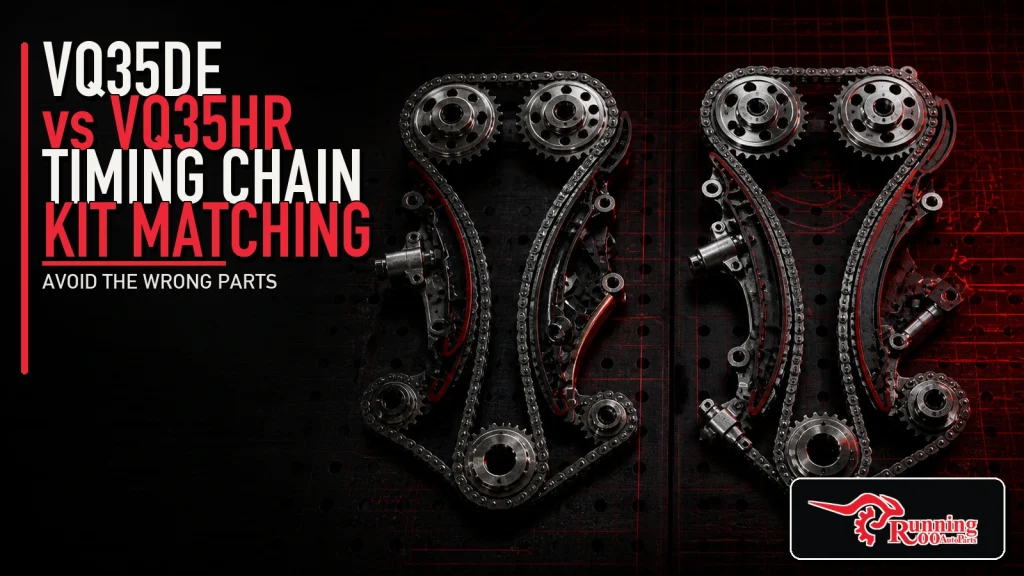
VQ35DE and VQ35HR engines both carry the familiar Nissan 3.5-litre V6 identity, but that does not make their timing-chain kits interchangeable. A listing that mentions a 350Z, Infiniti or 3.5L V6 can still describe the wrong engine generation, chain layout or cam-control components for the vehicle in front of you.
The goal of this guide is not to identify an engine from one photograph. It is to show a reliable order of checks: confirm the full engine code and production data, diagnose why the timing system is being opened, then match the kit and VVT content to the original components.
Quick answer: VQ35DE and VQ35HR parts should be selected by full engine code, VIN, production date and original component numbers. Do not order from displacement or vehicle name alone. Diagnose oil pressure, VVT control and mechanical timing before deciding whether the repair needs a basic chain kit, VVT solenoids or camshaft adjusters.
RunningRoo support for VQ35DE vs VQ35HR Timing Chain Kit
OEM-fit aftermarket replacement · 2-Year Warranty · Direct factory value · Fast, friendly support
Call 0425 890 125 · 24/7 free Melbourne pickup by appointment · Australian-based support 🇦🇺
What the DE and HR labels change for parts selection
The VQ35 family appeared in many Nissan and Infiniti vehicles, with changes to cylinder-head design, intake arrangement, valve timing and other architecture across variants. Those changes affect which chains, guides, tensioners, sprockets and control components belong in a repair.
A vehicle model can cross an engine transition, and imported or modified cars may not match local catalogue assumptions. Engine-bay appearance can help a technician narrow the variant, but the authoritative ordering evidence is the installed engine identification combined with the original part numbers.
Symptoms that deserve a proper timing-system check
- Start-up rattle from the timing-cover area
- Continuing chain noise at warm idle
- Camshaft-position or cam/crank correlation codes
- Rough idle, difficult starting or reduced response
- VVT angle that does not follow the commanded position
- Oil contamination, low pressure or a sticking control solenoid
- Noise or faults following earlier timing work
Timing chain, tensioner or VVT?
| Identification point | VQ35DE | VQ35HR |
|---|---|---|
| Ordering language | Look for an explicit VQ35DE application | Look for an explicit VQ35HR application |
| Vehicle overlap | Common in many earlier 350Z, Maxima, Murano and Infiniti applications | Used in selected later or higher-rev 350Z/Infiniti applications |
| VVT content | Some kits add solenoids or cam components | Do not assume DE cam-control parts transfer |
| Final confirmation | VIN, production date and original numbers | VIN, production date and original numbers |
The patterns above are diagnostic clues, not automatic replacement decisions. More than one fault can exist, especially on a high-kilometre engine or one with uncertain service history.
A step-by-step diagnostic sequence
1. Confirm the installed engine
Record the VIN, compliance/build information and complete engine code. Engine swaps are common in performance vehicles, so the body model and year may not describe the engine now installed.
2. Separate normal VQ sound from a new fault
Document a true cold start and fully warm idle. A new metallic rattle, especially one that is worsening or accompanied by running faults, deserves more attention than a stable injector tick.
3. Check lubrication first
Verify oil level, grade, filter condition and service history. VVT actuators and chain tensioners rely on oil pressure. If pressure is uncertain, measure it using the correct procedure before condemning mechanical parts.
4. Save codes and live data
Record all engine codes and freeze-frame data before clearing. Compare bank-specific commanded and actual camshaft position where supported; differences between banks can be diagnostically useful.
5. Test electrical and hydraulic controls
Inspect cam sensors, crank sensor, VVT solenoids, wiring and oil passages. Replacing a chain cannot correct an open circuit, and replacing a solenoid cannot correct a chain that has lost mechanical control.
6. Verify mechanical timing
When the evidence supports internal inspection, check chain tension, guides, sprockets, tensioner operation and timing references for the exact engine variant. Stop running the engine if timing appears to have moved.
Before ordering VQ35DE vs VQ35HR Timing Chain Kit parts
Confirm VIN, engine code and original part numbers first. RunningRoo combines high-quality OEM-fit aftermarket parts, a 2-Year Warranty, factory-direct pricing and responsive fitment support.
Need help? Call 0425 890 125. Melbourne pickup is available 24/7 by appointment from RunningRoo Auto Parts, Australia 🇦🇺.
Four RunningRoo product options to compare
The four links below are relevant catalogue options, not a declaration of fitment. Confirm the VIN, engine code, production date, original part numbers and required kit contents with RunningRoo or your workshop before ordering.
1. VQ35HR timing-chain kit for selected 350Z and Infiniti models — An HR-specific starting point; confirm the actual engine and model applicability.
2. VQ35DE timing-chain kit for Maxima, Murano, 350Z, Quest and Infiniti G35 — A DE-focused option for selected applications and production periods.
3. VQ35DE chain kit with two VVT solenoids — Consider only when diagnosis supports including the control solenoids.
4. Altima/Quest VQ35DE kit with two camshaft VVT components — Compare vehicle, year, engine code and original cam components before purchase.
Preventing a DE/HR fitment mistake
Before dismantling, print or save the exact product description and photograph the engine identification. When the cover is removed, compare chain count, link pattern, guide shape, tensioner design and sprocket references. Any unexplained difference should stop the installation until fitment is resolved.
Use the correct engine-specific timing procedure, not a diagram labelled only VQ35. Bank identification, timing marks and tensioner preparation must be unambiguous. After assembly, rotate and recheck the engine as directed, then review both banks’ camshaft data during the post-repair test.
- Keep DE and HR parts catalogues separate
- Confirm bank and camshaft positions before removal
- Replace specified seals and single-use fasteners
- Clean oil-control passages without introducing debris
- Verify all primary and secondary chain references
- Document final scan data and cold-start behaviour
Related RunningRoo technical guides
Continue with these closely related diagnosis and fitment resources:
Why Choose RunningRoo?
- High-quality aftermarket replacement – OEM fit
- 2-Year Warranty – reliability guaranteed
- Direct factory supply = competitive price
- Fast and friendly support
Call us: 0425 890 125
24/7 Free Pickup Available in Melbourne – By appointment only
RunningRoo Auto Parts – Based in Melbourne, Australia 🇦🇺
Frequently asked questions
Can a VQ35DE timing kit be installed on a VQ35HR?
Do not treat the kits as interchangeable. The full engine code and original components must match the product application.
Does a P0011 or P0021 code prove the chain is stretched?
No. Cam timing performance can be affected by oil, solenoids, wiring, actuators or mechanical timing. Diagnose the bank and control system before buying a chain kit.
Should VVT solenoids be replaced with the chain?
Only when testing, condition or the planned repair supports it. A kit that includes solenoids offers convenience, but included parts do not prove they are faulty.
Is a 350Z model year enough to identify the engine?
No. Production changes, market differences and engine swaps make VIN and installed-engine identification essential.
Final recommendation
A correct VQ35 timing repair begins by writing down the letters after VQ35. Distinguish DE from HR, diagnose the control and lubrication systems, verify mechanical timing and match the kit to the original parts. That discipline prevents one of the most expensive kinds of catalogue error: a complete kit for the wrong engine.
This article provides general technical information. Confirm fitment and repair procedures against current manufacturer service data, and use a qualified technician for internal engine-timing work.