
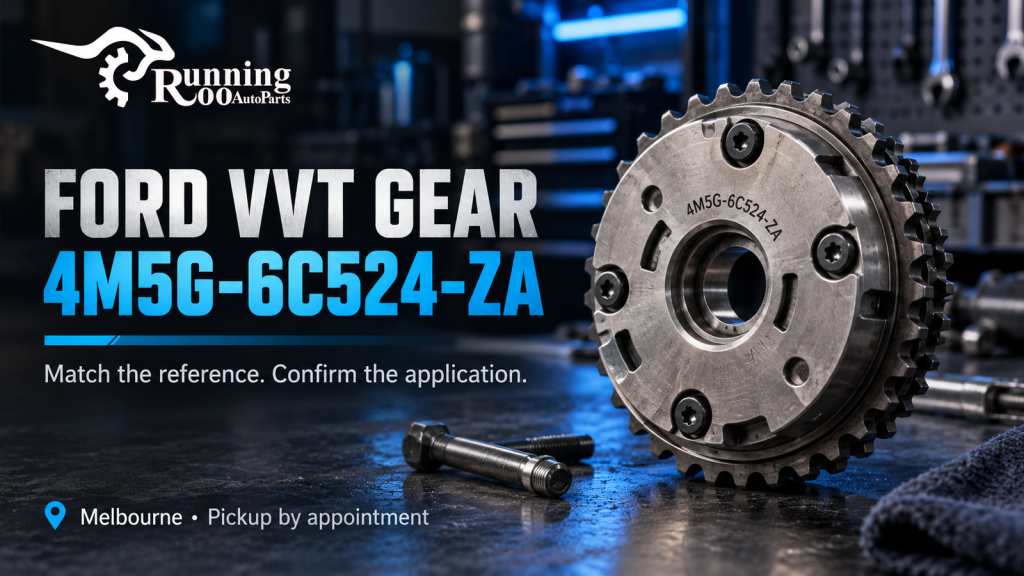
Searching for Ford VVT gear 4M5G-6C524-ZA is more precise than searching for a “Ford timing part”, but the number still needs to be connected to the actual vehicle and repair. RunningRoo’s listing describes one timing gear phase adjuster or camshaft sprocket and mentions 1.5-litre and 1.6-litre applications. It does not provide enough information to declare universal fitment across those engine capacities, and this guide does not infer an intake or exhaust position.
See the RunningRoo 4M5G-6C524-ZA phase adjuster and the matching RunningRoo eBay item. Call 0425 890 125 with the VIN, complete engine code and required OE reference. RunningRoo is Australian-operated in Blackburn, Melbourne, offering friendly support, local pickup by appointment and fast dispatch enquiries for confirmed stock.

One component, several names
The product title uses timing gear, phase adjuster and camshaft sprocket to describe the offered component. Workshops and customers may use “VVT gear” or “cam phaser” in an enquiry. Whatever wording is used, make sure the request identifies the same physical component and reference. Do not let a broad system name turn into an assumption that an electrical control valve, a sensor or a complete timing kit is being supplied.
The current package list says one timing gear phase adjuster camshaft sprocket. It does not describe a matched pair or a complete set of timing-drive components. If the workshop requests two adjusters, a control solenoid or additional hardware, list those requirements separately. A single product photograph should not be used to infer the contents of a larger repair package.
| Listing detail | What is stated | What still needs confirmation |
|---|---|---|
| Main reference | 4M5G-6C524-ZA | Match to the vehicle’s required reference |
| Other listed strings | C607124X0; 4M5G6C524ZA; 4M5G6C524YF | Any application or supersession relationship |
| Quantity | One phase adjuster/sprocket | Whether the repair needs additional parts |
| Engine description | Ford 1.5L / 1.6L in the title | Exact engine and build application |
| Intake or exhaust position | Not established here | Workshop and manufacturer parts confirmation |
What variable cam timing actually describes
Ford’s official OBD system document, page 114, explains variable cam timing as changing camshaft position relative to the crankshaft. It distinguishes intake-only, exhaust-only and other arrangements, and describes control using desired and actual cam positions with oil flow regulated by a solenoid. This is system background from a hybrid-vehicle document, not application evidence for this 1.5/1.6-litre listing. Its numerical thresholds and mechanical details must not be transferred to this part.
The practical purchasing lesson is to identify the component within the system. A workshop should explain whether it has found a problem requiring the phase adjuster itself or whether further testing is needed. A fault description containing “camshaft timing” does not automatically identify this exact item as the failed component. Ask for the diagnosis and the required part number together.
Do not turn a system explanation into an installation procedure. The actual engine’s Ford service information should determine the testing, required tools, mechanical setup and any completion procedure. The product reference helps identify a purchasing option; it does not replace the workshop’s application-specific instructions.
Preserve every character in the reference
The listing includes the main reference with and without hyphens. It also includes other strings that should be checked rather than treated as a universal interchange list. When sending an enquiry, copy the number exactly as recorded by the technician or visible on the existing part. Keep the suffix, because dropping it removes information from the request.
A photograph can help when a character is unclear. Provide a close-up of the marking and a wider image identifying the component. If the workshop has obtained a current replacement reference from Ford’s parts information, include that too. Make clear which number came from the removed part and which came from the parts enquiry, rather than presenting several numbers without context.
This guide does not claim that ZA and YF suffixes are universally interchangeable. A seller mentioning several references is not the same thing as a manufacturer-issued supersession record for every application. Ask for the relationship to be checked against your VIN and engine before treating an alternative reference as acceptable.
Confirm the camshaft position explicitly
The current website title does not establish the intake or exhaust position for this enquiry. Do not infer the position from the shape of a gear, a search-engine snippet or a similar-looking product. Ask the workshop to name the required position and reference using the correct vehicle’s parts information. That answer should be part of the order record.
If a technician asks for an “inlet gear” while an online listing simply says “phase adjuster”, resolve that wording before purchase. The same applies to a request for a pair. A single-component listing should not be assumed to cover both positions, even if the overall engine uses more than one adjustable camshaft. The exact application must be established independently.
Share the RunningRoo Ford phase-adjuster page and the corresponding eBay listing with the workshop. For package clarification and friendly local support, call 0425 890 125. A precise question about the required position is more useful than asking whether the item fits “a Ford 1.6”.
Read diagnostic information without turning it into a shopping code
A scan report can be valuable, but retain the complete report and the technician’s interpretation. A brief code description or a screenshot from a generic app may not explain why a particular component is being recommended. Ask what testing supports the decision and whether the workshop has confirmed the relevant mechanical and control-system information for the actual engine.
When the complaint involves noise or running behaviour, describe the conditions accurately. Note when it began and whether recent work or maintenance preceded it. Do not clear useful information merely to see whether a warning disappears before the workshop has recorded what it needs. Let the technician decide the appropriate diagnostic sequence using Ford’s applicable instructions.
The question for the owner is not “Which part appears most often in online discussions of this code?” It is “What evidence connects my vehicle’s problem to this requested part?” That question can prevent an unnecessary order and makes the repair recommendation easier to understand. This article promises neither a fault-code cure nor a performance improvement from replacing the gear.
Agree on the full repair scope
Once the phase adjuster has been identified as required, ask what else the workshop needs for the job. The current offer is one component. Any additional timing-drive parts, fasteners, seals or consumables should appear separately in the estimate if required by the vehicle’s repair procedure. Do not assume they are supplied simply because they may be pictured near a gear in an editorial image.
Clarify who supplies each item. If you are purchasing the adjuster and the workshop is supplying everything else, both parties should have the same confirmed reference. If the workshop wants to inspect the existing arrangement before finalising the list, agree on that step and avoid ordering speculative extras. The quotation should make uncertainty visible rather than hiding it in a package label.
Ask how the completed repair will be checked and what documentation will be provided. The applicable Ford procedure, not a generic online article, determines whether any specific testing or learning operation is necessary. Do not assume a reset or adaptation is always needed, or that none is needed, without checking the actual application.
Ordering and receiving a single precision component
Include the VIN, engine designation, required position and reference in the initial enquiry. Mention whether the vehicle has had an engine change or relevant previous repairs. If the marking is uncertain, send photographs before ordering. The goal is a clear match between the technician’s request and the exact item being supplied.
On arrival, keep the packaging and labels while the workshop checks the component against the order. If the supplied marking or visible configuration raises a question, contact RunningRoo before fitting. Do not modify a new component to make it resemble the removed one. A mismatch should be resolved through identification, not improvised installation.
Retain the supplier invoice and workshop record after the repair. Record the part actually installed and any related work, then note whether the original complaint was reassessed. This creates a useful history for future diagnostics instead of a vague entry saying that a “VVT problem” was addressed.
Melbourne support and dispatch planning
RunningRoo offers Blackburn pickup by appointment for Melbourne customers. Confirm the exact reference and stock first, then arrange the collection. If your workshop will collect, ensure it has the order details and knows which component has been confirmed. Friendly support can help clarify the supply arrangements without replacing the technician’s diagnosis.
For shipped orders, provide the destination postcode and ask about available services and fast dispatch for confirmed stock. An advertised dispatch arrangement is not a universal delivery guarantee. Plan the workshop appointment around the actual supply information and allow time for a receipt check before the vehicle is committed to fitting work.
Watch the related RunningRoo explanation
Inside a VVT Cam Phaser: Oil Passages and Locking Pin Explained is a RunningRoo educational video about the general subject. It is not a demonstration of the 4M5G-6C524-ZA product, a position identifier or a Ford installation guide. Refer to the correct manufacturer information for the engine being repaired.
How to review a recommendation for this Ford phaser
A useful workshop recommendation should connect three things: the diagnosed concern, the required component and the vehicle application. Ask the technician to show that connection in plain language. The report does not need to reproduce every workshop test, but it should explain why a phase adjuster has been selected and identify the reference and position required for this engine.
Then compare that recommendation with the seller’s description of one 4M5G-6C524-ZA-related component. If the workshop requests a solenoid, a pair of adjusters or a different suffix, the order is not yet ready merely because the words Ford and VVT appear in both descriptions. Clarify the difference. Where a supersession is involved, ask which current parts information supports the replacement reference.
It is also useful to ask what the workshop expects to verify after fitting. That question concerns the quality of the repair plan, not a demand for a particular reset routine. The technician should use the procedure applicable to the actual engine and explain any remaining uncertainty. A statement that the warning light will disappear is less informative than a plan to reassess the original concern and record the completed checks.
Before purchasing, confirm whether the quoted labour and additional parts relate to this exact single-component scope. If the recommendation changes after inspection, update both the quotation and the supplier enquiry. Keeping those records aligned avoids an order that reflects yesterday’s diagnosis while the workshop is planning a different job today. This review method is a practical communication aid, not a diagnostic flowchart, and it does not prescribe any mechanical test for an engine whose exact application has not yet been established.
Frequently asked questions
Is this a VVT solenoid?
The listing describes a timing gear phase adjuster camshaft sprocket, supplied as one piece. Do not order it when the workshop has requested a different control-system component without clarifying the exact part and reference first.
Is it definitely the intake gear?
This guide does not establish the position. Ask the workshop to confirm intake or exhaust application using the VIN, engine code and manufacturer parts information, then check the proposed item against that requirement.
Does it fit every Ford 1.5L or 1.6L engine?
No such universal claim is made. Engine capacity is not a complete application identifier. Provide the full engine designation, build details and required OE reference, including the suffix, before ordering.
Are all numbers in the listing interchangeable?
They are seller-listed reference strings, not a universal supersession statement. Ask for the relationship to be checked for your vehicle. Keep the existing component marking separate from any current replacement reference supplied by the workshop.
Will replacement clear a timing fault code?
No result can be guaranteed from the code alone. Professional diagnosis should establish why the adjuster is required and which completion checks apply. Replacing a part without confirming the cause can leave the original concern unresolved.
Confirm the reference with RunningRoo
Use the Ford 4M5G-6C524-ZA product page or the matching RunningRoo eBay listing for the confirmed order. Call 0425 890 125 with the VIN, engine code, camshaft position and OE reference. Our Australian-operated Melbourne business provides friendly support, local pickup by appointment and fast dispatch enquiries for available stock.
For collection and fitment enquiries, use the RunningRoo contact page. Blackburn, VIC pickup is by appointment.