
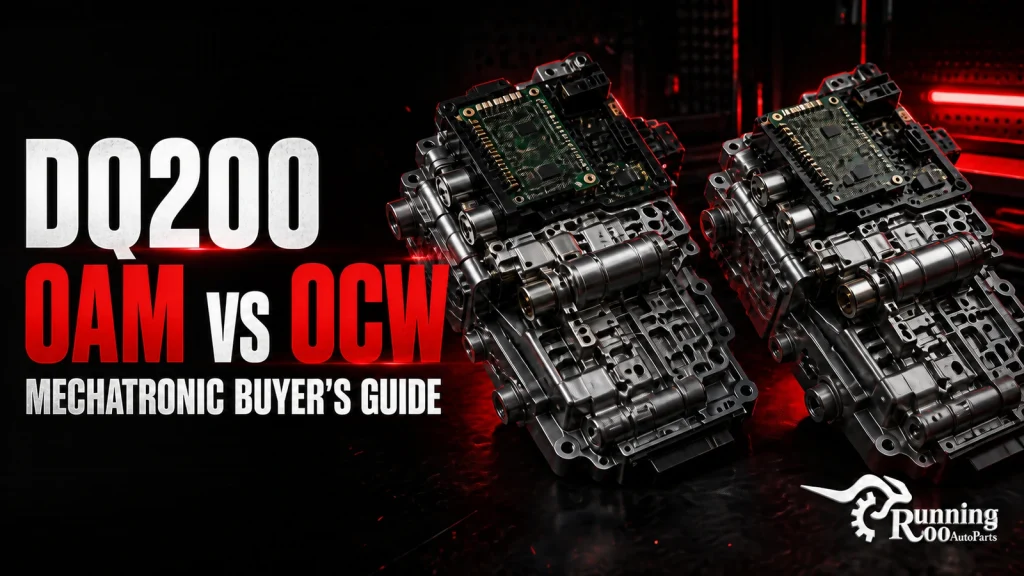
Buying a replacement DQ200 mechatronic unit by appearance alone is a costly mistake. The DQ200 family spans different hardware generations, control-unit revisions and software identities. Two units may both be described as seven-speed DSG mechatronics while requiring different coding, hydraulic configuration or vehicle compatibility.
Quick answer: 0AM and 0CW identify related but distinct DQ200 generations. Part numbers such as 0AM927769D and 0AM927769K must be checked against the original TCU label, gearbox code, VIN and software data. A matching connector or housing shape does not prove plug-and-play compatibility.
What the DQ200 mechatronic unit contains
The DQ200 is a seven-speed dry dual-clutch transmission used in many front-wheel-drive Volkswagen Group vehicles. Its mechatronic assembly combines electronic transmission control with hydraulic pressure regulation and gear/clutch actuation. Volkswagen describes DSG mechatronics as an integrated module containing the control unit, sensors and hydraulic actuators.
Because the mechatronic controls both clutch engagement and gear selection, an incorrect unit can create no-start, no-drive, communication, adaptation or shifting problems even if it physically bolts to the gearbox.
0AM vs 0CW: the practical distinction
| Identification | General description | What it does not prove |
|---|---|---|
| 0AM | Earlier DQ200 component family found across many older applications | It does not make every 0AM TCU or valve body interchangeable |
| 0CW | Later/revised DQ200 component family used across newer applications | It does not guarantee compatibility with another 0CW vehicle |
| DQ200 | Transmission family name | It is not a complete replacement-part specification |
Production ranges overlap between markets, and vehicles may have received replacement gearboxes or mechatronics earlier in their lives. Model year is therefore weaker evidence than the data on the installed unit.
Why 0AM927769D vs 0AM927769K needs careful checking
The letter at the end of a Volkswagen Group part number is significant. It can represent a revision or application distinction, and catalogue supersessions do not always mean that any later-looking suffix is a universal substitute.
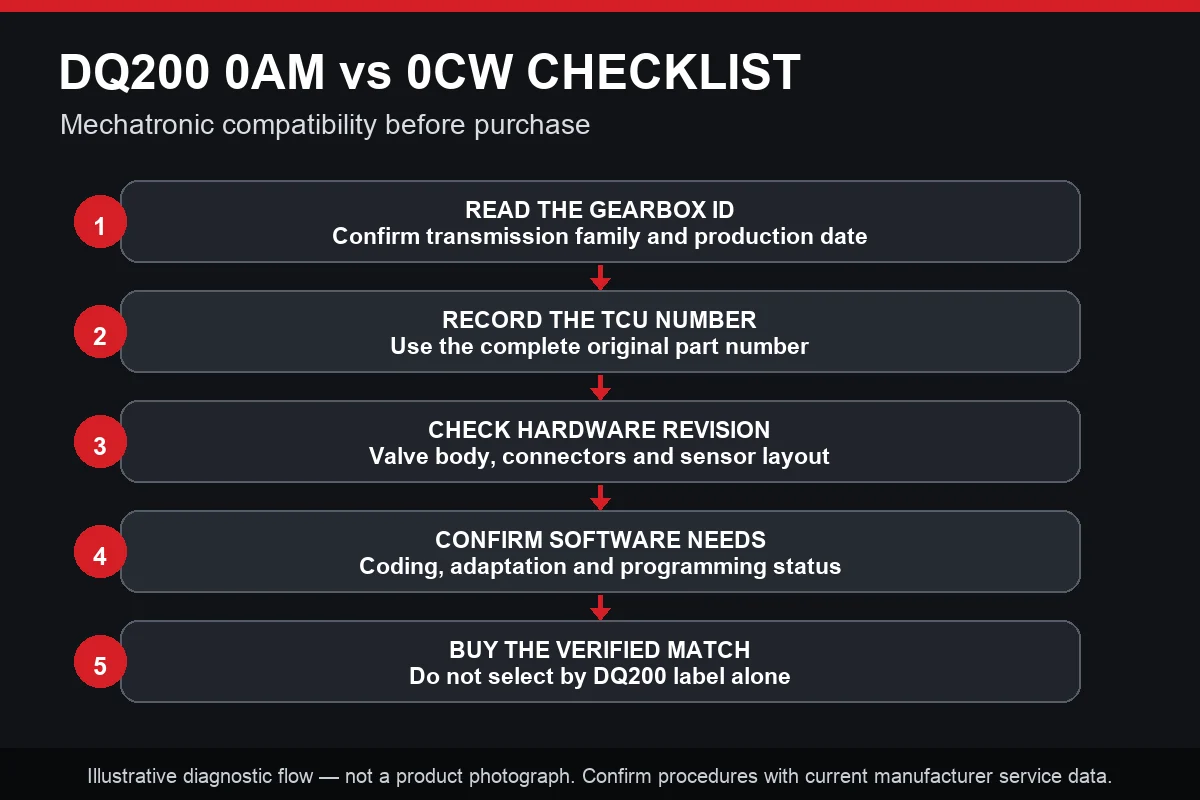
Before comparing 0AM927769D with 0AM927769K, collect:
- The full part number from the original TCU label
- The gearbox identification code
- Vehicle VIN, build date, model and engine code
- Hardware and software numbers read with a diagnostic tool
- Connector and hydraulic-body configuration
- Any record of previous gearbox or mechatronic replacement
Photograph the label before removing the unit. If communication is still possible, save a complete diagnostic scan and coding/adaptation record as well.
Vehicle model is not enough
A Golf, Polo, Audi A1, Audi A3, Škoda Octavia or SEAT Leon can exist with different engines and transmissions. Even within DQ200-equipped versions, software and component revisions vary. RunningRoo’s DQ200 compatible-models guide can help establish whether the vehicle belongs to the DQ200 family, but the final replacement decision still requires the installed-unit data.
First confirm that the mechatronic is actually faulty
Symptoms such as shudder, delayed engagement, flashing PRNDS, no drive or harsh shifting are not exclusive to the TCU. They can result from a worn clutch, selector-fork damage, low hydraulic pressure, wiring, battery-voltage problems or mechanical gearbox faults.
1. Perform a full diagnostic scan
Record codes from the transmission and related modules. Separate communication or power-supply faults from hydraulic-pressure, sensor, actuator and adaptation faults. Do not erase evidence before saving the report.
2. Verify battery voltage and network integrity
A weak battery, poor ground or CAN-bus problem can make a healthy TCU appear dead. Confirm power, ground and network communication using the correct wiring information.
3. Evaluate clutch and mechanical symptoms
Judder under take-off, unusual noises or inability to select particular gears may require clutch or selector-fork testing. Installing another mechatronic will not repair mechanical wear.
4. Check hydraulic evidence
Pressure-related codes, repeated pump operation or accumulator faults need methodical hydraulic diagnosis. The valve body, pump, accumulator and TCU are related but not identical failure points.
Three common replacement scenarios
| Scenario | Typical requirement | Main risk |
|---|---|---|
| Complete matched mechatronic assembly | Correct hardware plus coding, basic settings and clutch adaptation | Wrong revision or incomplete commissioning |
| Replacement TCU on existing valve body | Compatibility check, data transfer/programming and sealing | Software or identity mismatch |
| Valve-body/hydraulic repair | Confirmed hydraulic fault and clean assembly practice | Repairing hydraulics when the true fault is electronic or mechanical |
Programming, cloning and basic settings
Do not assume that a DQ200 mechatronic is plug and play. Depending on the replacement type and vehicle, the job may require coding, parameterisation, software matching, immobiliser or component-security work, data transfer, basic settings and clutch adaptation.
The exact process is determined by the original and replacement hardware/software combination. A specialist should confirm the plan before installation, particularly when the original controller cannot communicate and its data cannot be copied.
RunningRoo product references
RunningRoo lists these two units as separate product references:
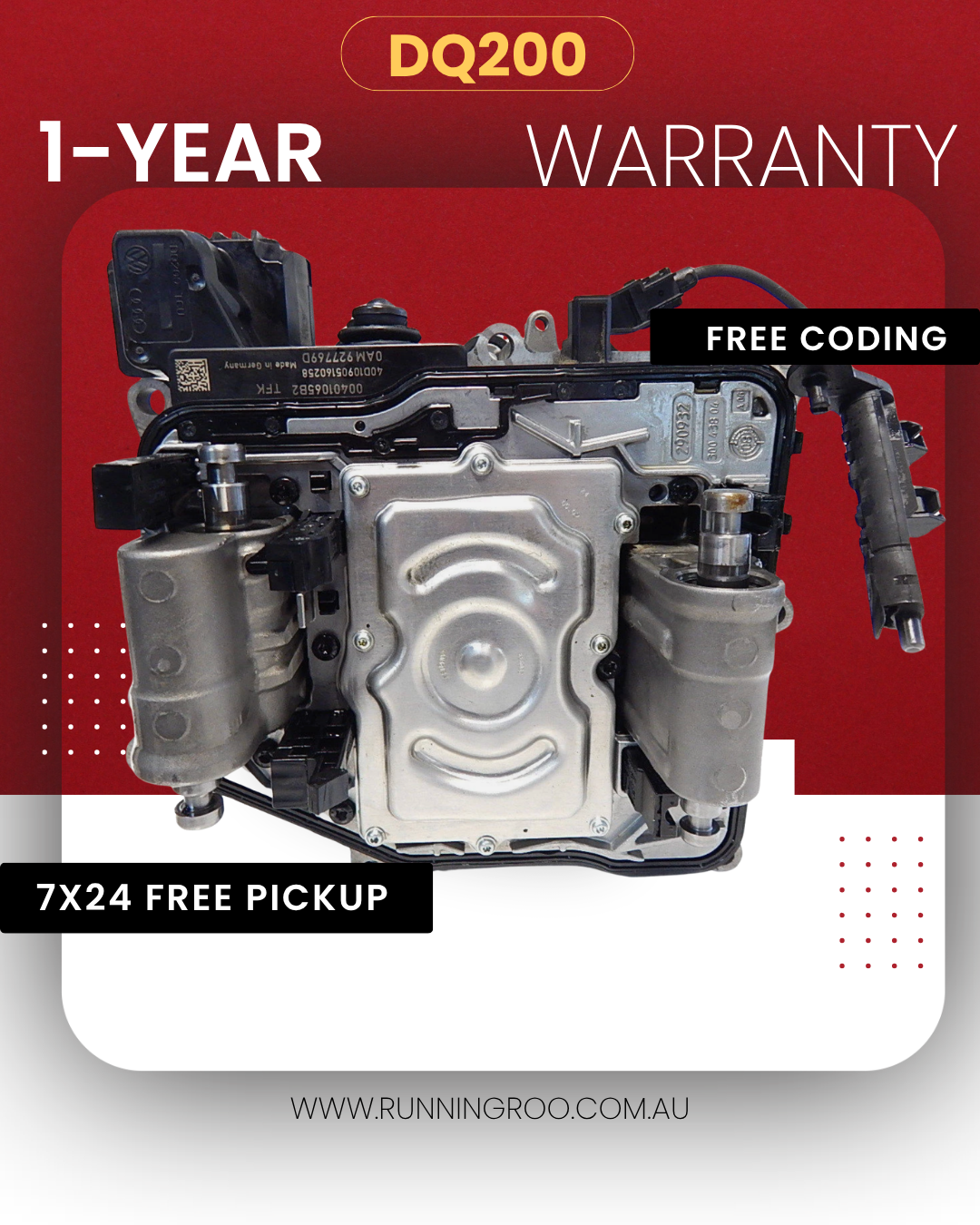
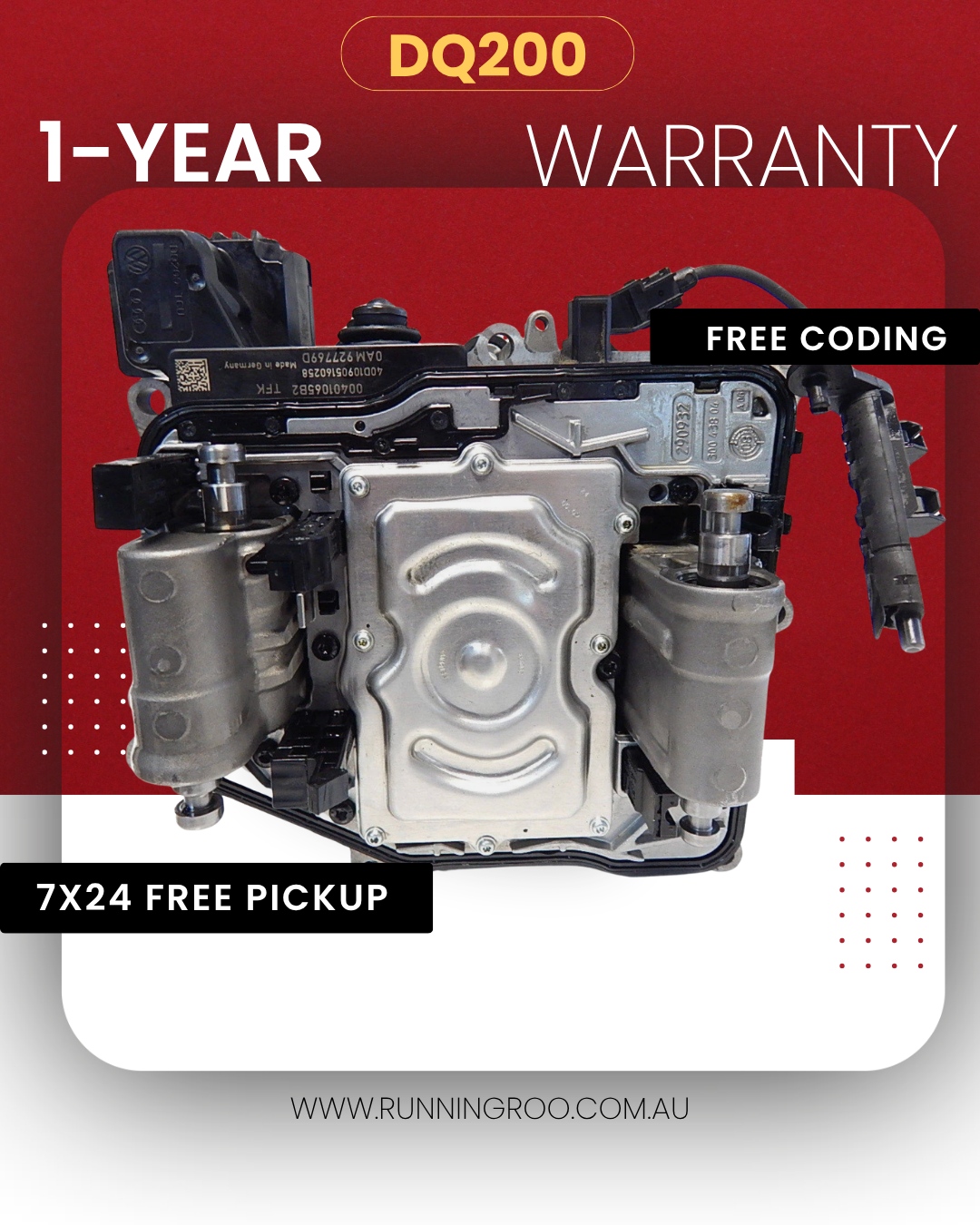
- DQ200 0AM mechatronic/valve body/TCU listed against 0AM927769D
- 0CW DQ200 mechatronic/valve body/TCU listed against 0AM927769K
The listings being related does not make them alternatives. Confirm the complete identifier, vehicle data and programming requirements before purchase. For fitment assistance, provide label photographs and a diagnostic identification report.
Pre-purchase checklist
- Confirm the gearbox is DQ200 rather than DQ250, DQ381 or another DSG family.
- Read the complete original TCU number, including suffix.
- Record hardware and software identification.
- Check VIN, engine code, gearbox code and build date.
- Ask whether the replacement includes the TCU, valve body or complete mechatronic.
- Confirm who will perform coding and basic settings.
- Diagnose clutch, fork and wiring condition before blaming the mechatronic.
- Use the specified fluid and commissioning procedure.
Frequently asked questions
Can an 0CW unit replace an 0AM unit?
Not as a general rule. Some specialist conversion paths may exist, but compatibility depends on hardware, software, vehicle configuration and installation procedure. Treat it as an engineering and programming question, not a simple supersession.
Does the same part number mean no programming is required?
No. Matching hardware improves the starting point, but coding, security data, basic settings and clutch adaptation may still be required.
Can I order from the registration number alone?
Registration lookups can assist, but they may not reveal previous replacements or the exact controller revision. Confirm the installed label and diagnostic identity.
What if the original TCU has no communication?
First verify power, ground and network wiring. If the controller is genuinely unrecoverable, a specialist must determine how vehicle-specific data and programming will be handled before the replacement is fitted.
Final recommendation
The safest way to buy a DQ200 mechatronic is to work from the installed unit outward: diagnose the fault, record every identifier, confirm the gearbox family, then plan coding and adaptation. When comparing 0AM927769D vs 0AM927769K, one matching word—DQ200—is not enough; the complete hardware and vehicle context determines the correct unit.
Transmission coding and hydraulic repair require appropriate equipment and experience. Confirm fitment and commissioning requirements with a qualified DSG specialist before purchase.