
By RunningRoo Auto Parts — written from the desk of our Product Manager
A failing wheel bearing is one of the most recognisable faults on a car — a low hum or growl that changes pitch with road speed and often changes when you turn. Left too long, a wheel bearing can seize, damage the hub or, in the worst case, allow a wheel to come loose. The repair is usually a complete hub-and-bearing assembly, a bolt-on job that is far easier than older pressed-in bearings. This guide explains what a wheel bearing does, how to identify the noisy corner and how to replace the hub correctly.
RunningRoo Auto Parts – Based in Melbourne, Australia 🇦🇺
📞 Free 24/7 Pickup Available (Contact 0425890125)
💬 Any questions? Message or Call us anytime! We’re here to help.Why Choose RunningRoo?
✅ Aussie Owned & Operated | 🚚 Fast Shipping | 🤝 Friendly Support
What a wheel bearing and hub assembly does
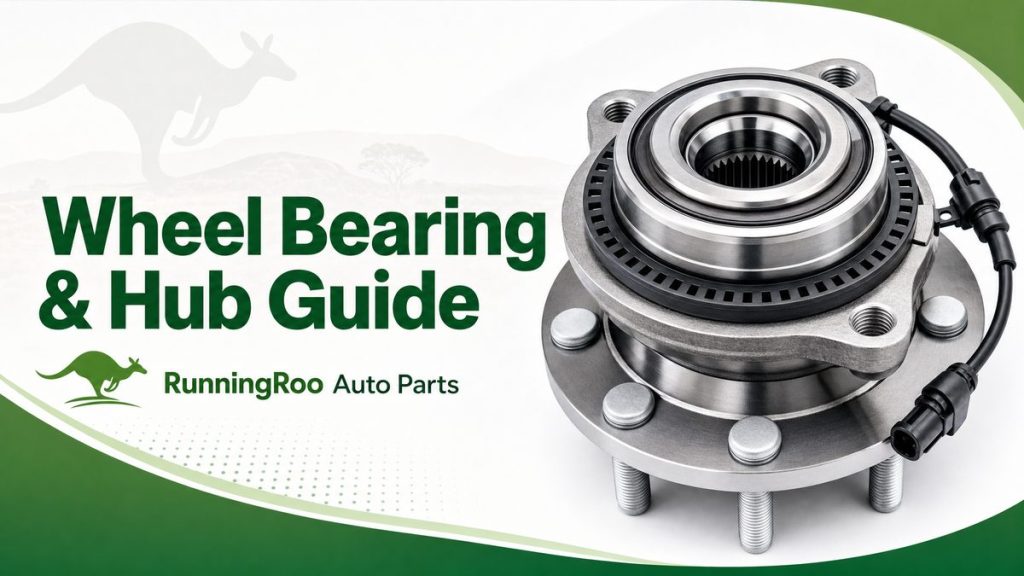
The wheel bearing lets the wheel spin smoothly while carrying the vehicle’s weight. On most modern cars the bearing is sealed and pressed into a hub assembly that also carries the wheel studs and, on many cars, the ABS sensor ring. When the bearing wears, the grease breaks down and the balls or rollers begin to pit, producing the characteristic hum.
Because the bearing is sealed, it is not serviced — it is replaced. On hub-and-bearing designs the whole assembly is swapped as one bolt-on unit, which makes the job much cleaner than the old days of pressing a bearing out and in.
The symptoms of a failing wheel bearing
The classic symptom is a humming, growling or rumbling noise that increases with road speed and may change pitch or disappear when the steering is turned one way or the other. A failed bearing can also cause a grinding noise, a vibrating steering wheel, and a loose or wandering feel. On ABS-equipped cars, a damaged bearing or sensor ring can trigger an ABS or traction-control warning.
| Symptom | Likely cause | Check |
|---|---|---|
| Hum that rises with speed | Wheel bearing | Jack up and rock the wheel |
| Noise changes when turning | Worn bearing | Confirm the loaded corner |
| Vibration through steering | Bearing or tyre | Check for play; inspect tyres |
| ABS / traction light | Bearing or sensor ring | Scan the ABS codes |
| Grinding or looseness | Failed bearing | Stop driving; inspect immediately |
How to confirm the noisy corner
The noise usually comes from the corner that is loaded when turning — a left-hand bearing often gets quieter when turning left and louder turning right, and vice versa. To confirm, safely jack up each wheel and rock it top to bottom and side to side; play in the wheel points to a worn bearing. Spinning the wheel by hand while listening at the hub can also reveal a rough or rumbling bearing.
Because tyre noise can sound like a bearing, check the tyres for uneven wear before condemning the bearing. A front bearing often produces a vibration through the steering wheel, while a rear bearing tends to hum without much steering feedback.
Replacing the hub assembly
Replacing a bolt-on hub assembly means removing the wheel, the brake caliper and disc, the axle nut and the hub bolts, then fitting the new hub and torqueing everything to specification. On many cars the ABS sensor must be transferred or reconnected, and the axle nut must be torqued correctly because it sets the bearing preload.
The most common mistakes are reusing an old axle nut, failing to torque it correctly, and damaging the ABS sensor or its wiring during the job. Replacing bearings in pairs on the same axle is often sensible, because the two sides share the same mileage and the second one usually fails soon after the first.
Pressed-in vs bolt-on bearings
Modern cars almost all use a sealed bolt-on hub-and-bearing assembly, where the bearing is pressed into a hub that carries the wheel studs and often the ABS ring. Replacing the whole assembly is a clean bolt-off, bolt-on job with no special press required. Some older or heavier vehicles still use a separate bearing that must be pressed out of the hub and a new one pressed in.
Knowing which type your car uses changes the job significantly. A bolt-on hub is DIY-friendly with basic tools, while a pressed-in bearing usually needs a hydraulic press and is better left to a workshop. The runningRoo hub assemblies for popular Australian models are the bolt-on type, which is why the repair is so accessible.
Diagnosing front vs rear bearings
A front wheel bearing often produces a vibration that is felt through the steering wheel, and the noise may change when the steering is turned because the load on the bearing shifts. A rear bearing usually produces a steady hum without much steering feedback, and the noise is more noticeable to passengers in the back seat.
The corner-loading test helps pin the side: if the noise gets louder when turning left, the loaded right-hand bearing is usually the culprit, and vice versa. Confirming the corner before ordering avoids replacing the wrong side and paying for labour twice.
Preventive maintenance
Wheel bearings are sealed and maintenance-free, but their life is shortened by hard impacts, potholes, and incorrect wheel or axle-nut torque. Avoid hitting kerbs and potholes hard, and always torque the axle nut correctly after any hub or driveshaft work, because an over- or under-torqued nut wears the bearing quickly.
If you hear a new hum that rises with speed, have it checked early. A bearing caught at the first sign of noise is a simple hub replacement, while a bearing left to fail can damage the hub and, in the worst case, allow the wheel to come loose.
Frequently asked questions
What does a bad wheel bearing sound like?
A low hum or growl that rises with speed and may change when turning. It is often mistaken for tyre noise.
How long can I drive on a bad wheel bearing?
Only a short distance to a workshop. A failed bearing can seize or allow the wheel to come loose, so it should be replaced promptly.
Should I replace both wheel bearings at once?
It is often wise to replace both on the same axle, since they share the same mileage and wear.
Do I need a wheel alignment after replacing a hub?
Not always for a hub bearing, but it is worth checking the alignment if the old bearing caused uneven tyre wear.
How much does a wheel bearing cost in Australia?
A quality hub-and-bearing assembly is inexpensive, and the job is usually a few hours of labour.
Do I need to replace the ABS sensor with the hub?
Not always. Many hubs include the sensor ring, and the existing sensor can be transferred. If the sensor is damaged or reading badly, replace it at the same time.
Why does my wheel bearing noise come and go?
The load on the bearing changes with speed and cornering, so the noise can fade or change pitch. It will get steadily worse as the bearing wears.
Key takeaways
A wheel bearing failure announces itself as a speed-related hum or growl, and the bolt-on hub design on most modern cars makes the repair straightforward. Confirming the noisy corner, ordering the correct ABS specification and torqueing the axle nut correctly are the steps that make the new hub last.
Addressing a bearing at the first sign of noise keeps the repair to a simple hub replacement, while ignoring it risks damage to the hub and, in the worst case, a wheel that comes loose.
How to order the right hub assembly
Wheel hub assemblies differ by whether they include the ABS sensor ring, by the number of wheel studs and by the axle type, so confirm fitment by vehicle, build year and, where relevant, whether the car has ABS. Sending the VIN or the original part number to the supplier removes the guesswork.
Confirm whether the new hub includes the ABS ring and whether the existing sensor can be transferred. Ordering the correct side and the correct ABS specification the first time avoids a hub that fits the studs but trips the ABS or traction-control light.
Torque the axle nut correctly
The axle nut sets the preload on the wheel bearing, so its torque is critical. An over-torqued nut overloads the bearing and wears it out quickly, while an under-torqued nut leaves play that also destroys the bearing. Always use the manufacturer’s torque specification and a new axle nut where one is specified as one-time-use.
After fitting, give the wheel a final check for play and spin it to confirm the new bearing is smooth and quiet. A correctly torqued axle nut is the difference between a hub that lasts for years and one that fails again within months.
When to replace bearings in pairs
Wheel bearings on the same axle share the same mileage, road conditions and impacts, so when one fails the other is usually not far behind. Replacing both on the same axle is often sensible, because the labour and the wheel alignment are already being done, and the second bearing will usually need doing soon anyway.
If the other bearing is still quiet and shows no play, replacing just the failed corner is acceptable, but budget for the other side in the near future. Replacing in pairs is the most cost-effective approach on a higher-mileage car.
Does a wheel bearing affect fuel economy?
Indirectly, yes. A worn bearing adds rolling resistance and can slightly increase fuel use, but the bigger risk is the damage it causes if ignored.
Can a wheel bearing cause a pulling steering wheel?
It can contribute, although alignment and tyres are more common causes. A failing bearing can also produce a vibration that feels like an unbalanced wheel.
Is a wheel bearing a DIY job?
A bolt-on hub is DIY-friendly with basic tools and the correct torque. A pressed-in bearing usually needs a hydraulic press and is better left to a workshop.
How do I know if the noise is a bearing or a tyre?
Tyres tend to produce a more constant road-noise hum, while a bearing often changes pitch or volume when cornering. A wheel-play check settles it.
Shop the parts mentioned in this guide
- Front Wheel Bearing Hub for Ford Falcon / Fairlane AU / BA / BF XR6 / Territory ABS
- RH Front Wheel Bearing Hub for Holden Commodore VT–VZ V6 / V8 ABS 99–11
- Rear Wheel Bearing Hub for Toyota Yaris NCP90 / NCP130 ABS 2005–2017
- Front Wheel Hub Bearing for Subaru Legacy / Liberty / Outback / Forester SJ 2014–2019
Watch on RunningRooAuto YouTube
- RunningRoo Auto Parts – trusted Melbourne parts support
- RunningRoo Auto Parts – product and fitment channel
RunningRoo Auto Parts – Based in Melbourne, Australia 🇦🇺
📞 Free 24/7 Pickup Available (Contact 0425890125)
💬 Any questions? Message or Call us anytime! We’re here to help.Why Choose RunningRoo?
✅ Aussie Owned & Operated | 🚚 Fast Shipping | 🤝 Friendly Support
Sources and further reading
- Wheel bearing — Wikipedia
- RACV — car maintenance and repair guidance
- CarsGuide — Australian motoring advice
- Bosch — automotive chassis systems
RunningRoo Auto Parts – Based in Melbourne, Australia 🇦🇺
📞 Free 24/7 Pickup Available (Contact 0425890125)
💬 Any questions? Message or Call us anytime! We’re here to help.Why Choose RunningRoo?
✅ Aussie Owned & Operated | 🚚 Fast Shipping | 🤝 Friendly Support