
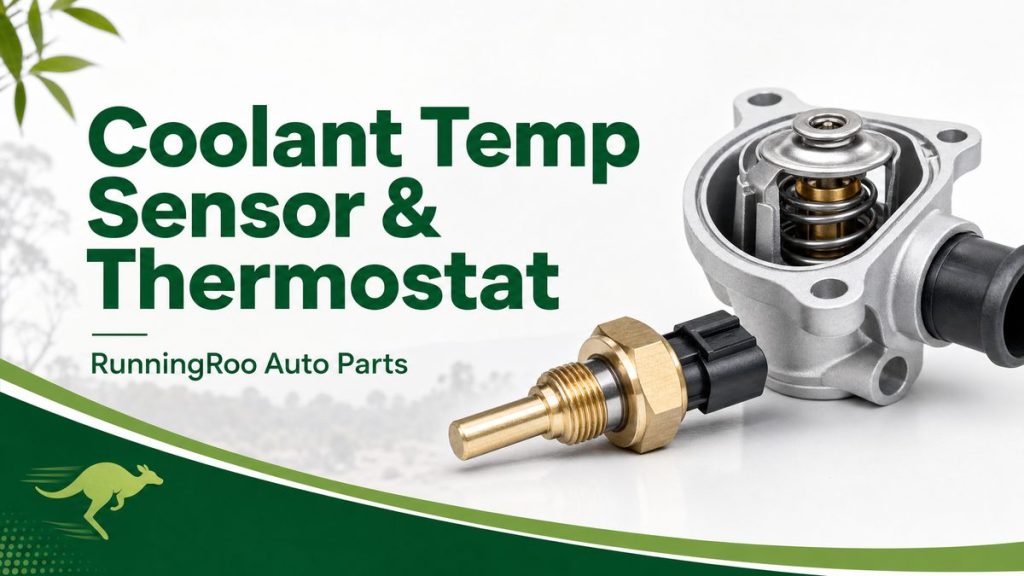
By RunningRoo Auto Parts — written from the desk of our Product Manager
Two inexpensive parts control most of what your engine knows about its own temperature: the coolant temperature sensor, which reports temperature to the engine computer, and the thermostat, which physically regulates coolant flow. When either one fails, the consequences range from poor fuel economy and rough cold starts to full overheating. Because the symptoms overlap, and because both parts are cheap and usually accessible, a careful diagnosis followed by the correct replacement is one of the best-value repairs you can do. This guide explains the difference between the two, how to recognise each failure and how to replace them without guessing.
RunningRoo Auto Parts – Based in Melbourne, Australia 🇦🇺
Free 24/7 Pickup Available (Contact 0425890125)
Any questions? Message or Call us anytime! We’re here to help.
Why Choose RunningRoo?
Aussie Owned & Operated | Fast Shipping | Friendly Support
What the sensor and thermostat each do
The coolant temperature sensor is a thermistor screwed into the cylinder head or coolant passage. Its resistance changes with temperature, and the engine computer uses that signal to set the fuel mixture, ignition timing, cooling-fan operation and idle speed. A second sender, or the same one on some cars, drives the temperature gauge on the dashboard.
The thermostat is a mechanical valve that stays closed while the engine warms up, then opens at a set temperature to allow coolant through the radiator. A thermostat stuck shut traps heat and causes overheating; one stuck open makes the engine run cold, which increases fuel consumption and prevents the heater from working properly.
The symptoms of each fault
A failing coolant temperature sensor usually causes the engine to run rich when cold or lean when hot, because the computer is receiving the wrong temperature signal. The classic signs are hard or rough cold starts, black exhaust smoke, poor fuel economy, a cooling fan that runs constantly or never runs, and a dashboard gauge that reads incorrectly. A sensor fault often sets codes such as P0115 to P0119.
A failing thermostat shows different symptoms. A thermostat stuck closed causes the engine to overheat quickly while the top radiator hose stays cool. A thermostat stuck open makes the engine take a long time to warm up, gives poor fuel economy and poor heater output, and may set a P0128 “coolant thermostat below regulating temperature” code.
| Symptom | Likely cause | First check |
|---|---|---|
| Overheating, top hose cold | Thermostat stuck closed | Feel the hoses; test thermostat |
| Long warm-up, heater cold | Thermostat stuck open | Test thermostat in hot water |
| Rich running / black smoke | Coolant temp sensor | Scan codes; test sensor resistance |
| Fan runs constantly | Sensor or wiring | Test sensor signal |
| Gauge reads wrong / cold | Sender or sensor | Test sender resistance |
How to test a coolant temperature sensor
The sensor is tested with a multimeter by measuring its resistance at known temperatures and comparing it with the manufacturer’s specification. At roughly 20 °C a typical sensor reads a few thousand ohms, and the resistance falls as the engine warms; a sensor that reads open circuit, short circuit or the wrong value for the temperature is faulty. A scan tool that shows the live temperature reading is even easier — if the computer reports an impossible temperature such as minus 40 °C or 130 °C on a cold engine, the sensor or its wiring is the problem.
Before replacing the sensor, check the connector and wiring for corrosion, because a poor connection produces exactly the same symptoms as a failed sensor. A coolant flush and a fresh, correctly mixed coolant change is also worth doing while you are there.
How to test a thermostat
Remove the thermostat and place it in a pot of water on the stove with a thermometer. Heat the water and watch the valve — it should begin opening within a few degrees of its marked temperature and be fully open before the water boils. A thermostat that fails to open, opens late or stays stuck open is faulty. This simple bench test is far more reliable than guessing from the symptoms alone.
When replacing a thermostat, fit a new gasket or seal, orient the valve correctly, and bleed the cooling system properly afterwards to remove trapped air. An air pocket in the cooling system can cause exactly the overheating symptoms that a faulty thermostat would.
Choosing the right parts
Both the sensor and the thermostat must match the engine. The sensor must return the correct resistance curve, and the thermostat must open at the correct temperature for that engine, so match by engine code and OE part number rather than by vehicle model alone. On engines where the thermostat is sold as a complete housing, replacing the whole housing often makes sense, because the plastic housing cracks with age and the seal is already included.
A quality aftermarket sensor or thermostat from a reputable supplier will perform to the original specification at a fraction of the dealer price. A cheap, unbranded sensor with the wrong resistance curve will send the wrong signal to the computer and cause the very symptoms you are trying to fix.
How the sensor and thermostat work together
The coolant temperature sensor and the thermostat do different jobs but depend on each other. The thermostat controls the physical flow of coolant, while the sensor reports the temperature that results. When the thermostat sticks open, the engine runs cold, and the sensor correctly reports that low temperature — so the computer richens the mixture and the fan behaves as if the engine were still warming up. When the sensor fails, the computer receives a false temperature, and it may run the fan constantly or set the wrong mixture even though the thermostat is working perfectly.
This interdependence is why the two faults are so often confused, and why a diagnosis should look at the reported temperature, the actual temperature and the behaviour of the fan together. A scan tool that shows the live sensor reading, combined with feeling the radiator hoses as the engine warms, quickly separates a sensor fault from a thermostat fault.
Bleeding and flushing the cooling system
Whenever the thermostat, sensor or coolant is disturbed, the cooling system should be refilled with the correct coolant and bled of air. An air pocket in the cylinder head can give a false high-temperature reading, switch the fan on constantly and cause localised overheating even when the thermostat and sensor are fine.
Flush the system if the coolant is old, discoloured or contaminated, because contaminated coolant corrodes the thermostat and the sensor and shortens the life of both new parts. Refill with the correct coolant-to-water ratio, run the engine to temperature with the heater on, and top up as the level settles. A properly bled system is the difference between a repair that stays fixed and one that returns with the same symptoms a week later.
Common part numbers and fitment notes
The coolant temperature sensor and thermostat are engine-specific, so fitment by engine code and OE part number matters. The same car model can use different sensors across engines and years, and a sensor with the wrong resistance curve will send the wrong signal to the computer even though it physically screws in. The thermostat must also open at the temperature the engine was designed for — a lower-temperature thermostat is a popular but usually unnecessary modification that can keep the engine in warm-up enrichment and increase fuel use.
On many modern engines the thermostat is sold as a complete housing that includes the valve and the seal, and it is often the housing that fails rather than the valve inside. A plastic housing that cracks or warps will leak coolant even if the thermostat itself still works, which is why replacing the complete housing is usually the better repair when the housing is old or brittle.
Before ordering, record the engine code, the build year and the original part number if it is legible on the old part, and confirm the fitment with the supplier. A few minutes confirming the part number up front avoids a sensor that fits the thread but sends the wrong signal, or a thermostat that opens at the wrong temperature.
Frequently asked questions
How do I know if my coolant temperature sensor is bad?
Hard cold starts, black smoke, poor economy and a cooling fan that runs constantly, often with codes P0115–P0119, point to a sensor fault.
What are the symptoms of a stuck thermostat?
Stuck closed causes rapid overheating with a cold top radiator hose; stuck open causes slow warm-up, poor economy and a cold heater.
Can a bad coolant sensor cause overheating?
Indirectly, yes. A sensor that fails to switch the cooling fan on can allow the engine to overheat in traffic.
Should I replace the thermostat and sensor together?
Not necessarily. Diagnose each part and replace only the faulty one, although replacing both while the coolant is drained is often convenient.
How much do these parts cost in Australia?
Both are inexpensive, and most are accessible. A quality aftermarket sensor or thermostat is a small fraction of the cost of engine damage from overheating.
Do I need to bleed the cooling system after changing a thermostat?
Yes. Trapped air can cause false overheating and fan operation, so the system must be refilled and bled correctly after any cooling-system work.
What coolant should I use?
Use the specification in the owner’s manual and the correct coolant-to-water ratio. Contaminated or incorrect coolant shortens the life of the new thermostat and sensor.
Can I keep driving with a coolant temperature sensor code?
For a short distance to a workshop, possibly, but a wrong temperature signal can cause rich running and overheating, so it is best fixed promptly.
Why does my temperature gauge never reach the middle?
The most common cause is a thermostat stuck open, which keeps the engine running cold and increases fuel consumption. Test the thermostat to confirm.
Can a coolant sensor fault cause a rich-running engine?
Yes. If the sensor reports the engine is colder than it really is, the computer richens the mixture, which wastes fuel and can produce black exhaust smoke.
Why is my cooling fan running all the time?
A constantly running fan is often a coolant temperature sensor reporting a false high temperature, or a failed fan relay. A scan tool showing the live sensor reading identifies the cause quickly.
Shop the parts mentioned in this guide
- Coolant Temperature Sensor for GM / GMC TPI / TBI / LT1 / LS1 / LS2 4.8–5.7L
- Coolant Thermostat Housing for Holden Cruze JH / Trax / Opel Astra A14NET 1.4L Turbo
- Thermostat Housing for Holden Commodore 5.7L V8 VR–VZ Gen3 LS1 HSV 99–05
- Water Pump & Thermostat Kit for Audi A4 / A5 / A6 / A7 / TT, Škoda / VW Polo / Golf
Watch on RunningRooAuto YouTube
- RunningRoo Auto Parts – trusted Melbourne parts support
- RunningRoo Auto Parts – product and fitment channel
RunningRoo Auto Parts – Based in Melbourne, Australia 🇦🇺
Free 24/7 Pickup Available (Contact 0425890125)
Any questions? Message or Call us anytime! We’re here to help.
Why Choose RunningRoo?
Aussie Owned & Operated | Fast Shipping | Friendly Support
Sources and further reading
- Thermostat — Wikipedia
- Bosch — engine management and sensors
- RACV — car maintenance and repair guidance
- CarsGuide — Australian motoring advice
RunningRoo Auto Parts – Based in Melbourne, Australia 🇦🇺
Free 24/7 Pickup Available (Contact 0425890125)
Any questions? Message or Call us anytime! We’re here to help.
Why Choose RunningRoo?
Aussie Owned & Operated | Fast Shipping | Friendly Support