
By RunningRoo Auto Parts — written from the desk of our Product Manager
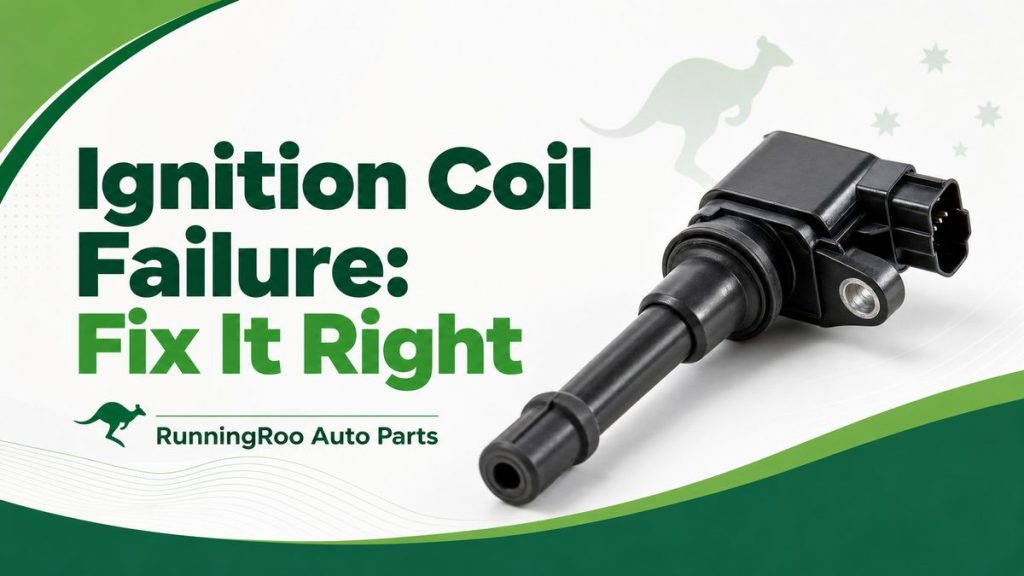
A single failing ignition coil can turn a smooth-running car into one that shakes, misfires and drinks fuel. The ignition coil is the part that steps the battery’s low voltage up to the tens of thousands of volts the spark plugs need to ignite the fuel, so when a coil starts to break down, the misfire is usually immediate and unmistakable. The good news is that an ignition coil is one of the most DIY-friendly engine parts to diagnose and replace, and a quality aftermarket coil costs a fraction of a dealer unit. This guide, written from our product team’s experience supplying coils to Australian workshops and home mechanics, explains how to spot a failing coil, confirm the diagnosis and replace it correctly.
RunningRoo Auto Parts – Based in Melbourne, Australia 🇦🇺
Free 24/7 Pickup Available (Contact 0425890125)
Any questions? Message or Call us anytime! We’re here to help.
Why Choose RunningRoo?
Aussie Owned & Operated | Fast Shipping | Friendly Support
What an ignition coil does
Most modern cars use a coil-on-plug design, where each spark plug has its own small coil sitting directly on top of it. The coil receives a low-voltage signal from the engine computer and fires a high-voltage pulse through the plug at exactly the right moment. Older engines may use a single coil with a distributor, or a waste-spark setup where one coil fires two cylinders, but the failure symptoms are broadly the same.
Because a coil lives in the hottest part of the engine bay and is switched thousands of times a minute, it is under constant electrical and thermal stress. The windings inside eventually break down, the insulation cracks, and the coil can no longer produce a strong enough spark. When that happens, the affected cylinder misfires, and the unburned fuel heads straight into the exhaust where it can damage the catalytic converter if you keep driving.
The symptoms of a failing ignition coil
The most common symptom is an engine misfire: a stumble, hesitation or shake that is most noticeable under load, such as accelerating or climbing a hill. A persistent misfire usually switches on the check-engine light, often with codes such as P0301 to P0308, where the last digit points to the failing cylinder. On some cars the light flashes, which means the misfire is bad enough to damage the catalytic converter and you should stop driving as soon as it is safe.
Other symptoms include a rough idle, a noticeable loss of power, poor fuel economy, difficulty starting, and sometimes a fuel smell from unburned petrol in the exhaust. A failing coil can also produce intermittent faults that only appear when the engine is hot, which makes them frustrating to catch. The table below separates the classic coil symptoms from the faults that are often confused with them.
| Symptom | Likely cause | First check |
|---|---|---|
| Misfire under load + P030x code | Ignition coil | Swap coils between cylinders and re-scan |
| Rough idle, no code | Vacuum leak, spark plugs or coil | Inspect plugs; check for vacuum leaks |
| No-start, cranks but won’t fire | Coil, crank sensor or fuel | Test for spark and fuel pressure |
| Misfire + fuel smell | Coil or leaking injector | Swap coil; check injector |
| Hesitation only when hot | Coil breaking down under heat | Test coil with engine warm |
How to test an ignition coil
The fastest test is the cylinder-swap method. Read the fault code, note the misfiring cylinder, then swap its coil with a coil from a known-good cylinder. Clear the codes and drive or idle the car until the fault returns. If the misfire moves to the new cylinder, the coil is confirmed faulty. If it stays on the original cylinder, the problem is the spark plug, wiring, injector or compression, not the coil.
You can also test a coil with a multimeter by measuring the resistance of the primary and secondary windings, but resistance checks miss many heat-related and high-voltage failures. A proper spark tester is more reliable. For most owners, the swap test is the quickest, cheapest and most conclusive method, and it is exactly the test our team recommends before ordering parts.
Spark plugs and coils: replace together or separately?
Coils and spark plugs wear on different schedules, but they work as a pair. A worn spark plug increases the voltage a coil must produce, which accelerates coil failure; a weak coil, in turn, can cause a new plug to foul. When one coil fails on a high-mileage engine, it is often sensible to replace the full set of spark plugs at the same time, and to consider the remaining coils if they share the same age and mileage.
On many engines the coils are accessible in minutes with basic hand tools, so the labour is minimal and the decision comes down to parts cost. Replacing a single failed coil is a legitimate fix when the others are relatively new, but on a higher-mileage car, a full set removes the risk of chasing one misfire after another over the following months.
Choosing a quality ignition coil
Not all coils are equal, and the difference shows up in the copper windings, the insulation and the reliability of the connector. A quality aftermarket coil from a reputable supplier is manufactured to match the original electrical specification, so the engine computer reads it correctly and the spark energy is consistent across all cylinders. A cheap, unbranded coil may fire weakly, fail within months, or trigger misfire codes that make the engine run worse than before.
Because the coil is a precision electrical part, we recommend matching it by engine code and OE part number rather than by vehicle model alone, and buying from a supplier who states the fitment clearly and backs the part with a warranty. The price difference between a quality coil and a bargain coil is small, but the difference in how the car runs is not.
Replacing the coil correctly
The job itself is usually straightforward: disconnect the battery or at least the relevant connector, unbolt the failing coil, lift it out, and fit the new one with a light smear of dielectric grease on the boot to keep moisture out and make future removal easier. Make sure the coil seats firmly on the plug and that the connector clicks home, then clear the fault codes and confirm the misfire is gone.
The most common mistakes are leaving the connector half-seated, damaging the rubber boot when forcing a coil into place, and failing to identify the real cause before swapping parts. If a new coil does not clear the misfire, stop and re-test rather than replacing all six coils in the hope that one of them was the problem.
Coil-on-plug vs older ignition systems
Understanding which ignition layout your car uses helps you interpret the symptoms and order the right parts. A coil-on-plug engine has one coil per cylinder sitting directly on the spark plug, which is the most common design on cars built from the early 2000s onwards. A wasted-spark engine uses one coil to fire two cylinders at once, and an older distributor system uses a single coil feeding all cylinders through a distributor cap and rotor.
The failure behaviour differs between the designs. On a coil-on-plug engine, a single failed coil causes a misfire on one cylinder. On a wasted-spark engine, a failed coil normally takes out two cylinders at once, which makes the misfire feel much rougher. On a distributor engine, a failing coil or cap causes misfires across all cylinders and can be harder to pin to a single part. Knowing the design narrows the diagnosis before you even scan for codes.
The most common ignition coil fault codes
The codes that point to a coil problem are the P0300 series, where P0300 is a random or multiple-cylinder misfire and P0301 to P0308 point to a specific cylinder. Related codes such as P0351 to P0358 indicate a fault in the ignition coil’s primary circuit for a particular cylinder, which usually means the coil, its connector or the wiring rather than the spark plug.
It is worth recording all the codes before clearing them, because a P0303 together with a P0353 tells you the problem is electrical and cylinder-specific, whereas a lone P0303 that moves cylinders after a coil swap confirms the coil itself. Clearing codes and hoping they do not return hides useful diagnostic information, so resist the temptation to reset the light before the fault is found.
Frequently asked questions
How do I know if my ignition coil is bad?
The classic signs are a misfire under load, a rough idle, a loss of power and a check-engine light with a P0301–P0308 code. The cylinder-swap test confirms it.
Can I drive with a misfiring ignition coil?
For a very short distance to a workshop, possibly, but a persistent misfire dumps unburned fuel into the catalytic converter and can destroy it. A flashing check-engine light means you should stop as soon as it is safe.
Should I replace all ignition coils at once?
If the coils share the same age and mileage, a full set is often the smartest value. If only one has failed and the others are new, replacing just that one is fine.
Do I need to replace the spark plugs with the coil?
Not always, but it is often wise, because worn plugs put extra strain on the new coil. Inspect the plugs and replace them if they are due.
How much does an ignition coil cost in Australia?
A quality aftermarket coil is typically far cheaper than a dealer coil. The job is usually quick because coils are accessible on most modern engines.
Are aftermarket ignition coils reliable?
Quality aftermarket coils from a reputable supplier can match or exceed the original. Cheap, unbranded coils are a false economy and can trigger repeat misfires.
What is the difference between a coil pack and a coil-on-plug?
A coil pack usually fires two or more cylinders from a single block, while coil-on-plug puts one coil directly on each spark plug. Both fail with similar misfire symptoms but affect a different number of cylinders.
Do ignition coils need to be matched to the spark plugs?
They must match the engine, not a specific plug brand. Use the correct coil for the engine code and ensure the spark plugs are the correct specification and in good condition.
Shop the parts mentioned in this guide
- 4x Ignition Coils for Hyundai Elantra / i30 / i40, Kia Soul / Cerato 27300-2E000
- Ignition Coil for Audi A4 / A5 / A6 / A8, VW Phaeton / Touareg 3.7–4.2L
- 6x Ignition Coils for BMW 320 / 325 E46, 520 E39, X3 E85, Z4 M54 / S54
- 12x Ignition Coils for BMW E65/E66 760i/760Li N73B60 6.0L
Watch on RunningRooAuto YouTube
- RunningRoo Auto Parts – trusted Melbourne parts support
- RunningRoo Auto Parts – product and fitment channel
RunningRoo Auto Parts – Based in Melbourne, Australia 🇦🇺
Free 24/7 Pickup Available (Contact 0425890125)
Any questions? Message or Call us anytime! We’re here to help.
Why Choose RunningRoo?
Aussie Owned & Operated | Fast Shipping | Friendly Support
Sources and further reading
- Ignition coil — Wikipedia (construction and function)
- Bosch — ignition systems
- RACV — car maintenance and repair guidance
- CarsGuide — Australian motoring advice
RunningRoo Auto Parts – Based in Melbourne, Australia 🇦🇺
Free 24/7 Pickup Available (Contact 0425890125)
Any questions? Message or Call us anytime! We’re here to help.
Why Choose RunningRoo?
Aussie Owned & Operated | Fast Shipping | Friendly Support