
By RunningRoo Auto Parts — written from the desk of our Product Manager
A timing chain kit is one of those parts where price and quality are easy to get the wrong way around. Because the parts sit deep inside the engine and the labour to fit them is expensive, a cheap kit that fails early is the most expensive kit you can buy. Equally, paying dealer prices is not automatically necessary — a well-made aftermarket kit from a reputable supplier can meet or exceed original specifications at a fraction of the cost. The skill is telling the difference. This guide, written from our product team’s experience sourcing and supplying timing kits to Australian workshops, explains exactly what to look for.
RunningRoo Auto Parts – Based in Melbourne, Australia 🇦🇺
Free 24/7 Pickup Available (Contact 0425890125)
Any questions? Message or Call us anytime! We’re here to help.
Why Choose RunningRoo?
Aussie Owned & Operated | Fast Shipping | Friendly Support
OEM-fit is not the same as genuine
One of the most useful distinctions to understand is the difference between “genuine”, “OEM” and “aftermarket”. A genuine part is one sold through the vehicle manufacturer’s own box. An OEM part is made by the same factory or supplier that makes the genuine part, often without the car maker’s logo and price. Aftermarket parts are made by independent manufacturers to fit and perform the same function.
“OEM-fit” or “OEM-quality” means the part is manufactured to match the original dimensions, materials and tolerances. That is what you want. What you want to avoid is an unbranded part that merely looks similar. The difference shows up in the tensioner spring rate, the hardness of the guides, the quality of the seals and, ultimately, how long the kit lasts inside a hot, oily engine.
What a complete timing chain kit should include
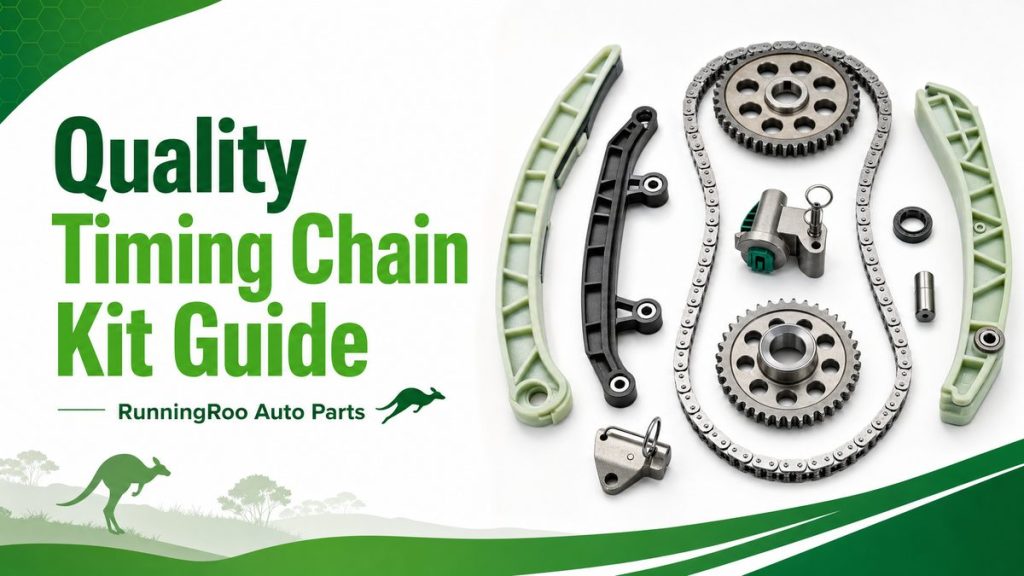
A bare chain is not a kit, and a kit is not just a chain with a couple of extras. A complete, job-ready timing chain kit should include every wear item you will replace in one go. The table below lists what a proper kit contains and why each piece matters.
| Component | Why it matters |
|---|---|
| Timing chain (or chains) | The main drive between crank and camshaft |
| Tensioner | Maintains correct chain tension as parts wear |
| Guide rails | Keep the chain aligned and quiet; plastic guides wear with age |
| Sprockets / gears | Renew the tooth profiles that the chain runs on |
| VVT gears (where applicable) | Replaces worn cam phasers while the engine is open |
| Seals, gaskets & fasteners | Allows correct resealing; many are one-time-use |
| Oil-pump chain (where applicable) | Renews the second chain that drives the oil pump |
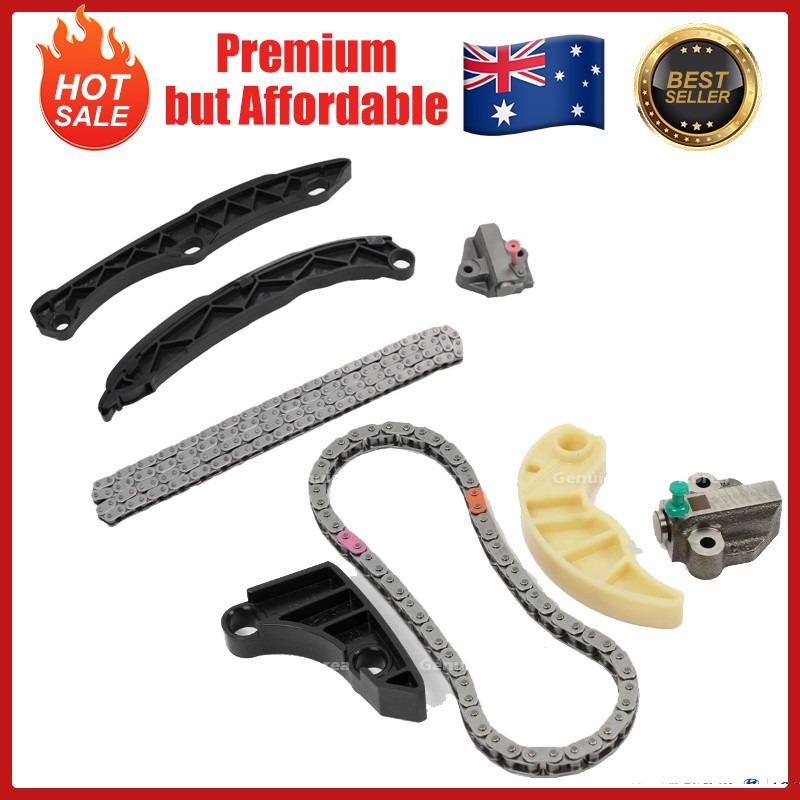
If a listing is vague about what is in the box, that is a warning sign. A reputable supplier states the contents explicitly and often shows a photograph of the complete kit laid out.
The parts of a kit that separate good from cheap
When we evaluate a timing chain kit for our range, the first thing we inspect is the tensioner. A quality tensioner uses a correctly rated spring, a smooth-acting plunger and hardened wear surfaces; a cheap one may use a weaker spring or a poorly machined body that allows the chain to go slack on start-up. The guides are second: quality guides are made from the correct wear-resistant polymer and are flat and true, whereas budget guides can be brittle, warped or softly moulded. Third are the chain and sprockets themselves, where the pitch, link quality and tooth hardness determine how smoothly and quietly the system runs.
Seals and gaskets are the quiet indicator of overall quality. A kit that bundles quality seals is usually a supplier who cares about the whole job; a kit with thin, ill-fitting gaskets suggests corners were cut everywhere. These are exactly the details a photograph of the complete kit helps you check.
Red flags to avoid
There are a handful of warning signs that a timing chain kit is not worth the saving. An unbranded or “white-label” box with no manufacturer information is the most obvious. A price dramatically below the market for the same application is another. Listings that say “fits many models” without engine codes or part numbers, or that show generic stock photos rather than the actual kit, should make you pause. Finally, a seller who cannot describe what is included or offer any warranty is not a seller you want inside your engine.
None of this means you must buy genuine. It means you should buy from a supplier who knows the product, states the fitment precisely, and backs the kit with a real warranty. That supplier can be aftermarket and still deliver a part that outlasts the original.
How to verify fitment before you order
Timing chain kits are engine-specific, so confirm fitment by engine code and part number rather than by model name alone. The same car model can use different engines in different years or markets, and a kit for the wrong engine code will not fit. Send the supplier your vehicle’s VIN, build year and engine code, and ask them to confirm the kit before dispatch. A good supplier welcomes that question; it is the fastest way to avoid a wrong part that cannot be returned once fitted.
It is also worth confirming the full list of what the kit includes, because on some engines the VVT gears, oil-pump chain or balance-shaft chain are sold separately. Knowing the complete contents up front means you will not be surprised mid-job by a missing tensioner or seal.
How a reputable supplier tests a kit
Quality does not happen by accident, and the suppliers worth buying from can usually explain how they verify a kit. A reputable timing chain kit supplier starts with the engineering: the chain pitch and link quality, the tensioner spring rate and plunger travel, and the guide material and flatness are checked against the original specification. Where the manufacturer has published a revised part — a common situation on engines with a known tensioner weakness — a quality supplier sources the updated design rather than reproducing the superseded one.
The next layer is consistency. Good suppliers inspect the incoming components, confirm the complete contents of every box, and photograph the actual kit so the buyer can see exactly what they are receiving. Finally, there is accountability: a clear warranty, a stated fitment by engine code, and a team who can answer a technical question before you buy. Those three layers — engineering, consistency and accountability — are the practical difference between a kit that outlasts the original and a gamble in a plain box.
Common mistakes when buying a timing chain kit
The first mistake is ordering by model name instead of engine code. The second is buying the cheapest listing without checking what is actually in the box, then discovering mid-job that the tensioner or guides are missing. The third is ignoring the warranty and return terms, which matters because a fitted part generally cannot be returned. The fourth is mixing a quality chain with an old tensioner to save a few dollars, which reintroduces exactly the failure the job was meant to fix.
Avoiding all four is simpler than it sounds: match the engine code, buy a complete kit from a supplier who states the contents and offers a warranty, and replace the whole system together. Those habits turn a timing chain replacement from a recurring worry into a one-time, durable repair.
Why the kit quality is the cheapest insurance you can buy
On a timing chain job, parts are the small part of the bill and labour is the large part. The last thing you want is to pay for eight hours of labour and then have a substandard tensioner fail in six months, forcing you to pay for the labour again. Spending a little more on a quality kit protects the far larger labour investment, which is why a reputable kit is genuinely the cheapest option over the life of the car.
At RunningRoo we build our timing chain kits the way we would want them fitted to our own cars: complete contents, clear engine-code fitment, quality tensioners and guides, and a warranty we are prepared to stand behind. Our Melbourne team is available to confirm fitment before you order.
There is one more reason quality matters that rarely appears in the parts catalogue: the updated part. On engines with a known tensioner or guide weakness, the manufacturer often revises the design mid-life, and a quality aftermarket supplier sources the updated component rather than reproducing the superseded one. Buying from a supplier who tracks those revisions means your “aftermarket” kit can actually incorporate improvements over the original part, which is a genuine advantage rather than a compromise.
Finally, think of the kit as a system rather than a collection of boxes. The chain, tensioner and guides wear together and are designed to work together, so the most reliable result comes from replacing them as a matched set from a single, reputable source. Mixing a premium chain with a bargain tensioner, or a quality tensioner with old guides, reintroduces the weak link that the job was supposed to eliminate.
Frequently asked questions
Is an aftermarket timing chain kit as good as genuine?
A quality OEM-fit aftermarket kit can match or exceed genuine specifications. The key is buying from a reputable supplier, not the price tag alone.
What should a complete timing chain kit include?
Chain, tensioner, guide rails, sprockets or gears where required, and the seals and fasteners needed to reseal the engine — plus VVT gears and the oil-pump chain where applicable.
How do I confirm a kit fits my car?
Match the engine code and part number, and confirm with the supplier using your VIN and build year. Never rely on the model name alone.
Are cheap timing chain kits worth the risk?
Usually not. A substandard tensioner or guide can fail early and force you to pay the labour twice, making the cheap kit the most expensive option.
What is the most important part of a timing chain kit?
The tensioner. A weak or poorly made tensioner is the most common cause of early failure, so it is the first component to check for quality.
Do I need to replace the VVT gears at the same time?
On VVT-equipped engines, it is often wise to replace worn cam phasers while the engine is open, but confirm with your workshop whether yours are within specification.
What is the biggest mistake when buying a timing chain kit?
Ordering by model name instead of engine code. The same model can use different engines across years and markets, so the kit must match the engine code and part number.
Should I buy a complete kit or just the chain?
A complete kit. The tensioner and guides wear with the chain, and replacing the chain alone while reusing old components is a known cause of early failure.
Why do some kits cost twice as much as others for the same car?
The difference is in the tensioner quality, guide material, chain and sprocket precision, and the seals included. A complete, correctly made kit costs more up front but protects a much larger labour investment.
What does “updated part” mean on a timing chain kit?
On engines with a known weakness, manufacturers revise the tensioner or guides during production. A quality supplier sources the updated design, so the aftermarket kit can incorporate improvements over the original.
Shop the parts mentioned in this guide
- Timing Chain Kit for Hyundai i45 / Kia 2.4L G4KJ 2009–2017
- Timing Chain Kit for Mazda 3 / 5 / 6 / Tribute 2.3L with VVT Adjuster 2003–2007
- Nissan Navara Duplex Timing Chain Kit 2.5 YD25 D40 / D22 — eBay
- Timing Chain Kit for Hyundai i20 / i30 / Kia Rio 1.4–1.6 G4FA / G4FC — eBay
Watch on RunningRooAuto YouTube
- RunningRoo Auto Parts – trusted Melbourne parts support
- RunningRoo Auto Parts – product and fitment channel
RunningRoo Auto Parts – Based in Melbourne, Australia 🇦🇺
Free 24/7 Pickup Available (Contact 0425890125)
Any questions? Message or Call us anytime! We’re here to help.
Why Choose RunningRoo?
Aussie Owned & Operated | Fast Shipping | Friendly Support
Sources and further reading
- Timing chain — Wikipedia (construction and function)
- Gates — timing system products
- Cloyes — timing chain and kit manufacturer
- CarsGuide — Australian motoring advice
RunningRoo Auto Parts – Based in Melbourne, Australia 🇦🇺
Free 24/7 Pickup Available (Contact 0425890125)
Any questions? Message or Call us anytime! We’re here to help.
Why Choose RunningRoo?
Aussie Owned & Operated | Fast Shipping | Friendly Support