
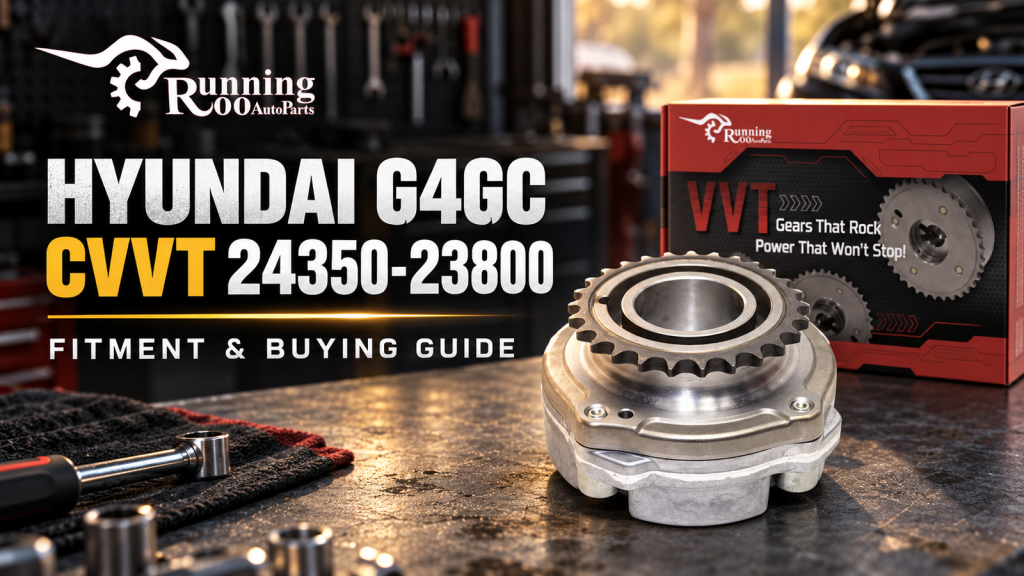
The Hyundai G4GC CVVT gear enquiry has a detail that broad “VVT replacement” guides often miss: the component’s mounting description and the valve timing it controls are not necessarily the same thing. Before ordering a gear for an Elantra, i30, Tucson or Tiburon, ask the workshop to identify the engine, the assembly and the exact reference it needs.
This guide covers the RunningRoo CVVT camshaft sprocket advertised as 24350-23800, also shown as 2435023800. The matching RunningRoo eBay listing was active at the 12 October 2026 check. The product description identifies a single CVVT gear for named G4GC 2.0-litre applications. It is not a complete timing belt or chain service kit.
RunningRoo is an Australian-operated auto-parts supplier based in Blackburn, Melbourne. For friendly support, call 0425 890 125 with the VIN, engine code and required OE reference. Melbourne local pickup is by appointment, and fast dispatch can be discussed once compatibility and stock are confirmed.

Start with G4GC, not simply “Hyundai 2.0”
The checked website description lists G4GC Beta 2.0-litre applications across several vehicle names and production ranges. Treat those details as the seller’s advertised applications, then check the actual car. The same model name and displacement can appear across different engine generations, so neither is sufficient on its own.
Provide the production date, VIN and complete engine code. If the vehicle has received a replacement engine, tell the supplier and installer before relying on the original vehicle specification. Ask the workshop to identify the required OE reference from the relevant parts information and to record any supersession it has confirmed.
Do not assume this assembly is interchangeable with a later Hyundai 2.0-litre gear or with another number beginning 24350. The final digits are part of the identification. A visually similar housing, tooth arrangement or mounting hole cannot replace a documented application match.
The technical distinction behind the buying decision
Hyundai’s Elantra HD service description explains an arrangement in which the CVVT assembly is installed on the exhaust-camshaft side while varying intake valve timing through the cam-to-cam drive. The manufacturer service text preserved in this independent archive describes oil-pressure control of intake cam phase. That distinction is why a casual label such as “exhaust gear” can be misleading without the correct diagram.
This is an application-specific explanation, not a statement that every Hyundai CVVT system works this way. The workshop should identify the actual drive arrangement before translating a diagnostic description into a parts order. Use the manufacturer’s information for the actual engine and do not transfer this layout to another engine family.
For a buyer, the practical response is to ask the mechanic for the OE number and assembly position together. If one person says “intake VVT” and another says “gear on the exhaust cam”, they may be describing different aspects of the same system, or they may be discussing different parts. Resolve that before ordering instead of choosing the label that sounds most familiar.
What the 24350-23800 listing supplies
The checked product is offered as one CVVT camshaft sprocket assembly. Its listing names several G4GC applications, but it does not establish that other components required for a complete timing service come with the gear. The workshop’s parts list should make that boundary explicit.
| Enquiry field | Information to provide | Why it helps |
|---|---|---|
| Vehicle identity | VIN, build date and exact model | Establishes the vehicle context |
| Engine identity | Confirmed G4GC code and replacement-engine history | Avoids selecting by displacement alone |
| Assembly reference | 24350-23800 or the verified required supersession | Identifies the requested component |
| Component position | Workshop description and applicable diagram | Resolves ambiguous intake/exhaust terminology |
| Supplied scope | One advertised CVVT assembly | Prevents assuming a complete service kit |
| Additional items | Installer’s separate hardware and sealing requirements | Makes the full repair order visible |
Use the RunningRoo product description and matching eBay item as the commercial references for the offered assembly. Ask for clarification if the workshop’s requested version differs from the marking or description shown. Do not silently substitute a different suffix because an online search describes it as “similar”.
If the workshop is also carrying out scheduled or condition-based timing-drive work, keep that scope separate. The gear may be one line on a larger quotation, but buying it does not automatically address every item in that quotation. The installer should specify what is being reused, inspected or replaced under the applicable procedure.
Diagnose the system before choosing the component
Hyundai’s TSB 09-EM-002 includes Beta 2.0-litre applications among the vehicles discussed for CVVT oil control valve inspection. It directs attention to the OCV when investigating relevant running complaints and codes, and says not to replace a valve that operates normally. The bulletin is a useful example of evidence-based component selection; it is not a diagnosis of your car.
A professional assessment should therefore establish which component or condition needs attention. Ask the workshop to explain its conclusion in terms of the actual findings. A recorded camshaft-related code can guide the diagnostic process, but it does not itself establish that the 24350-23800 gear is defective or compatible.
Keep the distinction between the OCV and CVVT gear clear when discussing the result. If the recommendation is for the control valve, ask for that valve’s reference. If the recommendation is for the gear, ask for the gear’s reference and the supporting findings. If both are recommended, the quotation should explain each item rather than combine them under an indistinct “VVT repair” label.
A better symptom description for an older G4GC vehicle
Write down what the driver observes rather than beginning with a diagnosis. Include when the problem appears, how often it occurs and whether the engine is cold or warm. If a warning light has appeared, record when it happened and provide the exact fault information obtained by the workshop.
Bring the service history and any recent repair invoices. A record that identifies the oil and filter used is more useful than a general claim that servicing is up to date. If the history is incomplete, say so. The mechanic can then assess the car without treating an unknown maintenance detail as an established fact.
If the complaint began after another job, describe the sequence without assuming the cause. This helps the workshop decide what to inspect and avoids a parts order based only on timing coincidence. A brief noise recording can help communicate the complaint, but it cannot establish the required assembly or replace a vehicle inspection.
Do not repeatedly clear fault information to see whether the light returns before the mechanic has reviewed it. Ask the workshop what records it needs and how it wants the car presented. A useful assessment starts with preserved information and a precise description of the symptom.
Compare repair proposals on the same basis
Suppose one quotation describes an OCV investigation and another describes fitting a CVVT gear. Those are different scopes, even if both were prompted by the same warning light. Ask each workshop to identify the diagnosed fault, the proposed component and the verification included in the price before comparing totals.
Similarly, a quotation that includes other timing-drive work should explain why that work is required. It may reflect a separate maintenance need or an inspection finding. The owner should be able to distinguish that reason from the CVVT gear diagnosis. This makes the decision clearer without assuming that additional work is either automatically necessary or automatically unnecessary.
Agree on how further findings will be handled once access is available. A sensible approval process records the new issue, explains its effect on the repair and gives a revised estimate before additional components are ordered. It prevents an initially focused parts enquiry from becoming an unclear repair commitment.
Confirm the order with the installer
If you are buying the gear yourself, send the mechanic the exact product link and advertised reference. Ask it to confirm that the assembly matches the job and that it accepts customer-supplied parts. Resolve who will check the delivery and who will contact the supplier if a discrepancy appears.
Then contact RunningRoo with the VIN, engine code, OE reference and any relevant photographs. A single complete enquiry is more effective than sending a model name first and the engine details much later. If a number cannot be read clearly, provide the photograph and state the uncertainty instead of guessing the missing characters.
The 24350-23800 website listing and eBay product page provide two ordering routes for the same enquiry. Choose the preferred checkout after the compatibility and supplied-scope questions are settled. Keep the written confirmation with the order record so the receiving check can use the same information.
Check the delivered assembly before fitting
Retain the packaging and photograph its label. The installer should compare the delivered assembly with the confirmed application and current service information before installation. That comparison should use part identification and the relevant dimensions or features specified by the manufacturer, not simply the resemblance to a cover illustration.
If a reference, mounting detail or supplied item differs from the order, pause the installation and contact RunningRoo with clear photographs. Do not modify the part to overcome an unexplained difference. The supplier needs to distinguish a picking issue from an application mismatch or an expected revision.
The actual installation should follow the correct Hyundai procedure. A general article cannot supply a universal tightening value or alignment sequence for every vehicle named in the sales title. The workshop should obtain the instructions for the engine and operation it is performing, including the final checks required by that information.
Plan collection, dispatch and the final handover
Melbourne customers can arrange local pickup in Blackburn by appointment. Call 0425 890 125 before travelling and quote the confirmed part or order reference. If the workshop still has an unresolved question about the assembly, address it before organising collection.
For Australian delivery, provide the destination postcode and the date the workshop needs the part. Ask about stock and fast dispatch separately from the transit estimate. Friendly support from an Australian-operated supplier is useful for coordinating those details, but a shipping estimate should not be treated as a guaranteed workshop completion date.
At the end of the repair, ask for the fitted reference and the workshop’s verification result to be recorded. The handover should connect the completed work to the original complaint. Keep that record with the service history so a future enquiry begins with known facts about what was inspected and replaced.
Related video and further reading
RunningRoo’s Inside a VVT Cam Phaser: Oil Passages & Locking Pin Explained gives a general visual introduction to cam-phaser terminology. It does not demonstrate this G4GC layout or establish a test procedure for 24350-23800. Use the relevant Hyundai service material for the actual assembly and repair.
For broader terminology, see the separate VVT gear versus solenoid diagnosis guide. This article focuses on the G4GC buying question, especially the risk of confusing the location of an assembly with the valve timing function being discussed.
Frequently asked questions
Is this a timing belt kit?
No. The checked listing offers a CVVT camshaft sprocket assembly. If the workshop requires timing-drive service parts, seals or hardware, obtain a separate list and confirm what must be ordered. A gear purchase should not be described as a complete timing service.
Why do descriptions mention both intake and exhaust?
The cited Elantra HD manufacturer description explains an arrangement where the assembly’s location and the valve timing it varies need careful distinction. Use the diagram and OE reference for the actual engine to resolve the enquiry. Do not apply a generic intake/exhaust label across all Hyundai engines.
Does 24350-23800 fit every Hyundai 2.0-litre engine?
No universal claim is made. Confirm the VIN, G4GC engine identification, production details and required OE reference. Another 2.0-litre engine or a similar-looking gear may have a different application. The complete number matters.
Does a CVVT code prove the gear has failed?
No. The workshop should follow the applicable diagnostic process and identify the fault. Hyundai’s cited OCV bulletin demonstrates that related components require assessment; it does not tell an owner to order this gear automatically from a code description.
Is the OCV supplied with the gear?
It is not identified as an included item in this guide. If the workshop requires an OCV, obtain its separate reference and confirmation of supply. Keep the two components distinct on the quotation and order so neither is bought or omitted by assumption.
How do I arrange a confirmed order?
Review the RunningRoo G4GC CVVT product or matching eBay listing, then call 0425 890 125 if compatibility needs checking. Melbourne local pickup is by appointment, with fast dispatch enquiries available for Australian customers once stock and the correct assembly are confirmed.