
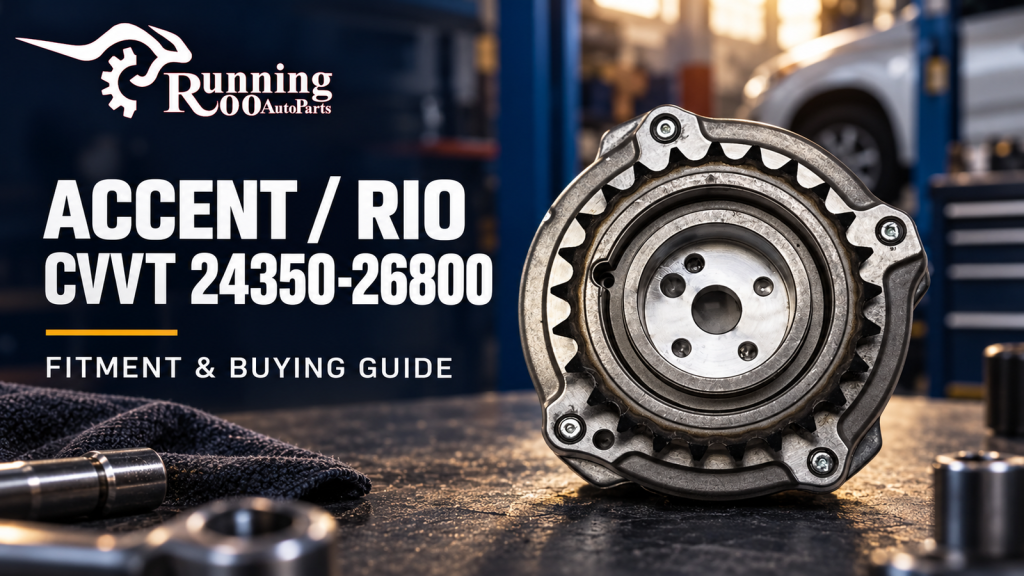
If a workshop has mentioned a CVVT gear for an older Hyundai Accent or Kia Rio, ask it to confirm the complete part number before shopping. The reference 24350-26800 is much more useful than “Hyundai timing gear”, but even a familiar reference needs to be checked against the vehicle, engine and required component. A camshaft-related fault code does not independently identify the replacement part.
This article covers the RunningRoo CVVT assembly advertised as 24350-26800, also written without the hyphen as 2435026800. Its matching eBay listing was checked as active on 12 October 2026. The advertised item is a camshaft timing gear assembly; it should not be mistaken for an oil control solenoid, a sensor or a complete timing-service package.
RunningRoo Auto Parts is Australian-operated and based in Blackburn, Melbourne. Call 0425 890 125 for friendly support with the parts enquiry. Melbourne local pickup is by appointment, and fast dispatch is subject to confirmation of the correct item, stock and order arrangements.

Resolve the application before interpreting the fault
The website title names Accent and Rio applications over a broad year range, while the description gives a narrower Accent range. That difference should trigger a compatibility check, not an attempt to choose whichever range includes your car. Send the VIN, production date, engine code and the OE reference specified by the workshop.
A registration year may differ from the production date, and a model name can cover more than one engine. Ask the mechanic to identify the engine actually installed, especially if the service history is incomplete. If a previous owner replaced the engine or camshaft components, mention that before the supplier relies on the vehicle’s original configuration.
Record 24350-26800 accurately. Removing the hyphen for a search is a formatting change; changing a digit or suffix is a different reference and needs verification. Do not assume another Hyundai number beginning with 24350 is equivalent. The supplier should confirm the requested application rather than infer compatibility from a similar-looking number.
Gear, oil control valve and sensor are different purchasing decisions
The listed item is a CVVT gear assembly. A buyer should ask the workshop whether that is the component it has diagnosed, rather than assuming every part involved in camshaft timing is sold under the same name. Clear terminology is especially important when an owner has received a verbal recommendation and is placing the order independently.
| Term in a repair discussion | What to clarify | What this listing establishes |
|---|---|---|
| CVVT gear or cam phaser | Exact assembly, position and OE reference | Advertised CVVT assembly 24350-26800 |
| Oil control valve or OCV | Separate control component and its part number | Not identified as included with this gear |
| Camshaft position sensor | Sensor identity and diagnostic evidence | Not the product covered by this guide |
| Timing kit | Required drive components and supporting items | A single assembly is not a complete kit |
| P0011 or another recorded code | Vehicle-specific diagnostic procedure and findings | A code does not establish fitment or package contents |
This table is a purchasing clarification, not a diagnostic flowchart. The workshop should determine the actual fault using the correct manufacturer’s information. If the invoice says “VVT part”, ask for a more precise description before ordering; that simple change can prevent a gear being bought when the repairer intended a different component.
Review the RunningRoo 24350-26800 product page and the matching eBay item with the installer. Confirm the current supplied assembly and whether any separate hardware or sealing items are needed. The presence of a central mounting hole or familiar outer shape does not verify the application.
What Hyundai’s official diagnostic material says
Hyundai’s original TSB 09-EM-002 names the Alpha 1.6-litre Accent MC among its CVVT applications. It calls for oil control valve assessment when investigating relevant complaints and says not to replace a valve that operates normally. This manufacturer-authored bulletin, preserved in an independent archive, supports diagnosis rather than an automatic parts order from a code alone.
Kia’s Tech Times discussion of CVVT performance provides broader manufacturer background on distinguishing control and mechanical concerns. It directs technicians to the applicable service procedures. This is not a 24350-26800 fitment document or a substitute for the correct Accent or Rio manual; the useful lesson is to identify the actual failed component before choosing the replacement.
For the owner, the practical question is what the workshop has already established. Has it identified the relevant system, followed the applicable diagnostic process and specified the failed component? That evidence is more useful than a list of possible symptoms copied from a generic product advertisement.
Make the first workshop visit productive
Bring a concise symptom history. Describe when the complaint happens, whether the engine is cold or warm, and whether it began before or after a particular service or repair. Provide the exact recorded fault codes if available, but keep the code separate from any conclusion about which component must be replaced.
Include the service invoices that show the oil and filter information. If those records are unavailable, explain that rather than supplying a guessed oil specification. The technician needs to assess the vehicle’s actual condition using the applicable procedure. A parts order should not be used to fill gaps in that assessment.
If the car behaves differently at different times, describe that variation. A short recording may help communicate a noise, while a written account can capture the conditions of a running concern. Neither is a substitute for inspection. Ask the mechanic whether the symptom was reproduced and what evidence supports the recommendation.
When a warning or serious running problem is present, ask the workshop for vehicle-specific advice about using or transporting the car. A product listing cannot determine whether continued driving is appropriate. The aim is to get the car assessed and the repair defined, not to conduct repeated experiments in the hope that a symptom will reveal a part number.
Read a gear-replacement recommendation critically
A useful recommendation names the assembly, reference and application, then explains the findings that justify replacement. It should also identify any separate work required to complete the repair. If the explanation consists only of “the code says camshaft”, ask for the diagnostic conclusion in clearer terms.
This does not mean every owner needs to reproduce the mechanic’s tests. It means the purchasing decision should have a traceable basis. The workshop can explain what was found and why the gear is the requested part without turning the handover into a technical training session.
If another component was recently replaced without resolving the complaint, provide that history. Ask whether the current recommendation follows new evidence or simply moves to the next possible part. A record of previous work can help the technician avoid repeating assumptions and helps the owner understand why the proposed scope has changed.
Check the exact reference and supplied scope
Send RunningRoo a clear photograph of any readable marking on the removed or accessible assembly, together with the VIN and engine code. If the workshop has obtained an OE reference from the manufacturer’s catalogue, include it in full. Do not remove letters or trailing characters because they look unimportant.
Ask whether the supplied product is one gear assembly and what, if anything, comes with it. A replacement gear does not automatically include the OCV, sensor, chain, belt, seals or bolts mentioned elsewhere in a workshop quotation. Keep those items separate until their inclusion or separate supply has been confirmed.
The current listing is the commercial source for the product offered. The manufacturer service information is the technical source for diagnosis and installation. Neither source does the other’s job: a workshop manual does not certify a seller’s stock, while a sales page does not replace the manufacturer’s procedure.
Budget for the finished repair
Obtain the labour and supporting-parts estimate before using the gear price as the total cost. Ask whether the quotation covers diagnosis, installation and the final verification of the original complaint. If additional work might be required after access, agree on an approval point and how the workshop will explain the finding.
For a customer-supplied part, confirm that arrangement with the installer in advance. Send the exact RunningRoo CVVT listing, not just a screenshot of the price. The installer can then check the advertised reference and supplied scope. Use the eBay equivalent if that is your preferred purchasing channel after the compatibility question has been resolved.
Avoid comparing quotes that cover different components as though they are interchangeable. One may describe an OCV-related repair while another includes a gear assembly and associated labour. The cheapest figure can be misleading if it answers a different question from the repair your vehicle actually needs.
Receiving the assembly and handing it to the installer
Keep the packaging and order reference with the part. Before installation, the workshop should compare the supplied assembly with the confirmed application and requested reference. A visual comparison is useful, but it should accompany the parts information rather than replace it.
If a detail does not match, contact RunningRoo with photographs before altering the assembly or attempting to make it fit. State whether the discrepancy concerns the label, marking, mounting arrangement or expected package contents. A precise description helps the supplier investigate the order efficiently.
Ask the installer to follow the applicable Hyundai or Kia procedure for the actual engine. This article does not provide a universal torque value, timing sequence or bench-test instruction. Those details depend on the application and task, and the workshop should obtain them from the appropriate service information.
Verify the outcome and retain a useful record
After the repair, ask how the original complaint was reassessed. A cleared code is an administrative step; the workshop should explain the relevant operational checks and whether the reported symptom was resolved under suitable conditions. Any remaining concern should be recorded separately rather than hidden by a general “all fixed” statement.
Keep the diagnostic conclusion, fitted reference and final invoice together. If the car later returns with a different complaint, those records help the next technician understand what was actually tested and replaced. They also make the vehicle’s history more useful when ownership changes.
For local support, call 0425 890 125. RunningRoo offers Melbourne local pickup in Blackburn by appointment and can discuss fast dispatch for Australian orders. Confirm the item and stock first; friendly support works best when the enquiry includes the VIN, engine code, OE number and workshop’s diagnosis.
Related RunningRoo video
Watch Inside a VVT Cam Phaser: Oil Passages & Locking Pin Explained for a general visual introduction to cam-phaser terminology. It is not a 24350-26800 inspection procedure, and the internal parts shown should not be assumed identical to this assembly. Use the relevant manufacturer information for the actual test and repair.
The separate VVT gear versus solenoid diagnosis article discusses broader terminology. This page is focused on the 24350-26800 buying decision and the application checks that prevent a broad Accent or Rio search from producing the wrong order.
Frequently asked questions
Does P0011 mean I need 24350-26800?
No. A fault code must be interpreted through the diagnostic process for the actual vehicle. Hyundai’s cited information considers the CVVT system and related checks; it does not make a gear replacement automatic. Confirm the diagnosis and then the part’s compatibility.
Is 2435026800 different from 24350-26800?
Those two written forms contain the same digits and differ only in hyphenation. A different digit or suffix is a separate reference requiring confirmation. Preserve the complete manufacturer reference when asking RunningRoo to check the application.
Does it fit every Accent or Rio in the advertised years?
This guide makes no such promise. The listing’s title and body use different application ranges, so the VIN, engine code, build details and OE reference should resolve the enquiry. Do not select the broader range merely because it includes your registration year.
Is an oil control valve included?
The product is advertised as a CVVT assembly. An OCV is not identified here as an included item. If the workshop requires one, ask for its separate part number and confirm supply independently instead of assuming it comes with the gear.
Can RunningRoo diagnose the car from the listing?
The team can help with product information and compatibility enquiries, but the required repair should be established through professional diagnosis. Send the workshop’s findings along with the vehicle details so the parts conversation starts from a clear request.
Where can I purchase the confirmed part?
Order through the RunningRoo website or matching eBay listing. For Melbourne local pickup by appointment or fast dispatch enquiries, call 0425 890 125. Confirm current stock and the exact supplied item before coordinating the workshop booking.