
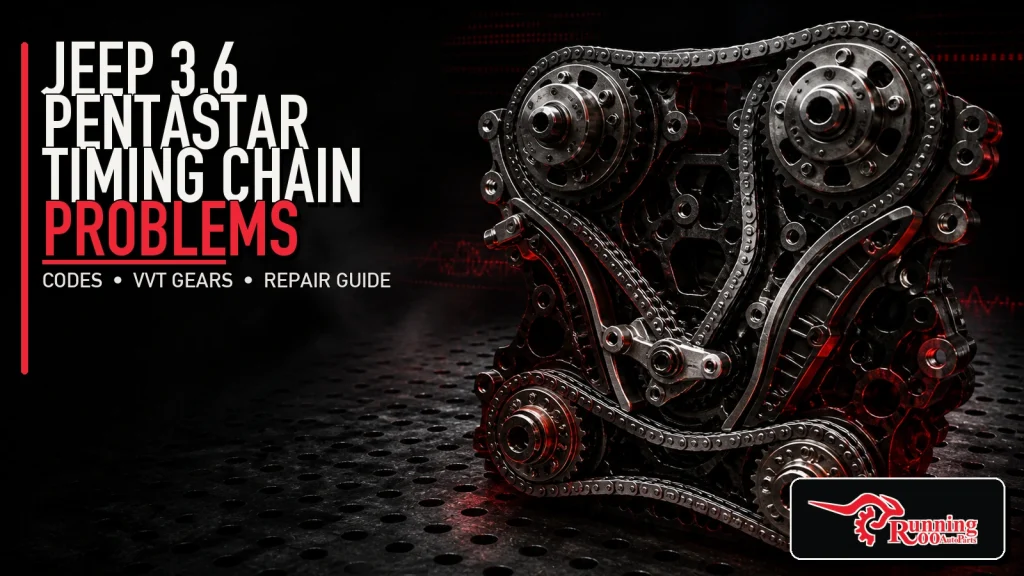
A 3.6-litre Pentastar timing complaint can involve more than one chain, guide, tensioner or camshaft phaser. That complexity is why a generic “timing-chain noise” diagnosis is not enough. The same vehicle can also develop rocker, lifter, oil-pressure, sensor or accessory faults that owners describe with similar words.
This guide is designed to prevent a complete-kit purchase from becoming the first diagnostic step. It explains how to evaluate symptoms and codes, decide whether camshaft adjusters belong in the repair and verify kit fitment across selected Jeep, Chrysler, Dodge and Fiat applications.
Quick answer: a Pentastar rattle plus cam/crank correlation evidence needs prompt diagnosis, but the code or sound alone does not prove every chain and VVT gear is faulty. Check lubrication, bank-specific scan data, sensors and mechanical timing, then select a standard kit or a four-VVT kit based on documented findings.
RunningRoo support for Jeep 3.6 Pentastar Timing Chain Problems
OEM-fit aftermarket replacement · 2-Year Warranty · Direct factory value · Fast, friendly support
Call 0425 890 125 · 24/7 free Melbourne pickup by appointment · Australian-based support 🇦🇺
Understanding the Pentastar timing layout
The DOHC V6 layout uses a coordinated chain drive to maintain crankshaft-to-camshaft timing across both cylinder banks. Camshaft phasers then adjust valve timing under oil and electronic control. An error in one bank, one sensor or one actuator can therefore appear alongside broader correlation symptoms.
Pentastar applications and production revisions span many models. A kit described for a Jeep Wrangler may also list a Chrysler 300, Dodge Journey or Fiat Freemont, but model coverage does not replace VIN and original-part verification.
Symptoms that deserve a proper timing-system check
- Metallic rattle during start-up or idle
- Ticking or tapping that may actually come from the valve train
- Camshaft-position or cam/crank correlation codes
- Rough running, difficult starting or reduced power
- Bank-specific actual cam angle that does not reach its target
- Guide debris, abnormal tensioner travel or timing-mark error
- Noise and codes that began after previous engine work
Timing chain, tensioner or VVT?
| Evidence | Possible control/phaser issue | Possible chain-drive issue |
|---|---|---|
| Scan pattern | One cam angle responds slowly or inconsistently | Persistent bank correlation or multiple related positions |
| Oil/control test | Solenoid, oil feed or phaser fails test | Control side passes but base timing is wrong |
| Physical inspection | Phaser play or locking fault | Guide wear, slack, debris or tensioner problem |
| Repair choice | Targeted phaser/control repair | Chain kit, with phasers only if inspection supports them |
The patterns above are diagnostic clues, not automatic replacement decisions. More than one fault can exist, especially on a high-kilometre engine or one with uncertain service history.
A step-by-step diagnostic sequence
1. Confirm the exact Pentastar application
Record VIN, model, build date and engine identification. Check whether previous engine or cylinder-head work changed any original components.
2. Locate the sound
Compare cold start, warm idle and controlled engine-speed conditions. A stethoscope used by a trained technician can help separate timing-cover noise from rocker, injector and accessory sources.
3. Verify the oil baseline
Check oil level, condition, viscosity and pressure clues. Because tensioners and phasers use engine oil, lubrication faults must be resolved before condemning expensive mechanical parts.
4. Analyse codes by bank and camshaft
Save freeze-frame data and identify which bank and position is involved. Inspect relevant sensors, connectors and wiring, then compare target and actual cam angles.
5. Command and test VVT operation
Where approved equipment supports it, evaluate control-solenoid and phaser response. Do not use uncontrolled activation methods or assume a response problem is mechanical before checking oil and electrical supply.
6. Inspect base timing
If the evidence supports access, inspect every chain, guide and tensioner position included in the engine-specific procedure. Verify both banks; a correct-looking mark on one side does not clear the whole system.
Before ordering Jeep 3.6 Pentastar Timing Chain Problems parts
Confirm VIN, engine code and original part numbers first. RunningRoo combines high-quality OEM-fit aftermarket parts, a 2-Year Warranty, factory-direct pricing and responsive fitment support.
Need help? Call 0425 890 125. Melbourne pickup is available 24/7 by appointment from RunningRoo Auto Parts, Australia 🇦🇺.
Four RunningRoo product options to compare
The four links below are relevant catalogue options, not a declaration of fitment. Confirm the VIN, engine code, production date, original part numbers and required kit contents with RunningRoo or your workshop before ordering.
1. RunningRoo Pentastar timing-chain kit for selected 2011–2015 vehicles — A chain-drive option for selected Dodge, Jeep and Chrysler applications.
2. Fiat Freemont/Chrysler 300/Jeep 3.6 Pentastar chain kit — Compare exact model, production date and component layout.
3. Jeep/Dodge/Chrysler 3.6L V6 compatible timing-chain kit — A further kit choice for VIN-based comparison.
4. Pentastar timing-chain kit with four VVT gears — Use the broader four-phaser scope only when diagnosis and parts comparison justify it.
When does a four-VVT-gear kit make sense?
A kit that includes four VVT gears can be valuable when multiple phasers fail inspection, kilometres and labour access support a comprehensive repair, or existing damage makes reuse unwise. It is not proof that all four gears are defective. Replacing good components without resolving an oil-control fault can leave the original code unchanged.
Set the engine at the specified timing position, keep bank and cam locations clearly labelled and use the correct holding tools. After tension is applied, recheck every reference and rotate the engine as specified before starting. Post-repair verification should include oil pressure clues, noise, codes and actual camshaft response on both banks.
- Label left/right bank and intake/exhaust components
- Inspect rocker and valve-train noise separately
- Check for debris and oil-passage restriction
- Replace one-time fasteners and specified seals
- Follow exact tensioner preparation and release steps
- Verify all four cam positions after repair
Related RunningRoo technical guides
Continue with these closely related diagnosis and fitment resources:
Why Choose RunningRoo?
- High-quality aftermarket replacement – OEM fit
- 2-Year Warranty – reliability guaranteed
- Direct factory supply = competitive price
- Fast and friendly support
Call us: 0425 890 125
24/7 Free Pickup Available in Melbourne – By appointment only
RunningRoo Auto Parts – Based in Melbourne, Australia 🇦🇺
Frequently asked questions
Does a Pentastar ticking noise mean the chain is bad?
No. Valve-train and injector sounds can be confused with chain noise. Location, scan evidence and inspection are required.
Should all four camshaft phasers be replaced?
Only when testing, condition and the planned repair support that scope. A four-gear kit is an option, not a diagnosis.
Can one bank be out of time while the other is correct?
Bank-specific faults and installation errors are possible. The complete engine timing procedure should verify both banks.
Are all 2011–2015 Pentastar kits the same?
Do not assume so. Confirm VIN, model, build date, original component numbers and any production revisions.
Final recommendation
Pentastar timing diagnosis works best when the engine is treated as a system. Separate valve-train noise from chain noise, analyse codes by bank and camshaft, test oil and electronic control, then verify mechanical timing. Only after that evidence is collected should the repair expand from a chain kit to four VVT gears.
This article provides general technical information. Confirm fitment and repair procedures against current manufacturer service data, and use a qualified technician for internal engine-timing work.