
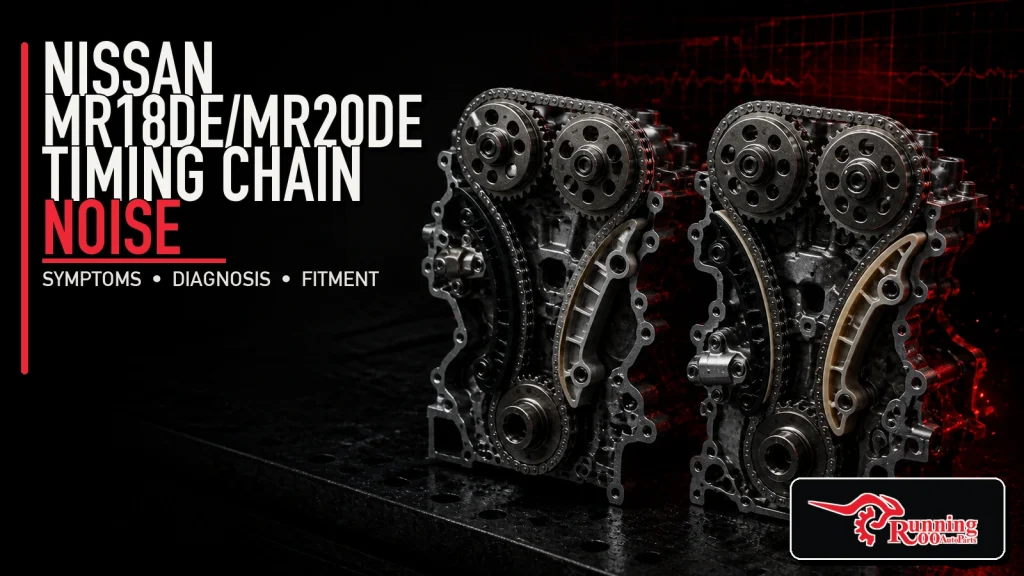
Nissan MR18DE and MR20DE engines appear across Tiida, Qashqai, X-Trail and other applications, which makes online parts searches look simpler than they are. A catalogue may group 1.8L and 2.0L models together, but a safe order still depends on the exact engine, production data and the components found on the vehicle.
Timing-chain noise also overlaps with VVT control faults, low oil pressure, accessory noise and earlier installation errors. This guide builds a practical diagnostic sequence and explains how to compare a standard chain kit with options that add a VVT component or RTV sealant.
Quick answer: verify MR18DE versus MR20DE before ordering, then check oil condition, scan camshaft data and locate the noise. A brief start-up rattle does not prove chain stretch; persistent noise, mechanical timing deviation, tensioner overtravel or damaged guides provide stronger evidence for a complete timing repair.
RunningRoo support for Nissan MR18DE/MR20DE Timing Chain Noise
OEM-fit aftermarket replacement · 2-Year Warranty · Direct factory value · Fast, friendly support
Call 0425 890 125 · 24/7 free Melbourne pickup by appointment · Australian-based support 🇦🇺
How the MR-series timing and VVT systems interact
The chain establishes the mechanical relationship between crankshaft and camshafts. Variable valve timing can then alter cam position using controlled oil pressure. If oil supply is poor or a control valve sticks, actual cam angle can lag behind its target even when the chain remains correctly timed.
MR18DE and MR20DE applications share family characteristics, which is why some kits are marketed across both. However, vehicle and production differences still affect fitment. Use the engine code and original parts rather than assuming every Tiida, Qashqai or X-Trail in a year range is identical.
Symptoms that deserve a proper timing-system check
- Rattle during the first seconds of start-up
- Continuing noise near the timing cover
- Rough idle, poor response or difficult starting
- Camshaft-position, VVT-performance or correlation faults
- Actual cam angle slow to follow its command
- Tensioner extension or guide wear outside specification
- A fault appearing soon after timing or cylinder-head work
Timing chain, tensioner or VVT?
| Possible cause | Typical clue | Confirmation |
|---|---|---|
| Oil/control fault | Cam response changes with temperature or command | Oil baseline, pressure, solenoid and passage testing |
| VVT actuator | Locking or movement test fails with base timing correct | Engine-specific actuator test |
| Chain/guide/tensioner | Persistent rattle, debris, overtravel or timing deviation | Mechanical inspection and timing check |
| Sensor/wiring | Circuit fault or unstable signal | Connector, wiring and signal diagnosis |
The patterns above are diagnostic clues, not automatic replacement decisions. More than one fault can exist, especially on a high-kilometre engine or one with uncertain service history.
A step-by-step diagnostic sequence
1. Identify the vehicle and engine
Record the VIN, engine code, build date and market. Pay extra attention to imports or replacement engines, where the badge and catalogue may disagree.
2. Reproduce the complaint
Record a true cold start, warm idle and gentle engine-speed change. Note duration and location. Normal injector sound is more regular than a loose, transient chain clatter, but listening alone is not proof.
3. Check oil and pressure clues
Confirm level, viscosity, condition and filter quality. Investigate an abnormal pressure warning or contaminated oil before testing VVT response.
4. Scan without erasing evidence
Save codes and freeze-frame data. Compare camshaft target and actual position where supported. Determine whether the fault is electrical, performance-related or true correlation.
5. Test VVT control
Inspect the control solenoid, wiring and oil passages using the correct service data. A new cam gear will not fix a blocked feed, and a new solenoid will not restore mechanical timing.
6. Inspect timing components
If the evidence points inside, examine the chain, guides, tensioner and sprockets as a system. Verify timing references before choosing the final parts list.
Before ordering Nissan MR18DE/MR20DE Timing Chain Noise parts
Confirm VIN, engine code and original part numbers first. RunningRoo combines high-quality OEM-fit aftermarket parts, a 2-Year Warranty, factory-direct pricing and responsive fitment support.
Need help? Call 0425 890 125. Melbourne pickup is available 24/7 by appointment from RunningRoo Auto Parts, Australia 🇦🇺.
Four RunningRoo product options to compare
The four links below are relevant catalogue options, not a declaration of fitment. Confirm the VIN, engine code, production date, original part numbers and required kit contents with RunningRoo or your workshop before ordering.
1. 10-piece MR18DE/MR20DE timing-chain kit — A complete-kit starting point for selected Tiida, Qashqai and X-Trail applications.
2. MR18DE/MR20DE timing-chain kit with VVT — Consider when diagnosis and component comparison support including the VVT unit.
3. Tiida/Qashqai MR18DE/MR20DE timing kit with RunningRoo RTV — Includes sealant convenience; use it only where the service procedure specifies.
4. MR18DE/MR20DE timing-chain kit for selected 2005–2010 applications — Verify year range, engine code and original kit layout.
Choosing between a standard kit and a kit with VVT
A VVT-inclusive kit is not automatically the better repair. If the actuator passes its specified checks and the problem is confined to worn chain guides, adding a gear may increase cost without solving an additional fault. If the actuator is damaged or fails to lock while oil control and base timing are correct, including it can avoid repeat labour.
Whichever kit is selected, compare all components before assembly. Seal the timing cover using the correct product, bead location and curing procedure. Excess sealant can squeeze into oil passages, while too little or poor surface preparation can create a leak.
- Verify engine code and original component numbers
- Check the VVT control valve separately from the actuator
- Inspect sprocket teeth and guide mounting points
- Replace seals and fasteners required by the procedure
- Rotate and recheck mechanical timing before first start
- Scan cam response and repeat the original noise test
Related RunningRoo technical guides
Continue with these closely related diagnosis and fitment resources:
Why Choose RunningRoo?
- High-quality aftermarket replacement – OEM fit
- 2-Year Warranty – reliability guaranteed
- Direct factory supply = competitive price
- Fast and friendly support
Call us: 0425 890 125
24/7 Free Pickup Available in Melbourne – By appointment only
RunningRoo Auto Parts – Based in Melbourne, Australia 🇦🇺
Frequently asked questions
Are MR18DE and MR20DE timing kits identical?
Some listings cover selected variants of both engines, but fitment still depends on vehicle, production date and original components. Confirm before ordering.
Does a start-up rattle always require a full kit?
No. Oil drain-back, a tensioner or VVT component may be involved. Inspect chain control and guides before deciding the scope.
Can I reuse the old VVT gear?
Reuse depends on inspection and the model-specific procedure. A gear that locks and moves correctly may be serviceable; one that fails its test should not be reused merely to reduce parts cost.
Why did the code return after chain replacement?
Possible causes include incorrect timing, unresolved VVT control or wiring faults, a mismatched kit or failure to verify the repair with live data.
Final recommendation
MR18DE and MR20DE timing faults are best solved by separating hydraulic control from mechanical timing. Identify the engine, preserve scan evidence, test the oil-control path and inspect the complete chain drive. Then choose a kit whose contents match both the vehicle and the proven repair scope.
This article provides general technical information. Confirm fitment and repair procedures against current manufacturer service data, and use a qualified technician for internal engine-timing work.