
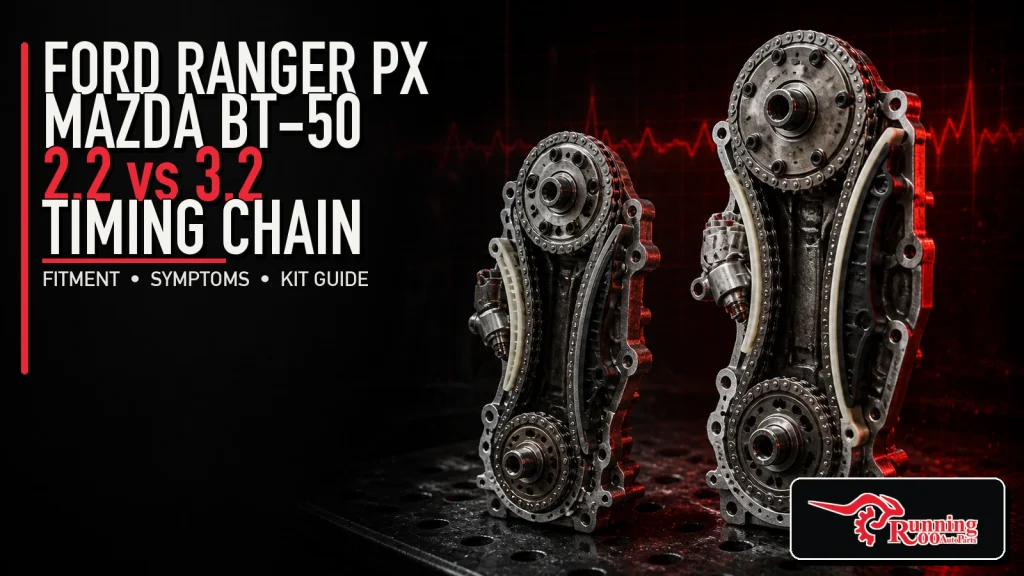
Searching for a Ford Ranger PX or Mazda BT-50 timing-chain kit often produces pages that group 2.2-litre, 2.4-litre and 3.2-litre diesel applications together. That is convenient for search results but risky for ordering. The engines do not automatically use the same chain layout, sprockets, guides or oil-pump drive components.
This guide focuses on the decision that matters most before purchase: identifying the installed engine and matching the repair scope to the fault. It also explains which noises deserve attention, what evidence a workshop should collect and why a kit advertised for a Ranger can still be wrong for a particular Ranger.
Quick answer: do not order by the Ranger or BT-50 badge alone. Record the VIN, engine code, displacement, build date and original part numbers. A 2.2L chain kit and a 3.2L kit may differ substantially, and some 3.2L options include an oil-pump chain that is not described in simpler listings.
RunningRoo support for Ford Ranger PX & Mazda BT-50 Timing Chain
OEM-fit aftermarket replacement · 2-Year Warranty · Direct factory value · Fast, friendly support
Call 0425 890 125 · 24/7 free Melbourne pickup by appointment · Australian-based support 🇦🇺
Why 2.2L and 3.2L kit identification matters
Ford Ranger PX and related Mazda BT-50 models were sold with several diesel configurations across different markets and production periods. Even where engines share design ideas, component dimensions and kit contents can vary. Model-year descriptions also overlap around production changes, so registration year alone is not a reliable parts identifier.
A workshop should identify the engine from the vehicle data and inspect the removed components. The number of chains, guide shapes, sprocket tooth profiles, tensioner design and whether the oil-pump drive is included all need to agree with the intended application.
Symptoms that deserve a proper timing-system check
- Metallic rattle from the front or timing area during start-up
- Noise that becomes more obvious at idle or during engine-speed changes
- Hard starting, uneven running or reduced power
- Cam/crank correlation or position-related diagnostic codes
- Plastic guide material or metallic debris found in the oil
- A tensioner that is near the end of its working travel
- Noise or timing faults immediately after previous repair work
Timing chain, tensioner or VVT?
| Check | 2.2L/2.4L listing | 3.2L listing |
|---|---|---|
| Engine identification | Confirm exact four-cylinder engine and vehicle application | Confirm exact five-cylinder engine and vehicle application |
| Kit contents | Compare chain, guides, tensioner and sprockets | Check whether the oil-pump chain and related parts are included |
| Vehicle badge | Ranger, Transit or BT-50 references may overlap | Ranger PX and BT-50 references still require VIN confirmation |
| Best evidence | Original part numbers and component comparison | VIN, engine code, build date and full kit layout |
The patterns above are diagnostic clues, not automatic replacement decisions. More than one fault can exist, especially on a high-kilometre engine or one with uncertain service history.
A step-by-step diagnostic sequence
1. Verify the engine before diagnosing the kit
Photograph the identification label, record the VIN and confirm displacement. Modified vehicles and replacement engines make badge-based ordering especially unreliable.
2. Reproduce the noise safely
Record a true cold start and a fully warm idle. Note whether the noise is brief, continuous, load-sensitive or limited to a narrow engine-speed range. Do not place tools or hands near belts, fans or pulleys.
3. Check oil and service history
Chain tensioners rely on correct lubrication. Verify oil level, grade, contamination and filter condition. If an oil-pressure warning is delayed or abnormal, measure pressure using the correct procedure before condemning the chain.
4. Scan all relevant modules
Save current, pending and history codes before clearing them. Camshaft and crankshaft data can support a timing diagnosis, but a sensor or wiring fault must be separated from true mechanical deviation.
5. Inspect the complete drive
Where evidence justifies access, inspect chain condition, guide surfaces, tensioner operation, sprocket wear and the oil-pump drive components applicable to the engine. One visibly damaged guide often means debris inspection is also required.
6. Compare the new kit before installation
Lay out the new and removed components in matching order. Differences in guide profile, tensioner oil feed, chain width or sprocket design must be resolved before assembly, not after the engine is timed.
Before ordering Ford Ranger PX & Mazda BT-50 Timing Chain parts
Confirm VIN, engine code and original part numbers first. RunningRoo combines high-quality OEM-fit aftermarket parts, a 2-Year Warranty, factory-direct pricing and responsive fitment support.
Need help? Call 0425 890 125. Melbourne pickup is available 24/7 by appointment from RunningRoo Auto Parts, Australia 🇦🇺.
Four RunningRoo product options to compare
The four links below are relevant catalogue options, not a declaration of fitment. Confirm the VIN, engine code, production date, original part numbers and required kit contents with RunningRoo or your workshop before ordering.
1. Ford Ranger/Mazda BT-50 2.2L and Ford Transit 2.2/2.4L chain kit — A four-cylinder-focused listing; confirm the exact engine and original component layout.
2. RunningRoo Ford/Mazda 2.2L–2.4L chain-kit option — Useful for comparing kit contents and arranging Melbourne pickup after fitment is verified.
3. Ford Transit/Ranger and Mazda BT-50 diesel chain kit — Check that the engine family and production range match the vehicle.
4. Ford Ranger PX/Mazda BT-50 3.2 TDCi kit with oil-pump chain — A 3.2L-focused option whose oil-pump-chain content should be compared with the planned repair.
Repair planning for a working ute
A Ranger or BT-50 is often a work vehicle, so downtime can tempt owners to order the broadest-looking kit and start dismantling. That approach can create longer delays if one guide, seal or sprocket does not match. Confirming the kit first is normally faster than discovering a fitment problem with the engine open.
Timing alignment, fastener replacement, sealant placement and tensioner release must follow the exact engine procedure. After assembly, rotate the engine as specified, confirm every reference, prime components where required and monitor oil pressure and timing data during the first start.
- Photograph original timing marks and component orientation
- Keep removed parts arranged by position
- Check oil-pump drive parts when applicable
- Remove guide debris from the sump and oil pickup if found
- Use the specified sealant only in the specified locations
- Perform cold and warm post-repair checks
Related RunningRoo technical guides
Continue with these closely related diagnosis and fitment resources:
Why Choose RunningRoo?
- High-quality aftermarket replacement – OEM fit
- 2-Year Warranty – reliability guaranteed
- Direct factory supply = competitive price
- Fast and friendly support
Call us: 0425 890 125
24/7 Free Pickup Available in Melbourne – By appointment only
RunningRoo Auto Parts – Based in Melbourne, Australia 🇦🇺
Frequently asked questions
Do all Ford Ranger PX engines use a timing chain?
The vehicle range includes different engines and production periods. Identify the installed engine before relying on any general Ranger statement or parts listing.
Can a 2.2L timing-chain kit fit a 3.2L engine?
Do not assume so. The layouts and kit contents can differ materially. Match the VIN, engine code and original parts to a listing intended for that application.
Should the oil-pump chain be replaced at the same time?
Inspect the engine-specific oil-pump drive and follow the repair scope supported by condition and service information. Some kits include it; others do not.
Is a brief diesel start-up noise always chain wear?
No. Injectors, accessories, delayed oil pressure and other components can create similar sounds. Location, duration, scan data and inspection are needed.
Final recommendation
The safest Ford Ranger PX or Mazda BT-50 timing-chain purchase begins with engine identification, not a model badge. Separate 2.2L and 3.2L applications, diagnose the noise, inspect the complete drive and compare every component before assembly. That process protects both the new kit and the vehicle’s working life.
This article provides general technical information. Confirm fitment and repair procedures against current manufacturer service data, and use a qualified technician for internal engine-timing work.