
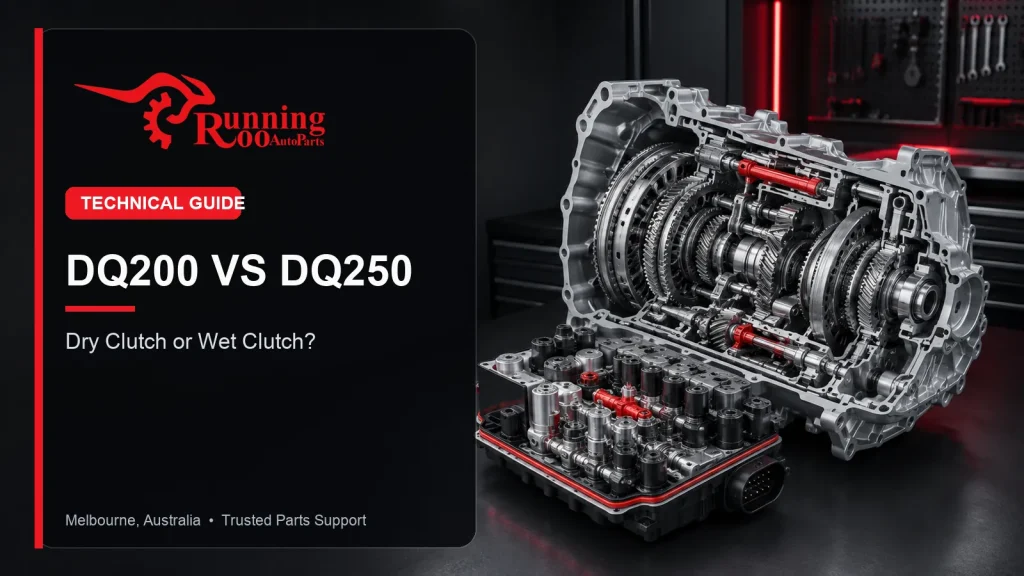
G’day everyone. I’m the Senior Product Manager here at RunningRoo Auto Parts, Australia’s trusted aftermarket automotive parts specialist. If you are looking at a Volkswagen, Audi, Skoda or Seat with a DSG gearbox, you will quickly come across the terms dry clutch and wet clutch. In this guide I’ll explain the difference between the DQ200 (dry) and the DQ250 (wet) DSG, how each one behaves, and which is better suited to different uses.
Choosing the right DSG matters because the two types are fundamentally different in how they manage heat and torque, and they have different maintenance needs. Understanding the trade-off will help you know what to expect from your car and what to budget for in the long run.
All prices below are in Australian dollars and are indicative only. If you would rather talk through your own gearbox before reading further, our Melbourne-based team can help over the phone.
RunningRoo Auto Parts – Based in Melbourne, Australia 🇦🇺
Free 24/7 Pickup Available (by appointment)
Any questions? Call us anytime: 0425 890 125
Why Choose RunningRoo? Aussie Owned & Operated | Fast Shipping | Friendly Support
What the terms dry and wet clutch mean
A dual-clutch gearbox uses two separate clutches to pre-select the next gear, allowing very fast and smooth shifts. In a dry clutch design, the clutches operate in air, while in a wet clutch design they are bathed in oil.
The DQ200 uses a dry clutch and is most commonly a seven-speed unit. The DQ250 uses a wet clutch and is a six-speed unit. Both are DSG gearboxes, but they are built for different levels of torque and different driving demands.
The clutch type is the single biggest difference in how the two gearboxes feel and how much they cost to maintain.
How they manage heat differently
The wet clutch is oil-cooled, which means the oil carries heat away from the clutch pack constantly. This lets a wet clutch tolerate more slip and more repeated launches without overheating, making it well suited to higher-torque engines and heavier vehicles.
The dry clutch has no oil bath, so it relies on airflow and careful engagement to manage heat. It is lighter and more efficient, but it is more sensitive to sustained slipping and repeated low-speed engagement, which is why it can overheat in heavy stop-start traffic.
This is the core trade-off: the wet clutch is more robust under load, while the dry clutch is lighter and more efficient but needs a gentler driving style.
Which one is better for your needs
If your car has a high-torque engine, or if you use it for towing, carrying loads or long highway driving, the wet clutch DQ250 is generally the better suited design because it handles heat and torque more comfortably.
If your car has a lower-torque engine and is mostly used for city and suburban driving, the dry clutch DQ200 is efficient and light, and it is fine as long as it is driven sensibly in traffic.
It is also worth remembering that the two gearboxes are fitted to different models, so in practice you do not usually get to choose between them on the same car. The manufacturer decides which DSG suits the engine and the vehicle’s intended use, which is why you will see the DQ200 on lower-torque models and the DQ250 on higher-torque models.
The table below summarises the key differences so you can compare them at a glance.
| Feature | DQ200 (dry) | DQ250 (wet) |
|---|---|---|
| Clutch type | Dry, in air | Wet, oil-cooled |
| Typical gears | 7-speed | 6-speed |
| Torque capacity | Lower | Higher |
| Heat tolerance | Less | More |
| Efficiency | Higher | Slightly lower |
How to tell which DSG your car has
The easiest way to tell is from the gearbox code, which is printed on the gearbox and can also be read from the build information using your VIN. The DQ200 common codes are 0AM and 0CW, while the DQ250 common code is 02E.
The number of gears is another clue. A seven-speed DSG is almost always a dry-clutch DQ200, while a six-speed DSG is usually the wet-clutch DQ250. If you are unsure, a specialist can confirm it quickly.
| Gearbox | Code | Clutch |
|---|---|---|
| DQ200 | 0AM / 0CW | Dry |
| DQ250 | 02E | Wet |
Maintenance and common problems
The DQ200 dry clutch does not have a clutch oil service like a wet clutch, but the mechatronic and the gearbox still need servicing. Its main weak points are the dry clutch itself, which can glaze or overheat, and the mechatronic, which can fail hydraulically.
The DQ250 wet clutch has a clutch oil circuit that needs to be serviced, and its clutches are generally more durable, but the mechatronic and the clutch can still wear. The wet clutch also adds a little weight and a small efficiency cost.
In terms of parts, the DQ200 clutch kit, mechatronic and shift forks are the components we see most often. The DQ250 shares a similar mechatronic concept, but its clutch pack is different and is not interchangeable.
When it comes to clutch life, a well-driven DQ200 dry clutch can still cover a lot of kilometres, but it is more sensitive to driving style than a wet clutch. The DQ250 wet clutch tends to be more forgiving, which is one reason it is preferred in the higher-torque models.
The mechatronic is a common failure point on both gearboxes, and it is often the component that causes a loss of drive or a change in shift quality. In most cases a repair is possible, but if the control board has failed a replacement mechatronic is usually required.
What a repair costs in Australia
The cost of repairing either DSG depends on what fails, but the dry clutch DQ200 tends to need clutch or mechatronic work more often on cars used in city traffic. The chart below compares indicative costs for the common DQ200 repairs.
__CHART__
These figures are a guide only. The exact cost depends on the gearbox type, the fault and your workshop’s labour rate.
| Repair | Indicative cost (AUD) | Notes |
|---|---|---|
| Mechatronic repair | $450 – $1,200 | Single hydraulic fault |
| Clutch kit replacement | $1,500 – $2,800 | Includes adaptation |
| Full mechatronic | $3,000 – $5,000 | Workshop-fitted |
Which is more reliable
There is no simple answer, because reliability comes down to how the gearbox is used and serviced. A DQ200 that is driven gently and serviced on time can be very reliable, while a DQ250 that is neglected can also fail.
The key difference is that the wet clutch is more forgiving under hard use and high torque, which is why it is used in the higher-torque models. If reliability under load matters most to you, the wet clutch is the safer choice.
If efficiency and light weight matter more, and you are not towing or hauling heavy loads, the dry clutch DQ200 is a perfectly good option.
Driving tips for a dry clutch
If you own a DQ200, the single most important thing is to avoid prolonged creeping in heavy traffic. Where possible, ease off the brake and let the car roll steadily rather than repeatedly creeping a few metres at a time.
Avoid aggressive launches and holding the car on a hill with the accelerator. These small changes in driving style reduce the heat generated by the dry clutch and help it last much longer.
Buying a used DSG-equipped car
If you are looking at a used car with a DSG, find out which gearbox it has and check the service history. For a DQ200, listen for a cold-start rattle or a judder on take-off, and for a DQ250, confirm the clutch and gearbox oil have been serviced on time.
A scan for stored fault codes is also worth doing, because it will reveal any mechatronic or clutch issues that may not be obvious on a short test drive.
Ultimately, both the DQ200 and the DQ250 are capable gearboxes when they are matched to the right vehicle and serviced correctly. The key is to understand which one you have, use it appropriately and maintain it on time.
If you are still weighing the two, the practical bottom line is this: for a lower-torque, city-focused car, the DQ200 dry clutch is efficient and appropriate. For a higher-torque, towing or load-carrying vehicle, the DQ250 wet clutch is the stronger choice.
If you are unsure which DSG is fitted to your car, or you need to source a part for it, our team can confirm the gearbox code against your VIN and make sure you get the right component the first time.
The two DSG types are different enough that buying the wrong part can be costly, so a quick confirmation of the gearbox code is always worthwhile before any work is done.
Whichever DSG you drive, the most important thing is to treat it with a little care and keep it serviced. A gearbox that is used appropriately and maintained on time will give you many years of reliable, smooth shifting.
If you have any doubt about which gearbox you have, or you are looking for a quality part, our team is here to help you get it right the first time.
A small amount of research up front will save you a lot of unnecessary expense and downtime later on.
That knowledge is exactly what we are here to help with.
Where to buy DSG parts
RunningRoo Auto Parts stocks DQ200 clutch kits, mechatronic units and shift forks at a fraction of typical retail pricing, with Melbourne pickup and Australia-wide delivery.
- 0AM DQ200 DSG7 Transmission Clutch Kit Gen1 for VW / Audi
- 0CW DQ200 7-Speed DSG Mechatronic (Valve Body & TCU)
- 0AM DQ200 Transmission 7-Speed Shift Fork (Reverse) for Audi / VW / Seat
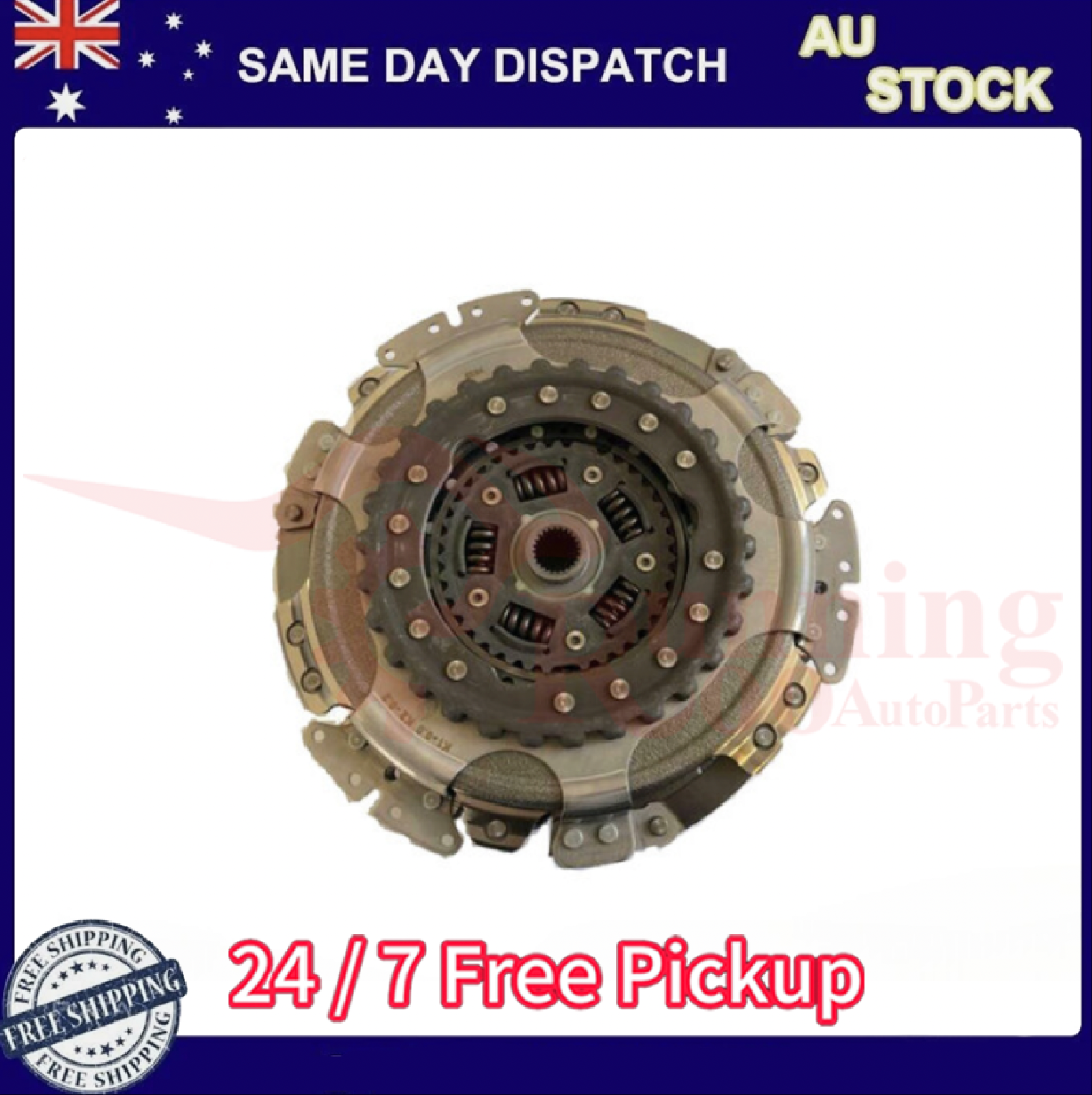
Watch what happens when a dry dual-clutch fails below, then browse the complete range on our eBay store.
Watch: What happens if a Volkswagen dry dual-clutch transmission fails?
You can also browse the full range here: RunningRoo Auto Parts on eBay Australia.
Not sure which DSG your car has, or which part you need? Our Aussie team can help you confirm it against your gearbox code.
RunningRoo Auto Parts – Based in Melbourne, Australia 🇦🇺
Free 24/7 Pickup Available (by appointment)
Any questions? Call us anytime: 0425 890 125
Why Choose RunningRoo? Aussie Owned & Operated | Fast Shipping | Friendly Support
Frequently asked questions
What is the difference between a dry and a wet DSG clutch?
A dry clutch operates in air, while a wet clutch is bathed in oil. The wet clutch is oil-cooled and more tolerant of torque, while the dry clutch is lighter and more efficient.
Which DSG is more reliable?
Neither is inherently more reliable, but the wet clutch is more forgiving under hard use and high torque, so it is generally the safer choice for heavier or higher-torque applications.
Is a DQ200 worse than a DQ250?
Not worse, just different. The DQ200 dry clutch is efficient and light but needs a gentler driving style, while the DQ250 wet clutch is more robust under load.
Does a DQ200 need clutch oil changes?
No, the dry clutch is not oil-bathed, but the mechatronic and gearbox still need servicing. The DQ250 wet clutch has a clutch oil circuit that does need servicing.
Which cars use the DQ200?
The DQ200 is used across a range of Volkswagen, Skoda, Seat and Audi models, commonly with lower-torque engines.
Which cars use the DQ250?
The DQ250 is used in higher-torque Volkswagen Group models, where the wet clutch is better suited to handling more power.
Can I swap a dry clutch for a wet clutch?
No. The gearbox is designed for one or the other, and the two clutch systems are not interchangeable.
Still have a question about your DSG? Call us anytime and we’ll help you get the right part.
RunningRoo Auto Parts – Based in Melbourne, Australia 🇦🇺
Free 24/7 Pickup Available (by appointment)
Any questions? Call us anytime: 0425 890 125
Why Choose RunningRoo? Aussie Owned & Operated | Fast Shipping | Friendly Support
References
Key data in this article is drawn from the following official manufacturer sources:
- Volkswagen Group — DQ200 7-speed dry-clutch DSG and DQ250 6-speed wet-clutch DSG technical documentation.
- Volkswagen Australia — DSG (DQ200) voluntary safety recall announcement, June 2013.