
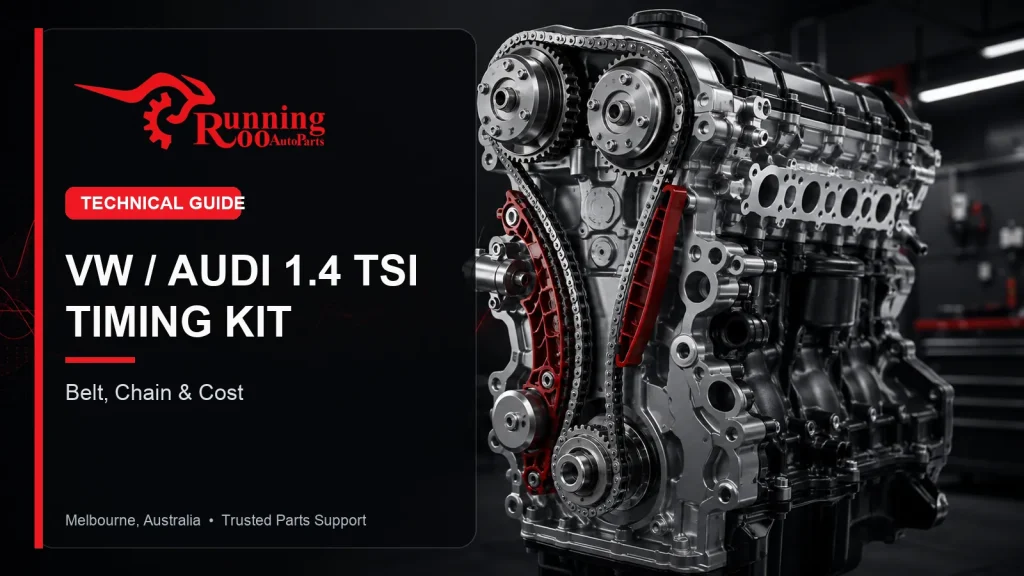
G’day everyone. I’m the Senior Product Manager here at RunningRoo Auto Parts, Australia’s trusted aftermarket automotive parts specialist. If you drive a Volkswagen, Audi, Skoda or Seat with the 1.4-litre TSI engine, you may be wondering whether the timing system uses a belt or a chain, and what happens when it needs attention. In this guide I’ll explain how the 1.4 TSI timing system works, the common failure modes, and what a replacement costs in Australia.
The 1.4 TSI is one of the most widely fitted engines in the Volkswagen Group range, so these questions come up constantly. The answer is not as simple as “it’s a chain” or “it’s a belt,” because the engine family uses a combination of a belt and an internal cam chain depending on the version.
Getting this right matters, because buying the wrong part or servicing only one half of the system can leave you with an engine that is still at risk.
Serving both the belt and the internal chain, when they are due, is the most reliable approach.
All prices below are in Australian dollars and are indicative only. If you would rather confirm the right kit for your exact engine code before reading further, our Melbourne-based team can help over the phone.
RunningRoo Auto Parts – Based in Melbourne, Australia 🇦🇺
Free 24/7 Pickup Available (by appointment)
Any questions? Call us anytime: 0425 890 125
Why Choose RunningRoo? Aussie Owned & Operated | Fast Shipping | Friendly Support
Does the 1.4 TSI use a timing belt or a chain
The answer depends on the engine code. Many 1.4 TSI engines use a timing belt to drive the camshaft, while the camshafts themselves are connected to each other by an internal chain. This means the engine has both a belt and a chain, each doing a different job.
The belt is the component that needs to be replaced on a service interval, usually at a set kilometre or age mark. The internal cam chain is designed to last the life of the engine but can still become noisy if the tensioner or guides wear.
Because of this layout, a 1.4 TSI timing job often involves replacing the belt and tensioner, and in some cases the internal chain components as well, depending on the engine and its age.
The good news is that the 1.4 TSI is a well-understood engine, and a timing kit replacement is a routine job for any workshop that works on Volkswagen Group vehicles regularly.
Common 1.4 TSI timing symptoms
A timing belt on a 1.4 TSI usually needs replacing on schedule rather than when it fails, but a worn belt can make a ticking or slapping noise. An internal chain that has stretched can produce a cold-start rattle from the front of the engine.
Other symptoms include a check engine light with a camshaft correlation code, a rough idle, a loss of power and, in severe cases, a no-start if the belt has jumped. The table below lists the signs and their urgency.
If the engine logs a camshaft correlation code, that is a strong signal that the valve timing has drifted, either because the belt has slipped a tooth or because the internal chain has stretched. Either way it should be investigated promptly.
| Symptom | What it usually means | Urgency |
|---|---|---|
| Cold-start rattle | Worn cam chain / tensioner | High — inspect soon |
| Ticking / slapping noise | Worn belt or tensioner | High |
| Check engine light | Cam correlation code | High — scan now |
| No start | Belt jumped or snapped | Critical — do not drive |
Which engine codes are affected
Common 1.4 TSI engine codes include the CAXA, CAVD, CTHD and BWK variants, which are fitted across a wide range of Volkswagen, Audi, Skoda and Seat models. The exact timing components differ between these codes and model years.
Because the timing layout can vary, it is essential to confirm your exact engine code before ordering parts. A VIN check is the quickest way to be sure you are buying the correct belt and chain kit.
| Engine code | Timing layout | Common models |
|---|---|---|
| CAXA | Belt + cam chain | VW Golf, Audi A3, Skoda Octavia |
| CAVD | Belt + cam chain | VW, Audi, Seat |
| CTHD | Belt + cam chain | VW, Skoda |
What a complete timing kit should include
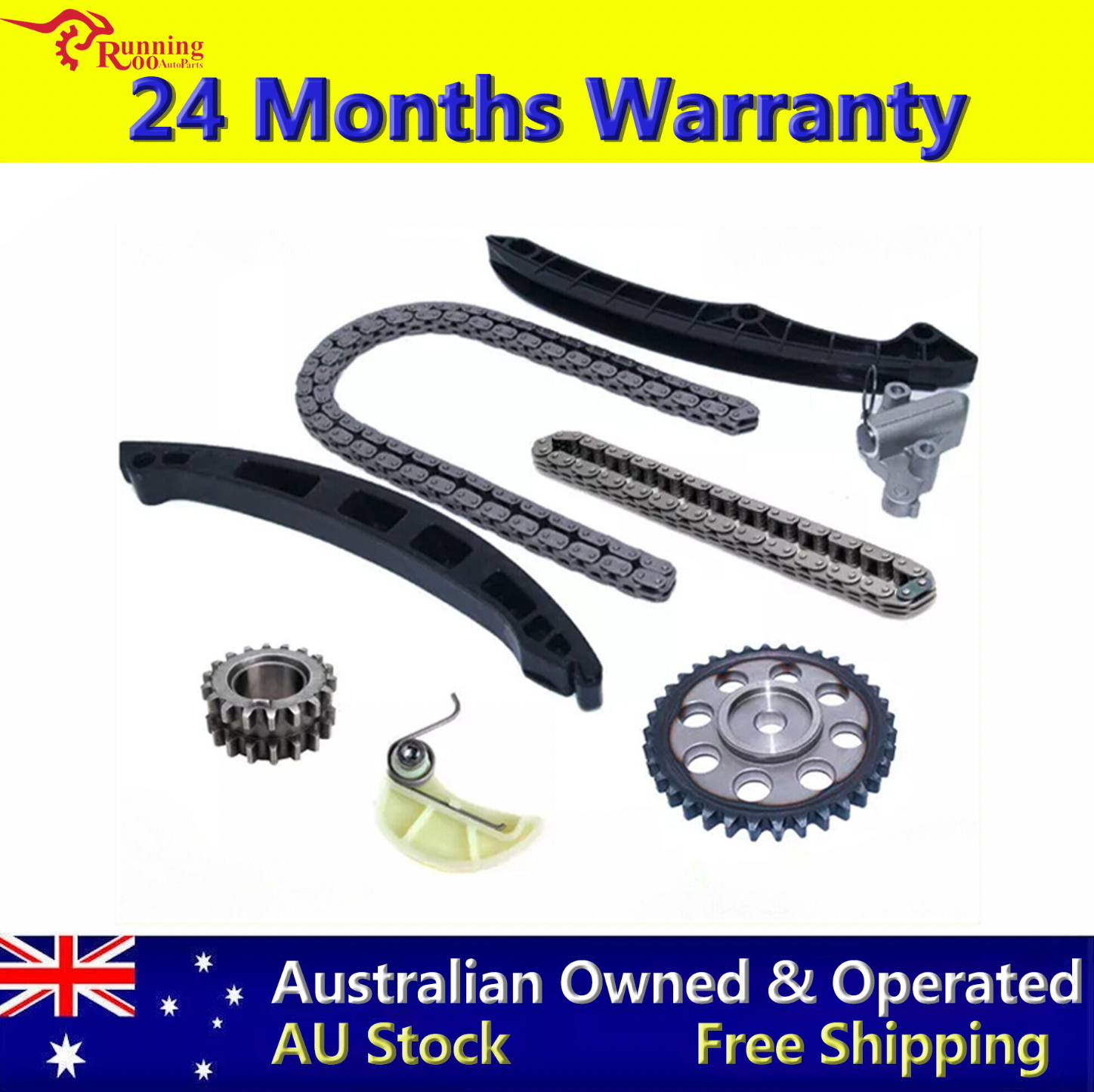
For a 1.4 TSI timing job, a complete kit should include the timing belt, the tensioner and the idler pulleys, along with the required gaskets and seals. If the internal cam chain is also being replaced, the chain, guides and tensioner should be included as well.
Buying a complete kit rather than just a belt is the safer approach, because the tensioner and pulleys wear alongside the belt. Fitting a new belt against an old tensioner is a common cause of a premature failure.
The table below shows what a complete kit should include, so you can compare quotes and avoid buying a bare belt.
| Component | Why it matters |
|---|---|
| Timing belt | The main drive component |
| Tensioner | Keeps the belt tight |
| Idler pulleys | Guide the belt |
| Chain / guides | Internal cam drive |
How much does a 1.4 TSI timing kit replacement cost
A 1.4 TSI timing belt replacement is a routine job and is generally less expensive than a full chain replacement. The parts cost is moderate, and the labour is well understood, so the total is usually in the low-to-mid range.
The chart below compares the indicative cost of parts, a workshop replacement and a dealer replacement, using Australian figures.
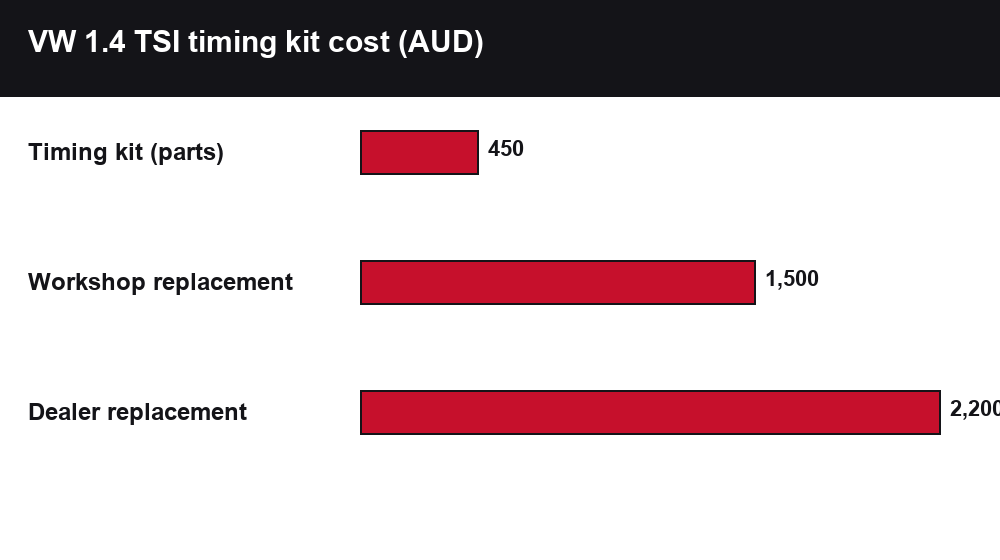
These figures are a guide only. The exact cost depends on your engine code, whether the water pump is included and whether you use a workshop or do the job yourself.
Why you should follow the service interval
A timing belt has a known lifespan, and it is designed to be replaced before it fails rather than after. If the belt snaps on an interference engine, the pistons can strike the valves and cause a major repair.
Following the manufacturer’s replacement interval, and replacing the belt, tensioner and pulleys as a kit, is the cheapest insurance you can buy for a 1.4 TSI engine.
If you have bought a used 1.4 TSI, confirm the belt has been replaced at the correct interval and budget for it if it has not.
How the timing system is checked
A specialist will inspect the belt for cracks, glazing or missing teeth, and check the tensioner for wear. The internal chain can be checked for stretch and the guides for wear, although this often requires removing the timing cover or the valve cover.
Reading the fault codes is also important, because a camshaft correlation code will often appear before the belt or chain fails completely. This early warning is what allows you to catch a problem before it becomes a major engine repair.
Preventing timing belt and chain failure
The simplest protection is to follow the service schedule and replace the belt, tensioner and pulleys as a complete kit. Reusing an old tensioner with a new belt is a false economy, because the tensioner is often the component that fails first.
For the 1.4 TSI, using the correct oil specification is also important, because the internal cam chain and tensioner rely on clean oil. Regular oil changes keep the chain quiet and prevent premature wear.
Buying a used 1.4 TSI
If you are looking at a used Volkswagen Group car with a 1.4 TSI, ask for the service history and confirm the timing belt has been replaced at the correct interval. If it has not, budget for it, because driving on an overdue belt is risky.
A cold-start listen and a scan for stored fault codes will also tell you a lot about the health of the timing system before you commit to the purchase.
With a properly serviced timing system, the 1.4 TSI is a smooth, efficient and reliable engine, and a well-maintained car can go for very high kilometres without any timing problems.
One of the most common questions we get is whether the belt and chain should be replaced at the same time. In most cases the answer is yes if the engine is being opened for a timing job, because the cost of the additional components is small compared with the labour to access them.
For an engine that is already at a high kilometre count, replacing the internal chain, guides and tensioner at the same time as the belt is a sensible precaution. It avoids the risk of the chain failing a short time after the belt has been replaced.
If you are unsure whether your engine’s timing system needs both a belt and chain kit, or just a belt, a quick check of your engine code against the correct parts list will answer it. This is exactly the kind of question our team can help with over the phone.
Remember that a timing belt job is not the place to save money by using the cheapest parts. A quality kit from a reputable supplier, fitted and timed correctly, is what protects the engine’s valves and keeps the car reliable for years to come.
Where to buy a 1.4 TSI timing kit
RunningRoo Auto Parts stocks timing kits and chain components for the 1.4 TSI and related Volkswagen Group engines, at a fraction of typical retail pricing with Melbourne pickup and Australia-wide delivery.
- 1.4 TSI Timing Kit for VW / Audi / Skoda / Seat (CAXA CAVD CTHD BWK)
- 1.8 / 2.0 TFSI Timing Chain Kit for Audi / Seat
- 12-Piece EA888 Timing Chain Tensioner Kit for Audi / VW / Skoda
Watch a short overview of our timing kits below, then browse the complete range on our eBay store.
Watch: RunningRoo Auto Parts — high-quality OEM timing kits and VVT gears
You can also browse the full range here: RunningRoo Auto Parts on eBay Australia.
Not sure which kit fits your 1.4 TSI? Our Aussie team can confirm it against your engine code.
RunningRoo Auto Parts – Based in Melbourne, Australia 🇦🇺
Free 24/7 Pickup Available (by appointment)
Any questions? Call us anytime: 0425 890 125
Why Choose RunningRoo? Aussie Owned & Operated | Fast Shipping | Friendly Support
Frequently asked questions
Does the 1.4 TSI have a timing belt or chain?
Most 1.4 TSI engines use a timing belt to drive the camshaft and an internal chain between the camshafts, so they have both. You need to confirm your engine code to be sure.
How often do you need to replace a 1.4 TSI timing belt?
The belt is replaced on a fixed interval per the manufacturer’s schedule, usually every 90,000 to 160,000 kilometres or a set number of years, whichever comes first.
How much does a 1.4 TSI timing kit cost?
In Australia a timing belt replacement with a complete kit is typically in the low-to-mid range, with dealer prices higher again.
Can I replace a 1.4 TSI timing belt myself?
It is possible for an experienced mechanic with the correct tools and locking procedure, but it is not a beginner job because incorrect timing can damage the engine.
What are the symptoms of a worn 1.4 TSI timing chain?
A cold-start rattle, a check engine light with a cam correlation code, rough idle and power loss are the main signs.
Which cars use the 1.4 TSI engine?
The 1.4 TSI is fitted across a wide range of Volkswagen, Audi, Skoda and Seat models, including the Golf, Octavia, Leon and A3.
Should I replace the water pump with the timing belt?
On many engines the water pump is driven by the timing belt and is replaced at the same time, because the labour is already being paid for.
Still have a question about your 1.4 TSI? Call us anytime and we’ll help you get the right kit.
RunningRoo Auto Parts – Based in Melbourne, Australia 🇦🇺
Free 24/7 Pickup Available (by appointment)
Any questions? Call us anytime: 0425 890 125
Why Choose RunningRoo? Aussie Owned & Operated | Fast Shipping | Friendly Support
References
Key data in this article is drawn from the following official manufacturer sources:
- Volkswagen Group — 1.4 TSI (EA111 / EA211 family) engine technical documentation, timing belt and camshaft chain system description.
- Volkswagen Group — factory service schedules and timing belt replacement interval specifications.