
By RunningRoo Auto Parts — written from the desk of our Product Manager
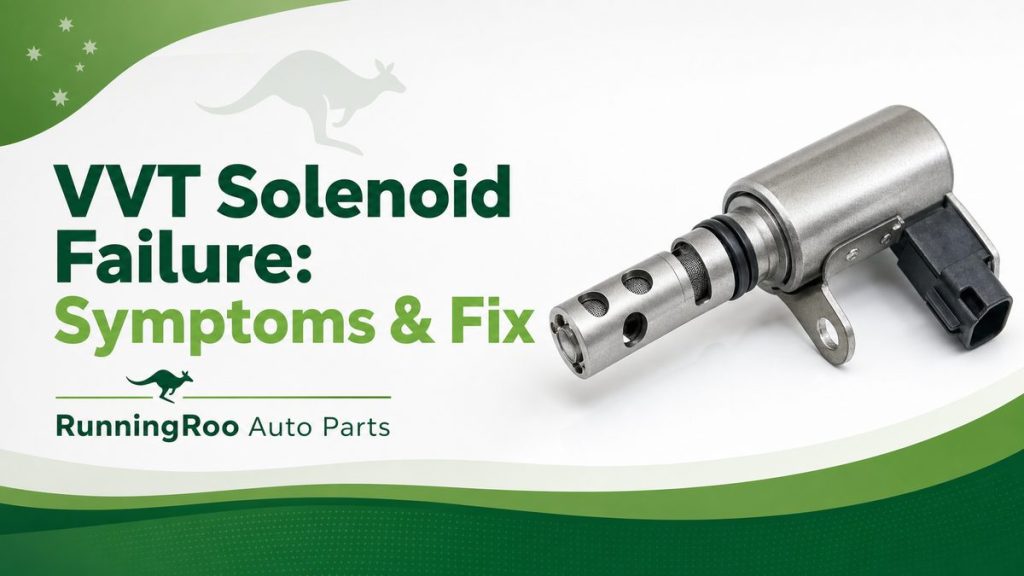
Variable valve timing depends on a small but critical part: the oil control valve, usually called a VVT solenoid or OCV. This solenoid directs pressurised engine oil into the camshaft phaser to advance or retard the valve timing, and when it sticks, leaks or fails electrically, the whole VVT system stops working correctly. The symptoms can look expensive, but the fix is often a single bolt-on solenoid that costs a fraction of a camshaft phaser. This guide explains what the VVT solenoid does, how to recognise a failing one and how to replace it without throwing money at the wrong part.
RunningRoo Auto Parts – Based in Melbourne, Australia 🇦🇺
Free 24/7 Pickup Available (Contact 0425890125)
Any questions? Message or Call us anytime! We’re here to help.
Why Choose RunningRoo?
Aussie Owned & Operated | Fast Shipping | Friendly Support
What the VVT oil control valve does
The oil control valve is an electrically operated spool valve bolted to the cylinder head or timing cover. The engine computer sends it a pulse-width-modulated signal, and the valve slides to open and close the oil passages that feed the camshaft phaser. More oil pressure on one side of the phaser advances the cam, and pressure on the other side retards it, so the solenoid is effectively the tap that controls the phaser.
Because the solenoid is both electrical and hydraulic, it can fail in two ways: electrically, when the coil winding or connector breaks, or hydraulically, when dirt, sludge or a worn spool causes it to stick. Both failures produce the same broad symptom — incorrect valve timing — which is why a correct diagnosis looks at the oil, the wiring and the solenoid together rather than assuming the camshaft phaser itself has failed.
The symptoms of a failing VVT solenoid
The classic signs are a rough or hunting idle, reduced power and throttle response, a drop in fuel economy, and a check-engine light with VVT-related codes such as P0010 to P0025 or P0340/P0341. Because the solenoid controls oil flow to the phaser, a sticking solenoid can also cause a rattle from the camshaft area as the phaser flutters between positions without enough oil pressure to hold it steady.
In severe cases the engine may enter a limp mode or fail an emissions test. The important point is that these symptoms overlap heavily with a failed camshaft phaser, a blocked oil passage or low oil, which is why the solenoid should be tested before anything expensive is replaced.
| Symptom | Possible cause | First check |
|---|---|---|
| Rough idle + P0010–P0025 | VVT solenoid circuit or valve | Scan codes; test solenoid resistance and operation |
| Power loss + poor economy | Sticking solenoid or phaser | Check oil level/quality; test solenoid |
| Cam rattle on idle | Low oil pressure to phaser | Oil pressure test; inspect solenoid |
| Code returns after oil change | Solenoid or wiring | Ohm-test solenoid; check connector |
How to test a VVT oil control valve
Start with a full scan to capture the exact code, then check the oil level and condition, because a solenoid cannot work correctly without clean oil at the right pressure. Test the solenoid’s electrical winding with a multimeter against the manufacturer’s specification, and apply 12 volts briefly to confirm the spool clicks. A click does not prove the valve seals correctly under pressure, but it rules out an electrical failure.
The most conclusive test is to remove the solenoid and inspect the spool and screens for sludge, metal particles and sticking. If the spool is dirty or the screens are blocked, cleaning may restore function temporarily, but a solenoid that has been contaminated is best replaced, because the internal wear that caused the sticking will not reverse itself.
Solenoid, phaser or oil — telling them apart
The VVT solenoid, the camshaft phaser and the engine oil form a single system, and each can cause the others’ symptoms. A solenoid that tests good electrically but still sets VVT codes points to the phaser or an oil-pressure problem. A phaser that rattles but holds timing may simply be starved of oil by a blocked solenoid. This is why a methodical diagnosis always beats a parts cannon.
The cheapest and most common first step is an oil and filter change, because fresh oil fixes a surprising number of VVT faults that are really just sludge. If the fault persists, replace the solenoid — the inexpensive, accessible part — before condemning the phaser, which is far more labour to change.
Replacing the VVT solenoid correctly
On most engines the solenoid is held by one or two bolts and is accessible from the top of the engine. Disconnect the connector, unbolt the old solenoid, fit the new one with a new O-ring or seal where supplied, and torque the bolt correctly. Always use the correct specification oil and change the filter at the same time, because a new solenoid fitted into a dirty engine will fail again quickly.
After fitting, clear the fault codes and confirm the engine idles smoothly and the code does not return. If the code comes straight back, the problem was not the solenoid, and the wiring, oil pressure or phaser needs further investigation.
The most common VVT solenoid fault codes
The codes that point to a VVT oil control valve problem are the P0010 to P0025 range. On a typical four-cylinder, P0010 and P0013 refer to the intake-side VVT solenoid circuit, while P0011 and P0014 indicate the intake camshaft timing is over-advanced or over-retarded. P0020 and P0023 are the equivalent codes for the exhaust side, and P0021 and P0024 are the exhaust timing codes. On V6 and V8 engines the same families repeat for each bank.
A circuit code such as P0010 usually means an electrical problem in the solenoid or its wiring, while a timing code such as P0011 means the valve timing is actually wrong — which can be caused by a sticking solenoid, a blocked oil passage, a failed phaser or a stretched chain. This is why the same symptom can have several causes, and why the solenoid, oil and phaser must each be checked before parts are replaced.
Why fresh oil fixes so many VVT faults
The VVT solenoid and the camshaft phaser are both oil-actuated, which makes the engine oil the most important part of the diagnosis. Sludge from extended oil-change intervals is the number one cause of a sticking solenoid, because the tiny spool and its screens clog with deposits that stop the valve moving freely. A car that presents with a P0011 or P0014 code and dirty oil will often respond to a simple oil and filter change before any parts are needed.
This is also why a new solenoid should always be paired with fresh oil of the correct specification. Fitting a clean solenoid into a dirty engine simply transfers the contamination to the new part, and the fault returns within weeks. The oil change is not an optional extra in this repair — it is part of the fix.
Maintaining the VVT system for long life
The VVT system only works as well as the oil that feeds it, so the single most important maintenance habit is to use the correct specification oil and change it on schedule. Many VVT solenoid and phaser failures are really oil failures in disguise — sludge from extended intervals clogs the tiny spool and its screens, and the wrong oil grade changes the pressure the phaser relies on. A car that has a documented service history with the correct oil rarely suffers an early VVT fault.
It is also worth addressing any VVT-related fault code promptly rather than letting it linger. A sticking solenoid left unrepaired forces the phaser to work against restricted oil flow, which accelerates wear in the far more expensive mechanical parts. Catching the problem at the solenoid stage — a cheap, accessible part — is how you avoid a camshaft phaser or timing-chain repair later.
Finally, remember that the VVT system shares its oil with the whole engine. A blocked oil filter, a low oil level or a failing oil pump will all present first through the VVT system, because the solenoid and phaser are the most sensitive consumers of oil pressure. If a new solenoid does not cure the fault, look upstream at the oil supply before condemning the phaser.
Frequently asked questions
What is a VVT oil control valve?
It is the solenoid that controls pressurised engine oil flowing to the camshaft phaser, allowing the engine computer to advance or retard valve timing.
What are the symptoms of a bad VVT solenoid?
A rough idle, loss of power, poor fuel economy and VVT-related fault codes such as P0010–P0025, sometimes with a rattle from the camshaft area.
Can I clean a VVT solenoid instead of replacing it?
Cleaning can temporarily help if the spool is sludged, but a contaminated or worn solenoid is best replaced, because the wear that caused the sticking remains.
Is a VVT solenoid the same as a camshaft phaser?
No. The solenoid controls the oil flow, and the phaser is the mechanical adjuster on the camshaft that the oil actuates.
How much does a VVT solenoid cost in Australia?
A quality aftermarket solenoid is inexpensive, and the job is usually quick because the solenoid is accessible. Always confirm fitment by engine code.
Can low oil cause a VVT solenoid fault?
Yes. The solenoid is hydraulically actuated, so low level, the wrong specification or sludged oil can mimic or cause a solenoid fault.
What does code P0011 mean?
It means the intake camshaft timing is over-advanced. It can be caused by a sticking VVT solenoid, a blocked oil passage, a failed phaser or a stretched chain, so it needs proper diagnosis.
Should I change the oil when replacing a VVT solenoid?
Yes, always. Fresh oil of the correct specification is essential, because sludge is the main cause of solenoid failure and a new solenoid will clog again in a dirty engine.
Will a VVT solenoid fault always turn on the check-engine light?
Usually, because the engine computer monitors the VVT solenoid circuit and the resulting timing, so a fault normally sets a code. Occasionally a sticking solenoid can cause rough running before the code appears.
How often should I change the oil to protect the VVT system?
Follow the manufacturer’s interval and use the correct specification oil. Clean, correctly specified oil is the single best protection for the VVT solenoid and phaser.
Shop the parts mentioned in this guide
- VVT Oil Control Valve for Mazda CX-7 / 5 / 6, MX-5 Miata, Tribute L3K9-14-420A
- 2x Variable Timing Oil Control Valves for Mercedes-Benz SLK200 W204 2710500578
- Oil Control Valve Solenoid for Jeep / Dodge / Chrysler 3.2–3.6L V6 5184150AF
- Engine Oil Control Solenoid Set (RH/LH) for Lexus RX / Toyota Camry 3.0L
Watch on RunningRooAuto YouTube
- RunningRoo Auto Parts – trusted Melbourne parts support
- RunningRoo Auto Parts – product and fitment channel
RunningRoo Auto Parts – Based in Melbourne, Australia 🇦🇺
Free 24/7 Pickup Available (Contact 0425890125)
Any questions? Message or Call us anytime! We’re here to help.
Why Choose RunningRoo?
Aussie Owned & Operated | Fast Shipping | Friendly Support
Sources and further reading
- Variable valve timing — Wikipedia
- BorgWarner — variable cam timing systems
- Bosch — engine management
- RACV — car maintenance and repair guidance
RunningRoo Auto Parts – Based in Melbourne, Australia 🇦🇺
Free 24/7 Pickup Available (Contact 0425890125)
Any questions? Message or Call us anytime! We’re here to help.
Why Choose RunningRoo?
Aussie Owned & Operated | Fast Shipping | Friendly Support