
By RunningRoo Auto Parts — written from the desk of our Product Manager
If you own a Volkswagen, Audi, Škoda or SEAT fitted with the 7-speed DQ200 dual-clutch gearbox, there is a fair chance you have searched the web for a replacement TCM (Transmission Control Module) or mechatronic unit. The DQ200 is one of the most common automatic transmissions on Australian roads, and its combined mechatronic/TCU design is also the component most often blamed when the gearbox starts jerking, losing drive or throwing a warning light. A brand-new unit from the dealer can cost more than the car is worth, so many Australian owners understandably turn to the second-hand market. This guide, written from a product manager’s perspective here at RunningRoo in Melbourne, explains exactly what you are buying, where the hidden risks are, and how to protect yourself.
RunningRoo Auto Parts – Based in Melbourne, Australia 🇦🇺
Free 24/7 Pickup Available (Contact 0425890125)
Any questions? Message or Call us anytime! We’re here to help.
Why Choose RunningRoo?
Aussie Owned & Operated | Fast Shipping | Friendly Support
What the DQ200 TCM and mechatronic unit actually do
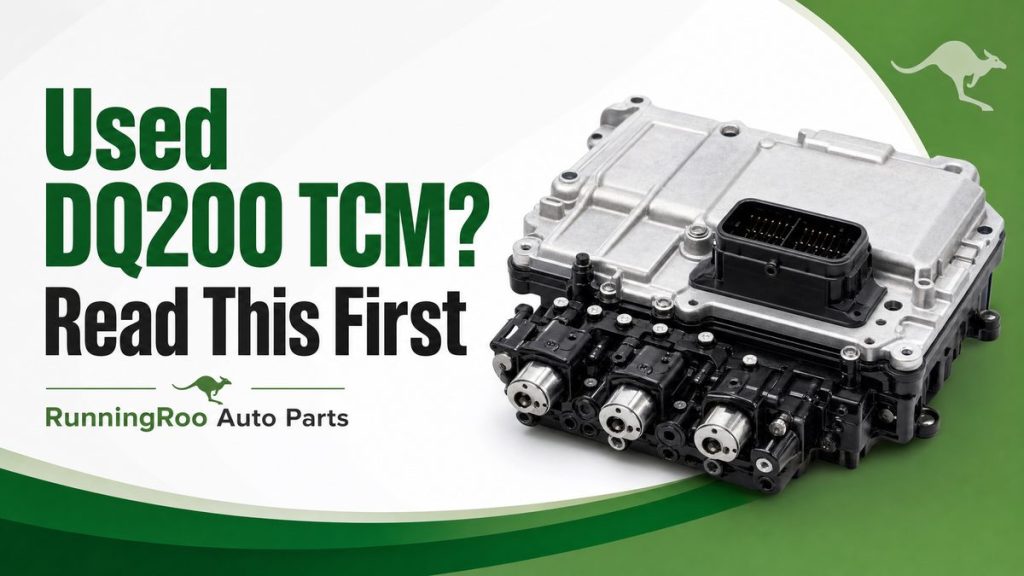
The DQ200 (Volkswagen internal code 0AM) is a seven-speed, dry-clutch direct-shift gearbox. Unlike a conventional automatic, it has no torque converter and, unlike a wet DSG such as the DQ250, its clutches run dry rather than in an oil bath. Two sub-systems are bolted together inside the transmission housing: the electro-hydraulic mechatronic unit and the TCU electronics that control it.
In the DQ200, these two functions are physically combined into a single assembly. The mechatronic unit contains the hydraulic pump, accumulator, solenoid valves and the gear-shift forks that move the synchros, while the attached electronic module (often called the TCM or TCU) reads the input-speed, output-speed, pressure and temperature sensors and drives those solenoids in real time. When the industry talks about “DQ200 TCM failure”, it is usually talking about a fault somewhere in this combined electro-hydraulic package rather than a simple wiring problem.
The most common genuine failure modes our team sees are hydraulic pressure loss from a cracked accumulator body, a failed internal pump, worn or sticking solenoids, and electronic faults in the TCU such as corrupted memory, failed CAN communication or the well-documented “lost communication with TCM” code. Because the module is coded to the vehicle and protected by Volkswagen’s component-protection system, it is not a simple plug-and-play part.
Why so many DQ200 units are sold second-hand
The DQ200 was fitted to a huge range of small and mid-size VW Group models, including the Golf, Jetta, Passat, Polo, Caddy, Tiguan, Škoda Octavia and Superb, SEAT Leon and Audi A1 and A3. It was produced in enormous numbers from around 2008 onwards, which means there is a large global pool of donor cars, written-off vehicles and dismantled gearboxes feeding the used-parts market.
That supply is both good and bad news for buyers. It is good because genuine, good-condition units are genuinely available at a fraction of the dealer price. It is bad because the same popularity attracts poorly tested “pull-out” units, mislabelled part numbers and sellers who cannot tell you whether a unit has been tested on a bench, on a vehicle, or not at all. In Australia specifically, the second-hand market is a mix of local dismantlers, interstate sellers and imported units, and the origin of a unit matters because a unit from a corroded or flood-damaged vehicle can fail again within weeks.
Used vs refurbished vs new: what the labels really mean
One of the most confusing parts of shopping for a DQ200 unit is the vocabulary. The same physical part is sold as “used”, “tested”, “repaired”, “remanufactured”, “refurbished” or “new”, and those words do not mean the same thing. The table below summarises what each label should imply and what to ask the seller.
| Type | What it usually means | What to confirm with the seller | Typical risk level |
|---|---|---|---|
| New / genuine OEM | A brand-new module from the manufacturer’s supply chain | Part number and vehicle coding; component protection removal | Lowest (highest price) |
| Remanufactured | Disassembled, rebuilt with new wear items and re-tested to a written procedure | Exactly what was replaced and what test report is supplied | Low |
| Repaired / refurbished | A specific known fault (e.g. accumulator, TCU board) was fixed; not a full rebuild | Which fault was fixed, which parts were used and the test result | Low–medium |
| Tested used | A second-hand unit that has been plugged in and checked, often on a bench | What “tested” means — bench power-on, valve actuation or full road test | Medium |
| Untested “pull-out” | Removed from a donor vehicle and sold as-is | Nothing can be guaranteed; treat as a core | High |
The single most important question to ask any seller is not “does it work?” but “what did you actually test, and can you show me the report?”. A unit that powers up on a bench is not the same as a unit that has been road-tested through all seven gears and confirmed free of pressure faults.
The real risks of buying a used DQ200 TCM in Australia
The first risk is fitment and part-number confusion. The DQ200 mechatronic was revised several times during its life, with common part numbers including 0AM927769D, 0AM927769E, 0AM927769G and 0AM927769K, and the later 0CW-generation units. A unit with the wrong index letter, or one that has been flash-updated to a different software version, may not communicate correctly with your car even if it physically bolts in. Always match the original part number on the old unit rather than trusting a generic listing that says “fits Golf”.
The second risk is coding and component protection. Volkswagen Group vehicles use component protection to tie certain modules to the vehicle. A second-hand TCU typically will not simply work after installation; it must be unlocked, coded and adapted using a suitable diagnostic tool such as VCDS or ODIS, and it needs a basic-settings routine so the gearbox can re-learn clutch touch points and shift timing. If the seller cannot supply the unit in a state that your workshop can code, the saving can quickly disappear in labour.
The third risk is misrepresented condition. Because the DQ200 mechatronic is sealed and the faults are often internal, a cosmetically clean unit can still have a cracked accumulator or a worn pressure valve. Photographs are not enough; you need a seller who can demonstrate testing and who stands behind the part with a warranty.
The fourth risk is consumer protection. Used parts bought from an Australian business are covered by the Australian Consumer Law consumer guarantees, which require the part to be of acceptable quality and fit for purpose, but a private seller or an overseas seller may leave you with little practical recourse if the unit fails. The ACCC’s consumer guarantees page explains these rights in detail (see Sources).
A 10-point checklist before you buy
- Read the code first. Confirm the fault is actually the TCM/mechatronic and not a battery, earth, wiring or clutch problem. A proper scan is far cheaper than a wrong purchase.
- Match the part number. Read the number off your original unit (e.g. 0AM927769K) and match the index letter, not just “DQ200”.
- Confirm the generation. Establish whether your car uses the earlier 0AM unit or the later 0CW unit, and whether your vehicle is MQB or PQ-platform.
- Ask what “tested” means. Request the specific test performed — bench, hydraulic or road test — and a written result.
- Ask for the failure history. A repaired unit should come with a clear description of what was fixed and which parts were replaced.
- Check coding readiness. Confirm whether the unit will need component-protection removal, coding and basic settings, and who will do it.
- Confirm the warranty. Get the warranty period in writing and understand what it covers (unit only, or also labour).
- Verify the seller. Prefer an established Australian seller with real reviews and a physical address rather than an anonymous listing.
- Check the return policy. A “no returns” policy on a high-value electrical part is a red flag.
- Budget for the complete job. Include oil, filter, a proper scan and the coding/adaptation labour, not just the part price.
Why coding and basic settings matter
Even a perfect second-hand DQ200 unit will not behave correctly without adaptation. The gearbox controller stores learned values for clutch kiss points, shift-fork positions and solenoid behaviour. After a unit swap, a workshop must run the basic-settings procedure so the new module can calibrate to your exact clutches and forks. Skipping this step is one of the most common causes of a “good” second-hand unit that still jerks, flares or drops into limp mode after installation.
This is why we always tell Australian owners to factor in the diagnostic and coding labour up front. A cheap unit is a false economy if you also need an hour or two of specialist programming, and it is exactly the kind of hidden cost that turns a “bargain” into an expensive exercise in frustration.
Frequently asked questions
Is it safe to buy a used DQ200 mechatronic unit?
It can be, provided you match the part number, buy from a seller who tests the unit and backs it with a warranty, and factor in coding and adaptation labour. An untested “pull-out” unit is a gamble.
What is the difference between a TCM and a TCU?
The terms are used interchangeably for the DQ200. The transmission control module (TCM) and transmission control unit (TCU) both refer to the electronic controller that, in the DQ200, is combined with the hydraulic mechatronic unit.
Can I fit a used DQ200 unit myself?
Physically removing and refitting the mechatronic is possible for a confident DIYer with the right tools, but coding, component-protection removal and basic settings generally require specialist diagnostic equipment. Most Australian owners use a VW specialist workshop for the programming stage.
Will a second-hand unit work without coding?
Usually not. Component protection and vehicle coding mean the unit must be matched to the car before it will operate normally.
How do I know whether my car has a 0AM or 0CW unit?
Check the part number on the original unit or the vehicle data sticker, and confirm with your workshop. The 0CW is the later revision of the same 7-speed dry-clutch family.
What warranty should I expect on a used unit?
Reputable Australian sellers typically offer at least 90 days and often longer. Always get the terms in writing and confirm whether labour is included.
Shop the parts mentioned in this guide
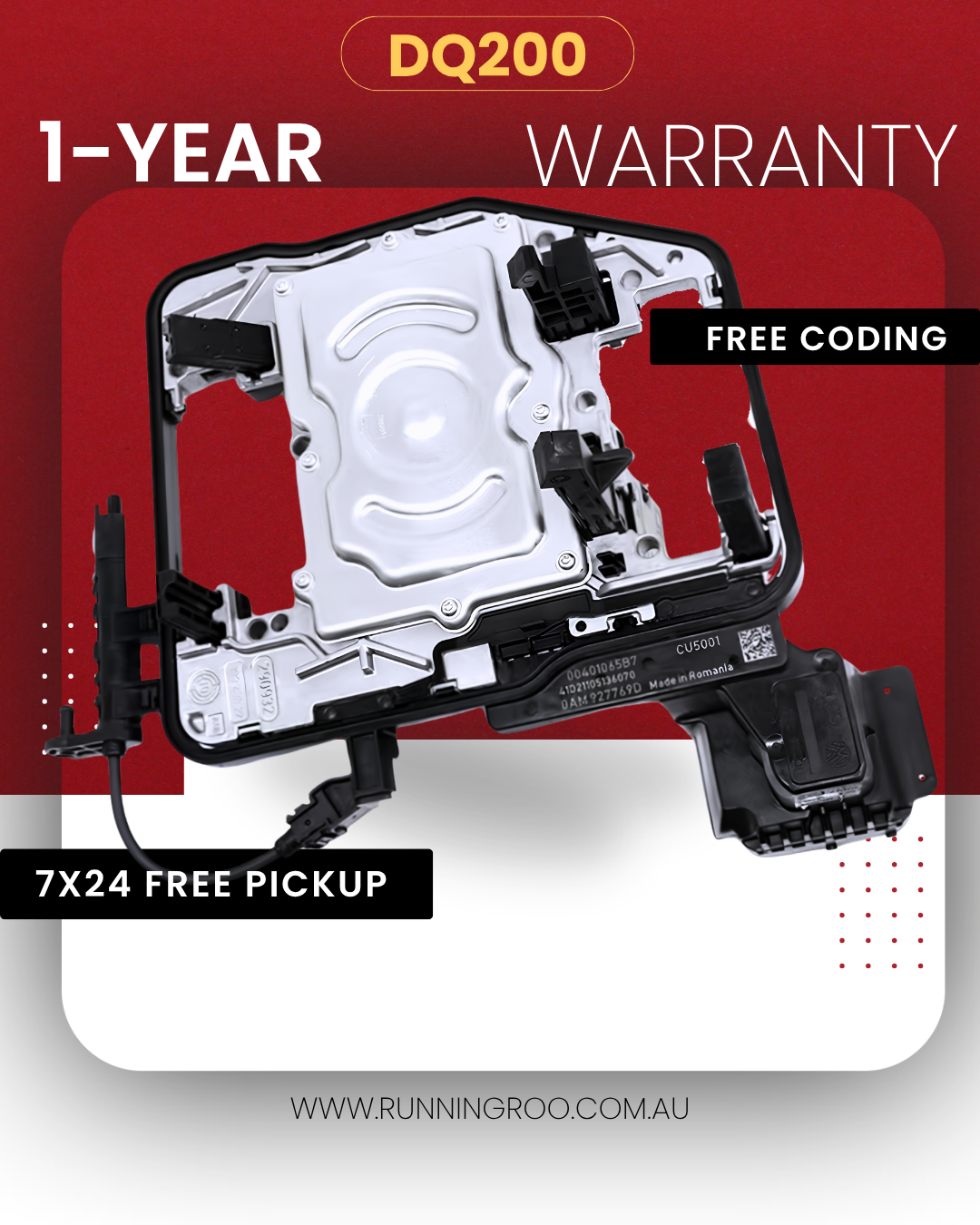
- DQ200 0AM 7-Speed DSG Mechatronic (Valve Body & TCU) — 0AM927769D + programming
- DQ200 0AM Transmission Control Module (TCU) for Audi / VW — 0AM927769D
- DQ200 0AM TCU 0AM927769K for Audi / VW — eBay
- DQ200 0AM Transmission Control Module (TCU) 0AM927769K — eBay
Watch on RunningRooAuto YouTube
- RunningRoo Auto Parts – trusted Melbourne parts support
- RunningRoo Auto Parts – product and fitment channel
RunningRoo Auto Parts – Based in Melbourne, Australia 🇦🇺
Free 24/7 Pickup Available (Contact 0425890125)
Any questions? Message or Call us anytime! We’re here to help.
Why Choose RunningRoo?
Aussie Owned & Operated | Fast Shipping | Friendly Support
Sources and further reading
- Direct-shift gearbox — Wikipedia (DQ200 0AM technical overview)
- Consumer rights and guarantees — Australian Competition & Consumer Commission (ACCC)
- BorgWarner — dual-clutch and transmission control systems
- Volkswagen Australia
RunningRoo Auto Parts – Based in Melbourne, Australia 🇦🇺
Free 24/7 Pickup Available (Contact 0425890125)
Any questions? Message or Call us anytime! We’re here to help.
Why Choose RunningRoo?
Aussie Owned & Operated | Fast Shipping | Friendly Support