
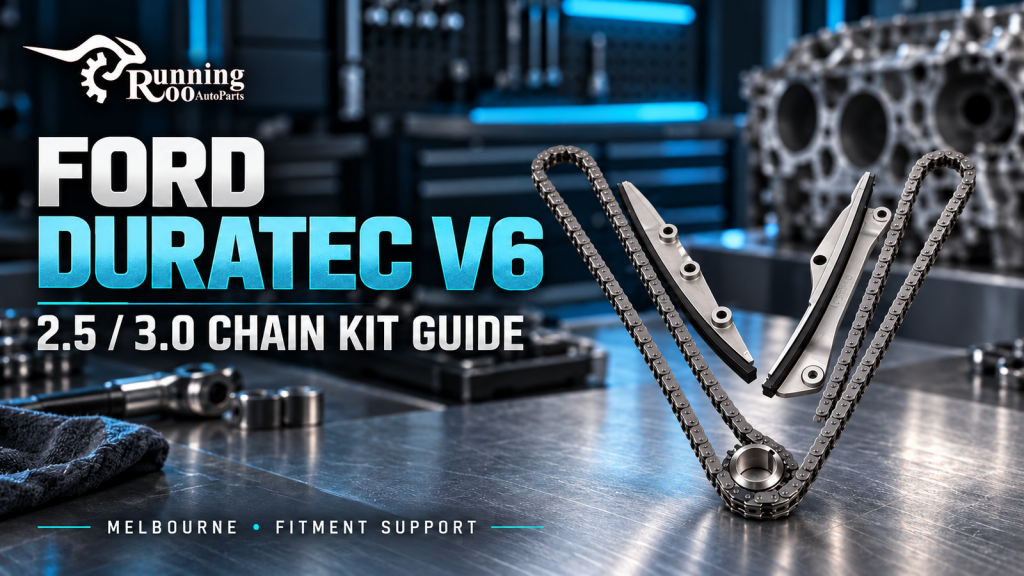
The name Duratec is not precise enough to select a timing chain kit. A buyer needs the engine configuration, vehicle identification and required part references, especially when shopping for an older imported Ford or Mercury application. This guide focuses on RunningRoo’s early 2.5/3.0-litre V6 listing and explains how to compare its two-chain package with the workshop’s actual repair requirements.
The RunningRoo early Duratec V6 timing kit and matching RunningRoo eBay item were checked as available on 14 October 2026. Call 0425 890 125 with your VIN, engine code and OE references for friendly support. RunningRoo is Australian-operated in Melbourne, offering local pickup in Blackburn by appointment and fast dispatch options to confirm for the current item and destination.

Begin with the exact engine, not just “Ford V6”
The seller’s description identifies selected older Contour, Taurus, Cougar, Mystique, Sable and Lincoln LS applications with 2.5 or 3.0-litre DOHC V6 descriptions. Those are catalogue leads rather than a universal compatibility statement. This article does not extend the package to every vehicle called Duratec, every Taurus generation or another Ford V6 of similar capacity.
Ford’s official 1999 Taurus owner guide distinguishes different engine configurations within the same model family, including the 3.0-litre Duratec and other engines. It is a useful example of why a model name and displacement can still leave uncertainty. The owner’s guide is not a timing-kit fitment approval or a workshop replacement procedure. Ford Taurus owner guide.
Send the complete VIN, engine identification, build date and original market when enquiring. If the vehicle was imported into Australia, include any workshop-confirmed information about its original specification. If the engine has been replaced, say so. The proposed kit must match the installed configuration and the required references, not merely the description on an old registration record.
Read the advertised application range carefully
The product title refers to 1995–2000 applications, while the written application section includes some entries with different ending years. Treat that as a prompt for a specific fitment check. Do not silently choose the wider range or assume that the title overrides every line of the description. Ask the supplier and installer to resolve the individual vehicle against the correct parts information.
The seller also uses VIN-code letters beside several application descriptions. Such abbreviated codes belong to a defined vehicle and market context. They should not replace the full VIN in an Australian parts enquiry. Copy the complete identification and allow the workshop to interpret it using the appropriate manufacturer information rather than selecting a kit from one remembered letter.
If a catalogue result appears to match the car but the engine details do not agree, keep the discrepancy visible. A supplier can investigate a clear question; it cannot reliably correct an identification error that was omitted from the enquiry. Mark an uncertain detail as unresolved instead of choosing whichever answer makes the purchase seem easiest.
Understand the two-chain package description
The written list names two chains, two tensioners and several guide entries. It also contains a gear entry whose description should be clarified against the photograph and the installer’s requirement. The catalogue image shows the general arrangement of the offered set, but the written gear label and the visual presentation should not be treated as interchangeable evidence.
| Seller-listed entry | Listed quantity or reference | What to resolve |
|---|---|---|
| Chains | Two, C-392 | Confirm the required pair for the installed engine |
| Tensioners | Two, 9406 | Confirm each required position and current supplied version |
| Guide entry | 7409 | Match its position and reference |
| Guide entry | 7410 | Match its position and reference |
| Additional guide entry | Two, 9408 | Confirm both components in the package |
| Gear entry | Described as cam-LH S-833 | Clarify the actual supplied gear and its position before ordering |
These alphanumeric entries are reproduced as seller package references. They are not presented as Ford OE numbers. Ask the workshop to provide the required manufacturer references, then ask RunningRoo to explain the match. A supplier stock or kit component code can help locate a product, but it should not be mistaken for a vehicle manufacturer’s part designation.
The gear line deserves a direct question: which gear is supplied, and does it match the gear the workshop requires? Obtain a labelled image or written clarification. This article does not resolve that discrepancy by guessing from appearance. It also does not claim that every camshaft gear, crankshaft gear or associated service material is included.
A paired chain package still needs position-by-position approval
A kit with two chains can look comprehensive, but the installer must identify all required positions and references. Ask the workshop to map its planned replacement parts to the seller’s list. If a component is retained after inspection, record that decision. If something additional is required, keep it visible as a separate order line rather than assuming it is hidden within the kit title.
Avoid a comparison based only on the number of objects in a product photograph. One image may show assembled components, another may separate them, and a promotional cover may emphasise only part of the set. The reliable comparison is the confirmed written list against the vehicle-specific requirement. The editorial illustration is not an installation diagram or a packing guarantee.
If another Duratec package appears in a search, compare its engine and application before its price. A later 3.5-litre product or a different Ford timing layout should not be brought into this enquiry simply because the family name is shared. Keep the early 2.5/3.0 V6 scope explicit in the message and on the workshop estimate.
Ask what supports the timing-drive diagnosis
Owners often search for a kit after hearing a sound or receiving a broad repair recommendation. Start with the actual complaint: when it occurs, how long it has been present and whether other work preceded it. Give the technician that history without declaring the chain to be the cause before assessment. A clear observation is more useful than a guessed component name.
Ask the workshop to document the findings supporting replacement and the parts it intends to renew. If inspection is incomplete, ask which aspects of the scope remain conditional. The workshop may need to clarify a gear requirement or another component before the order can be finalised. That is a useful decision point to identify before scheduling labour around an assumed package.
This article does not provide a universal chain-wear measurement, tensioner setting or timing-mark sequence for all early Duratec V6 engines. It also does not claim a fixed replacement interval based solely on age or mileage. The applicable Ford service information and the professional assessment of the actual vehicle should determine those decisions.
Use the owner guide for context and the workshop procedure for repair
An owner’s manual can help identify the vehicle’s operating and maintenance context, but it is not the same document as a workshop repair instruction. Keep that distinction clear when gathering references. A manufacturer source is valuable, yet its purpose and applicability still determine which claim it can support. The Taurus owner guide does not certify the aftermarket kit discussed here.
Ask the installer to obtain the correct service procedure for the specific engine and vehicle. That procedure should determine tooling, component handling, fastening requirements and any other installation details. This guide deliberately does not substitute a generic internet sequence for those instructions or declare that a particular fastener can be reused without checking.
When another vehicle’s repair video is suggested, ask whether its exact engine and procedure apply. A visually similar arrangement may be educational without being a valid instruction for the job. Use videos to understand terminology and prepare questions, while keeping technical decisions tied to the proper vehicle-specific material.
Build a parts request that resolves the catalogue questions
Send the RunningRoo Duratec product link, full vehicle details and the workshop’s required parts list together. Include an explicit question about the listed gear position. If using eBay, attach the enquiry to the matching RunningRoo item. This keeps the discussion grounded in one actual package rather than several similar search results.
Add readable photographs of existing markings when the workshop already has access to them. Label those images and avoid mixing them with generic catalogue photographs. If there is a difference between the old part and a proposed replacement, ask the installer and supplier to resolve it before fitting. Record any confirmed replacement relationship with the order.
For friendly local support, call 0425 890 125. RunningRoo’s Australian-operated service can help clarify the description and supply options. Melbourne local pickup in Blackburn is by appointment. For delivery, ask about fast dispatch to the actual postcode, then coordinate the workshop date around confirmed availability and any separately required items.
Compare repair estimates on equal terms
Request separate lines for diagnosis, the approved kit, additional components, service materials and labour. If one estimate includes gears and another does not, ask why. If a workshop proposes further inspection, ask whether the quoted figure is provisional. These questions make the comparison meaningful without assuming that a larger or smaller number is automatically better.
For an older or imported vehicle, also ask the workshop to identify any supply uncertainties that could affect timing. Do not presume that every ancillary item is immediately available because the main kit is in stock. The important plan is the availability of all required parts, together with a clear process for approving any new findings.
Clarify who supplies the components and how the installer will accept them. If the owner orders the kit, provide the fitment confirmation and allow time for inspection before the booked work. If the workshop supplies it, ask for the product identity on the estimate. Both arrangements benefit from the same accurate vehicle and component information.
Check the package while every item is identifiable
Retain the delivery label, order reference and internal packaging until the installer checks the set. Count the two chains, two tensioners and guide entries against the confirmed list. Pay particular attention to the clarified gear entry. If the delivery does not agree with the written confirmation, contact the supplier with photographs before installation begins.
Keep new components separate from removed parts. If several similar components are laid out together, label their relationship to the vehicle and order. Avoid modifying or partly fitting a questionable item in an attempt to determine compatibility. An unresolved part match is an enquiry to settle, not a reason to improvise the installation.
After the repair, ask for a final record of the parts fitted and the work completed. Retain the diagnostic findings, revised scope if any, invoice and service advice. This provides useful continuity for the next workshop visit and prevents an initial recommendation from being mistaken for work that was actually carried out.
Related RunningRoo timing video
The RunningRoo timing-system educational video provides general background for a parts discussion. It is not a Ford Duratec 2.5/3.0 installation instruction and does not confirm this package’s inventory. Use it to understand the terms, then rely on the confirmed seller list for purchasing and the applicable manufacturer procedure for the repair.
Frequently asked questions
Is this suitable for every Ford Duratec engine?
No. This guide focuses on the seller’s early 2.5/3.0-litre DOHC V6 application description. Duratec naming alone is not sufficient for fitment. Provide the VIN, installed engine identity and required OE references. Do not extend the package to another displacement or generation because the family name appears similar.
Are two chains and two tensioners listed?
Yes, those quantities appear in the written package description used for this guide. Confirm the current supplied set and the required positions before ordering. The presence of those quantities does not establish that every gear or installation material required for the vehicle is included in the same parcel.
Why does the gear entry need clarification?
The written gear label and visual presentation should be reconciled with the workshop’s required component. Ask RunningRoo which gear is supplied and obtain its confirmed reference and position. This guide does not guess an answer from the picture. Resolve that detail before relying on the package for a booked repair.
Can I use the advertised years as the fitment decision?
Use them as a starting point only. The title and detailed application list are not identical in scope, and the installed engine must still match. Send the full vehicle information and have the supplier and workshop confirm the actual application. An advertised range is not a substitute for a VIN-based check.
Does a noise mean I should buy this kit now?
Have the vehicle assessed professionally first. Record the circumstances and obtain the findings that support the proposed replacement. A sound can help explain a complaint, but it does not establish the required parts by itself. The order should follow an agreed diagnosis and component scope, not a general assumption about older engines.
How do I arrange an order in Australia?
Review the RunningRoo Duratec kit and corresponding eBay listing, then call 0425 890 125. Send the vehicle and workshop details, resolve the gear description and confirm all required components. Arrange fast dispatch or Melbourne pickup by appointment in Blackburn only after the package and supply details are clear.