
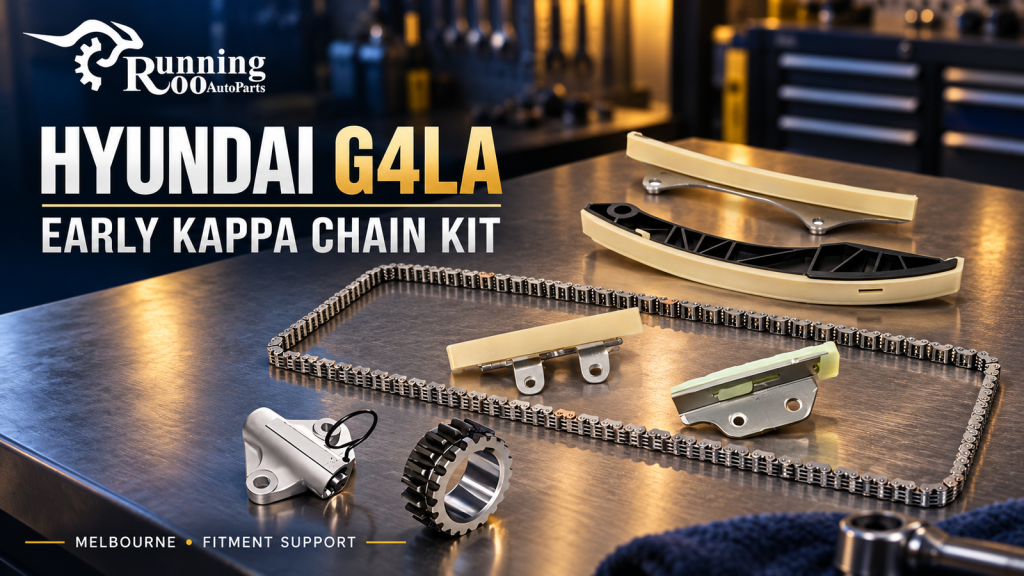
A Hyundai G4LA timing chain kit should be checked against the engine’s generation and component references, not ordered from the i10 or i20 badge alone. The featured RunningRoo listing describes an early Kappa package with a chain, tensioner, four guides and a crank gear. Understanding that scope helps an owner ask the right questions before organising a workshop repair.
This guide focuses on the seven-piece written package and the identification issues around early Kappa engines. It explains why a 1.2 or 1.25 capacity description is not a complete parts specification, how to separate the seller’s application range from a confirmed VIN match, and which additional requirements should remain on the workshop’s list.
Review the RunningRoo Hyundai G4LA timing chain kit and its matching RunningRoo eBay listing. For friendly support, call 0425 890 125. Australian-operated RunningRoo offers Melbourne local pickup in Blackburn by appointment and can discuss fast dispatch once the correct application, contents and current stock are confirmed.

Start with the full early-Kappa identification
The seller describes the package for selected Hyundai i10 and i20 1.2-litre Kappa G4LA applications and gives a broad 2007–2013 range. Treat that as catalogue information for an enquiry, not a guarantee covering every vehicle in those model families. The workshop should confirm the installed engine and build before the supplier approves the parts.
Do not use registration capacity alone to decide whether the listing is suitable. The full engine code, vehicle identification and component references provide a more precise basis for the match. If the registration or an old invoice uses a different capacity description, ask the workshop to resolve it rather than choosing whichever label resembles the advertisement.
An import or replacement engine adds another reason to keep the records clear. Provide the VIN and explain any engine change, then include the installed unit’s identifying information. A VIN describes the vehicle’s original configuration, while the actual engine also needs checking. Neither a badge nor a remembered engine size should replace that comparison.
What Hyundai training material says about early Kappa
An archived Hyundai Motor Company PB Kappa training document distinguishes a 1,197 cc version described for India from a 1,248 cc version described for Europe and general markets. It presents the early engine as a four-cylinder DOHC design using a single chain for the camshafts, crankshaft and oil-pump drive, and discusses that training version without CVVT. See the Hyundai PB Kappa training material, reproduced on an independent document archive.
Those details explain why the engine generation and market matter, but the training document does not approve the RunningRoo kit for every G4LA-labelled engine. Its early-engine description should not be extended to all later Kappa variants. The installer needs the appropriate service information for the actual build and must check the required components before fitting them.
The document is a training reference rather than a complete replacement procedure for your car. This guide therefore does not provide timing positions, bolt torques or a shortened fitting sequence. The useful buying decision is to identify the correct generation and package, then have a qualified workshop apply the relevant repair information.
A capacity label is a starting point, not the final match
If one record says 1.2 and another says 1.25, do not automatically conclude that the engine is either compatible or incompatible with the advertised kit. Ask for the exact identification and required OE references. The supplier can then check the application instead of trying to infer it from a rounded capacity description.
The same caution applies to the G4LA family code. Preserve the code, but also supply the build and vehicle details needed to identify the relevant version. An engine-family name can narrow the search without resolving every production difference. The order should reflect the actual components required by the workshop, not a broad assumption about all Kappa engines.
For a parts enquiry, write the vehicle details exactly as confirmed. If something is uncertain, label it as uncertain rather than silently correcting it to match the listing. A short clarification before purchase is more useful than receiving a package selected from inconsistent information and then discovering the disagreement during installation.
The seven-piece written package
The RunningRoo G4LA product description lists one chain, one tensioner, four guides and one crank gear. The table below turns that list into an ordering checklist. It does not prescribe which components on your engine are worn, and it should not be used as an installation diagram.
| Advertised component | Quantity or description | What to confirm |
|---|---|---|
| Timing chain | One, described as BWA4x5x160L | Correct chain for the confirmed application |
| Tensioner | One | Required assembly and supplied reference |
| Guides | Four | Match all required guide positions |
| Crank gear | One | Correct configuration for the identified engine |
| Camshaft gears or CVVT assemblies | Not listed | Separate enquiry if required by the workshop |
| Seals, bolts, oil, filter and other materials | Not established | Workshop to identify additional requirements |
| Tools and installation instructions | Not established | Installer to use the correct equipment and procedure |
A chain description such as the one shown in the sales list is not enough to establish compatibility by itself. Do not approve the package simply because a chain length or product photograph appears similar. The application, associated components and required references must also agree with the engine being repaired.
Four guides should likewise be checked as identified components, not merely counted as four pieces of similar colour. Ask the workshop to compare the required positions and part details with the confirmed package. A clear contents list is helpful, but the installer still needs to establish that the actual delivered components are correct.
Keep camshaft adjusters separate from this package
The written contents do not list CVVT assemblies or a pair of camshaft gears. If the workshop’s estimate includes those parts, ask whether it is discussing a different engine version or a broader repair package. Do not assume that the presence of a crank gear means every gear associated with the engine is included.
This is especially relevant when browsing several Hyundai or Kia listings at once. A chain package, a standalone adjuster and a kit with additional camshaft gears can share familiar brand and engine-family wording while representing different purchases. Keep the exact product link and required part references attached to each item in the order plan.
The correct response to an unclear comparison is to ask the installer and supplier to reconcile it. Avoid selecting a larger package just because it appears more comprehensive, or a smaller one solely because it costs less. The diagnosed work and confirmed application should determine which components are needed.
Obtain a useful workshop assessment before buying
Tell the workshop what prompted the enquiry and when the concern occurs. Provide service history, prior timing work and any previous diagnostic records. The technician should decide which checks are appropriate and identify the repair scope. A noise description or a general online discussion does not establish that this particular kit is the required solution.
Ask the workshop to distinguish confirmed replacement items from components still awaiting inspection. If it recommends the seven-piece package, request a short explanation of how that scope relates to the findings. If additional parts are conditional, note that in the estimate rather than assuming they will definitely be needed or definitely reusable.
RunningRoo can help identify and supply the appropriate parts, but a catalogue enquiry is not an internal engine inspection. Send the supplier the workshop’s conclusions and required references once available. This keeps the ordering conversation focused on a match that can be checked, rather than asking the seller to diagnose a vehicle remotely.
Prepare the OE-reference comparison carefully
Ask the installer for the relevant OE references and preserve the full numbers. If a marking is difficult to read, a clear photograph may help, but identify the component and include the wider context. A cropped number with no explanation can be less useful than a labelled photograph showing which part the workshop is discussing.
Where a seller proposes a replacement or superseded reference, ask for the application to be confirmed and retain the answer. Do not treat a commercial SKU as if it were a Hyundai OE number. The supplier’s identifier locates the offered product; the vehicle and component references establish the application question that still needs answering.
A practical comparison list separates the chain, tensioner, guide positions and crank gear. It also records additional materials that the installer will supply independently. This is useful when the owner orders the main kit, because it prevents both parties from assuming the other has arranged a small but necessary item.
Compare quotations for the same repair
An accurate estimate distinguishes diagnosis, the confirmed chain package, additional parts, labour and final checks. The level of detail can be simple, but the scope should be clear. A kit price is not the complete cost of an installed repair, and a generic online labour estimate cannot account for the condition of the actual vehicle.
If two quotes differ, ask whether they include the same components and work. One may assume reuse of an item after inspection while another includes replacement; one may include service materials that another lists separately. Understanding those differences is more useful than comparing only the final total or the advertised number of pieces.
For owner-supplied parts, ask the installer to review the product and approve the required application before purchase. Agree when it will inspect the parcel and how any discrepancy will be resolved. This creates a clear handover between parts selection and installation without expecting a retail listing to answer every workshop question.
Send RunningRoo a complete early-G4LA enquiry
Include the VIN, full engine identification, build details, capacity as confirmed by the workshop, any import or engine-replacement history and the required OE references. Attach the exact product link and explain that you are checking the early seven-piece package. List any additional camshaft gears, seals or other materials separately.
A concise enquiry might say: “Please check this early G4LA Kappa chain package against my vehicle and the workshop’s references. Please confirm the chain, tensioner, four guides and crank gear, including any application differences relevant to the build. I would also like current stock and Blackburn pickup or dispatch information.” Add the actual vehicle information privately when sending the request.
Refer to the RunningRoo G4LA website listing or the matching eBay item, or phone 0425 890 125. The Australian-operated team offers friendly support and Melbourne local pickup by appointment. Ask about fast dispatch when a workshop booking depends on parts, while allowing separately for carrier transit.
Check the supplied kit before installation
Retain the labels, packaging and written fitment confirmation. Have the workshop compare the delivered chain, tensioner, guides and crank gear with the agreed requirements while they are unused. Count the items, but also check the actual references and configuration. A correct overall count does not by itself establish the correct application.
If a component appears different, contact the supplier with a clear description and useful photographs before fitting. Keep the order reference and the workshop’s original request together so the question can be resolved against the same information used for the purchase. Do not modify an uncertain component to make it appear to fit.
For collection, arrange the appointment and identify who will pick up the order. For delivery, confirm whether the parcel goes to the owner or directly to the workshop. Fast dispatch, transport time and installer availability are separate stages. A confirmed logistics plan is more reliable than assuming that a local supplier or a handling statement guarantees an immediate repair.
Record what the workshop actually completed
At handover, ask the invoice to identify the replaced components and any additional work authorised. Retain the engine information and parts references with the vehicle’s service history. This helps future maintenance because a short note saying “new chain” does not establish whether the tensioner, guides or crank gear were also renewed.
Follow the vehicle-specific maintenance guidance supplied by the workshop and manufacturer. The early-Kappa training source is useful context, but it does not create one universal service schedule for all later variants. Keep the actual specifications and service records rather than relying on a capacity label or an unverified recommendation copied from another model.
Related RunningRoo video
Watch Timing Chain Rattle: Wear Symptoms & When to Replace for related general education from RunningRoo. The video is not a G4LA fitting tutorial and does not establish whether this package suits a particular i10 or i20. Use it to organise questions, while basing the order on the workshop’s diagnosis and the supplier’s confirmed application.
Frequently asked questions
Does this kit fit every Hyundai i10 or i20?
No blanket fitment promise is made. The listing describes selected early G4LA Kappa applications. Confirm the VIN, installed-engine identification, build details and required OE references before ordering. A model badge and broad year range are useful search information but do not replace the complete application check.
Does 1.2 versus 1.25 decide whether the kit fits?
Capacity wording alone should not decide the purchase. The cited early Hyundai training material distinguishes market-specific capacities, so have the workshop establish the exact engine and component requirements. Send the confirmed details to RunningRoo rather than assuming that a rounded capacity label proves or disproves compatibility.
Are CVVT gears included?
The written package lists one crank gear but does not list CVVT assemblies or camshaft gears. If your workshop requires those items, identify them separately and ask whether the proposed package is the correct scope for the engine version. Do not infer their inclusion from a generic chain-kit description.
Can I use the training document as the fitting procedure?
No. It provides early-engine technical context and is not a complete repair instruction for your vehicle. The installer should use the correct service information, tools and component references for the actual build. This guide intentionally does not provide torque values or a shortened chain installation sequence.
How can I organise local pickup or fast dispatch?
Contact RunningRoo after the fitment and contents have been checked. Blackburn pickup is by appointment, and dispatch arrangements depend on current stock and the confirmed order. Call 0425 890 125 for friendly support and coordinate the workshop booking with the agreed collection or delivery plan.
Choose the early-Kappa package from confirmed details
The right starting point is the installed engine, its build information and the workshop’s required references. Compare those with the RunningRoo G4LA seven-piece kit and matching eBay listing, then confirm any additional requirements. Australian-operated RunningRoo offers Melbourne pickup by appointment and fast dispatch support for the correctly identified order.