
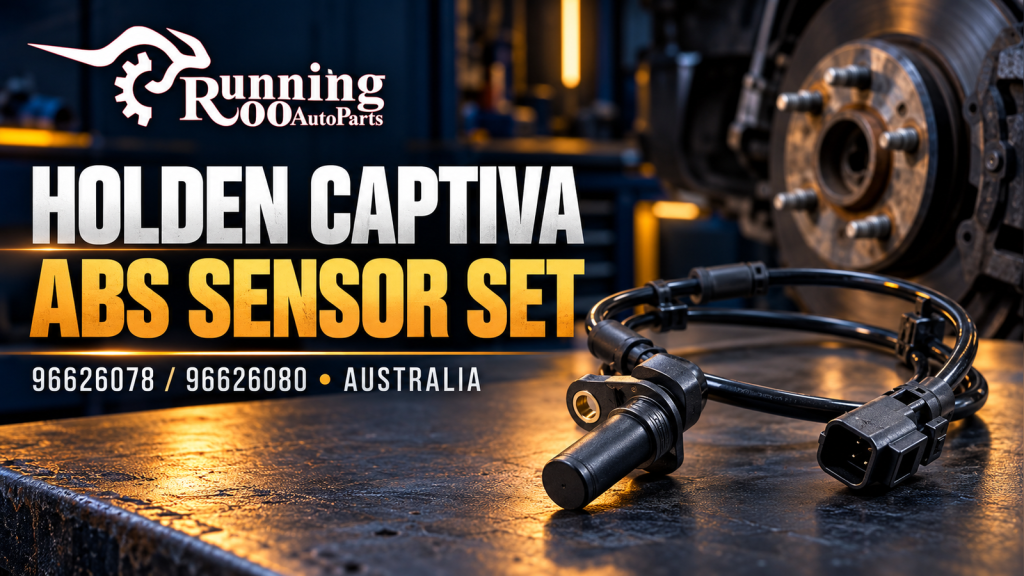
A Holden Captiva ABS warning and a four-piece wheel-speed sensor package are not the same thing. The warning is a reason to investigate the vehicle; the package is a purchasing option once the required parts have been identified. Australian owners comparing 96626078 and 96626080 listings should first establish the affected position, the vehicle application and the condition that the workshop intends to repair.
RunningRoo advertises a four-piece front and rear sensor set for Captiva applications under those references. This guide explains how to assess that set without assuming that every wheel sensor needs replacement. Review Holden Captiva ABS sensor set Australia at RunningRoo, compare matching RunningRoo eBay listing, or call 0425 890 125. RunningRoo is Australian-operated, with friendly support, Melbourne local pickup in Blackburn by appointment and fast dispatch for confirmed stock.

What the four-piece listing tells you
The checked RunningRoo description names four ABS wheel speed sensors, front and rear, with references 96626078 and 96626080. It also describes a 2007–2017 Captiva application range. Those details define the advertised offer, but they do not replace a VIN-based check for the actual vehicle or a position-by-position confirmation of the supplied sensors.
Ask how the two listed references are allocated within the package and which supplied component belongs at each required corner. Do not infer front, rear, left or right allocation from the order in which numbers appear in a title. The listing’s broad placement fields should be clarified against the vehicle requirement before the parts are treated as ready to fit.
Four pieces in a sales package do not establish four failed components. If the workshop has identified one fault, ask whether it recommends one replacement or a broader repair and why. A bundle can be a convenient purchasing format, but the diagnosis should determine what is fitted. Keep unused components and installed components clearly distinguished in the repair record.
The technical reason diagnosis must come first
HELLA’s manufacturer guide explains that wheel-speed information supports systems such as ABS, traction control and stability control. It identifies sensor-related fault possibilities including wiring problems, contamination, bearing issues and encoder damage. Its diagnostic approach combines fault information, live wheel-speed comparison and inspection of the relevant electrical and mechanical parts. See HELLA: checking and changing ABS wheel speed sensors.
HELLA also distinguishes active and passive sensors and warns against applying a resistance test to an active sensor. Its illustrated vehicle example is not a Captiva repair instruction. The practical consequence is to have the sensor type and applicable test method established by a qualified repairer, using the correct vehicle information, rather than trying an internet resistance value on an unidentified circuit.
For ordering, ask the workshop to translate its findings into a component request. A fault description associated with one wheel should not be reduced to “buy all sensors” without an explanation. The supplier needs the confirmed replacement requirement; the owner needs to understand whether the proposed set is being purchased for convenience, confirmed multiple failures or another documented reason.
Record the complaint in a useful way
Tell the workshop which warning appeared, when it was first noticed and whether any recent work had been carried out near the relevant area. Record the facts without trying to assign a cause. “The warning appeared after this visit” is useful history; “that proves the sensor was damaged” is a conclusion that still needs evidence.
If the warning is intermittent, describe the circumstances you observed rather than deliberately recreating a potentially unsafe situation. The workshop can decide what testing is appropriate. Ask for the actual diagnostic record to be retained, including the identified position and the result of the checks used to support the replacement recommendation.
This creates a clearer parts enquiry. Instead of requesting “Captiva ABS parts”, you can provide the VIN, the diagnosed position, the requested reference and whether the workshop wants the full four-piece package. A precise enquiry reduces the risk that a supplier interprets a general warning-light question as an instruction to choose a part on your behalf.
Match the vehicle and the individual sensor
Supply the VIN, build information, model description and the workshop’s required OE references. Include the engine code in the vehicle information where available, while recognising that it is not a substitute for checking the sensor application and position. If the vehicle has known modifications or relevant previous repairs, disclose those details before confirmation.
Ask the repairer which identifying features need comparison on this application. These may include the supplied reference, connector arrangement, lead routing and mounting form. The point is not to invent a universal Captiva sensor specification; it is to ensure that the actual supplied item is checked against the actual vehicle requirement using the correct information.
A clear photo of an accessible connector or readable part marking can help the enquiry, but do not remove components simply to obtain shopping pictures. Let the workshop decide what can be documented as part of its work. Photographs should support the written identity and position, not become the sole basis for a compatibility promise.
| Checkpoint | Evidence to request | What it prevents |
|---|---|---|
| Vehicle application | VIN and relevant build details | Treating a broad year range as universal fitment |
| Fault location | Workshop’s identified wheel position | Ordering an unspecified sensor from a generic warning |
| Part reference | Required OE number and seller confirmation | Mixing the two listed references without checking |
| Package allocation | Written front/rear and corner mapping | Assuming title order defines installation position |
| Repair quantity | Reason for each recommended replacement | Treating a four-pack as proof of four failures |
| Completion | Workshop’s verification and repair record | Equating a new part with an automatically completed diagnosis |
Decide whether the set matches the workshop’s plan
If the workshop requires the four-piece package, ask it to confirm the complete allocation before purchase. This is straightforward when each position and reference is written down. If only one component is required, discuss the purchasing options with RunningRoo rather than assuming that the package format determines the repair quantity.
Compare offers by confirmed contents and application, not simply by the lowest total shown in a search result. A listing for one sensor and a listing for four sensors represent different purchases. A title that mentions front and rear without a clear quantity should be clarified before it is compared with the RunningRoo set.
Check current terms and stock for the exact sales channel. The website and eBay links give you specific offers to discuss, but their descriptions should not be combined into an imagined package that neither seller page actually promises. Save the confirmation that identifies what is supplied and which application it has been checked against.
Send a complete enquiry to RunningRoo
A useful message states the VIN, build information, workshop diagnosis, required wheel position or positions, and the references requested. Add whether you are asking for the full four-piece set. Include any identification photographs already available from the workshop and flag anything that remains uncertain rather than leaving the supplier to infer it.
Review Holden Captiva ABS sensor set Australia at RunningRoo and matching RunningRoo eBay listing while preparing the message. Call 0425 890 125 if you need help explaining the package question. RunningRoo’s friendly Australian support can check the product and supply details, while the workshop determines the fault and the installation requirements for the vehicle.
If the repairer and supplier need different information, keep the roles clear. The seller may need a part marking to resolve the offer; the workshop may need diagnostic work to establish whether the sensor itself is required. A fitment enquiry is not a substitute for diagnosis, and a diagnostic code is not a complete shipping instruction.
Plan collection or dispatch around the confirmed parts
Melbourne customers can arrange Blackburn pickup by appointment after the set and stock are confirmed. Agree the collection time and order reference, especially if a workshop employee is collecting. Ensure that the person collecting knows whether the order is a four-piece package or another arrangement confirmed separately.
For delivery elsewhere in Australia, provide the postcode and ask about the current dispatch plan. Fast dispatch for available stock should be kept separate from the carrier’s transit time. If the vehicle is booked into a workshop, allow time for the delivered parts to be checked rather than scheduling the entire repair around an assumed arrival.
Where a vehicle’s warning requires prompt attention, follow the handbook and the repairer’s advice about use of the vehicle. Product availability does not establish that it is appropriate to keep driving while waiting for parts. The supply discussion should support the repair plan, not override the professional assessment of the vehicle’s condition.
Check the package before fitting
Compare the delivered quantity and references with the written order. Keep the individual components identifiable while the workshop confirms their intended positions. If a component differs from the agreed package or its identity is unclear, contact RunningRoo before installation rather than trying to adapt connectors or change the supplied part.
The technician should follow the applicable vehicle procedure for removal, routing, installation and verification. This guide deliberately avoids a universal torque figure, pinout, test voltage or resistance specification. Those details cannot be safely inferred from the fact that the listing covers a wheel-speed sensor set.
After the repair, ask for documentation of the components fitted and the checks completed. A useful record names the positions rather than simply stating “ABS sensors replaced”. If the workshop found another cause or performed additional work, have that recorded as well. This preserves the distinction between the purchased package and the actual repair.
A worked purchasing example
Consider an owner whose workshop requests a rear wheel-speed sensor after diagnosis. The owner finds a four-piece set and asks whether it will fit. The next step is to send the VIN, the exact diagnosed position and the required reference, then ask how that requirement maps to the set. Buying the set first does not resolve those questions.
Now consider a workshop that has identified several damaged components and requests a complete front/rear package. The same set may be a relevant option, but the allocation still needs confirmation. The difference is the documented repair requirement, not a change in what the product title says. Both buyers benefit from the same clear written mapping.
These examples are purchasing scenarios, not claims about a known Captiva failure pattern. They show why quantity, position and diagnosis should remain separate fields. A clear order helps the supplier provide the intended items and helps the workshop check that the delivery supports the work it has agreed to perform.
Frequently asked questions
Does an ABS light mean all four Captiva sensors are faulty?
No. The warning does not establish the number of components that need replacement. Have the vehicle professionally diagnosed and ask for the position and reason for each proposed replacement. The four-piece sales format should not be used as evidence that every sensor has failed.
Which of 96626078 and 96626080 is required for my wheel?
Ask the workshop and supplier to confirm the reference for the actual vehicle and position. This guide does not infer corner allocation from the title’s number order. Obtain a written mapping for the package before treating any individual component as ready for installation.
Is the 2007–2017 description enough to order?
Use it as a starting point, then provide the VIN and build information for confirmation. A broad year range does not replace the specific application check. Include the workshop’s requested OE reference and any relevant identification information already available.
Can I check the sensor with a generic resistance test?
Do not apply a generic test to an unidentified sensor. HELLA distinguishes sensor technologies and cautions against resistance testing active sensors. Have the workshop identify the relevant type and use the correct vehicle procedure and equipment for its diagnosis.
Is the cover photograph a picture of all four supplied parts?
The cover is an editorial illustration. Refer to the linked retailer offer and the confirmed written packing list for the actual package. The checked listing states four front/rear sensors, but the individual application and allocation still require confirmation.
Can I collect the set locally in Melbourne?
RunningRoo offers Blackburn pickup by appointment once the product and stock are confirmed. Australian delivery can also be arranged subject to current fulfilment details. Contact the team with the exact offer, VIN and workshop request before setting a collection or repair schedule.
Confirm the set against the diagnosed requirement
Review Holden Captiva ABS sensor set Australia at RunningRoo, compare matching RunningRoo eBay listing, and call 0425 890 125 with the vehicle and position details. RunningRoo provides Australian-operated friendly support, Melbourne local pickup by appointment and fast dispatch for confirmed stock. The best order is the one that connects a verified application and a clear package allocation to the workshop’s actual repair plan.
Related guide with a different scope
Holden Commodore VE Rear ABS Sensors Australia: 92211237 Pair and Connector Checks. This covers a different component, engine or background topic. It is not an interchange claim. The specific buying decision in this article remains tied to its named product and verified vehicle requirement.
Sources and evidence boundaries
HELLA: checking and changing ABS wheel speed sensors. Manufacturer information supports only the limited context described above. Retail contents and application leads come from the linked seller offers and are not independent OEM certification. Use the applicable complete service information for the actual vehicle and repair.
Review the RunningRoo product and the corresponding eBay offer, or call 0425 890 125. Contact RunningRoo with VIN, engine code and OE details for friendly Australian-operated support. Ask about Melbourne local pickup in Blackburn by appointment and fast dispatch for confirmed available stock; confirm item-specific fulfilment before booking labour.