
For Australian buyers, this guide focuses on matching the advertised parts to the actual vehicle before arranging supply. Melbourne customers can ask RunningRoo about Blackburn pickup by appointment; buyers elsewhere in Australia can confirm stock, dispatch arrangements and delivery to their postcode. For imported vehicles, provide the original market and complete engine identification rather than relying on an Australian registration description alone.
An Audi 3.0 TFSI timing chain kit enquiry often starts with a cold-start sound. Before selecting a four-chain package, distinguish a specific manufacturer bulletin from a broader repair recommendation. The official bulletin discussed below describes a narrowly defined condition and an upper-tensioner repair. It does not say that every noise requires a full chain kit, and it does not certify the tensioners contained in an aftermarket package as the latest manufacturer revision.

This guide examines Audi 3.0 TFSI timing chain kit Australia at RunningRoo and the corresponding matching RunningRoo eBay listing. Call 0425 890 125 with the VIN, engine code, workshop diagnosis and required OE references before ordering. RunningRoo offers friendly Australian-operated support from Blackburn, Victoria, Melbourne local pickup by appointment and fast dispatch arrangements for confirmed available stock. The aim is to help an owner or workshop select a package that matches an established repair scope, rather than buying the largest bundle on the strength of a sound description.
What Audi's cold-start bulletin actually covers
Audi's Audi technical service bulletin, 3 March 2015, dated 3 March 2015 and identified as 2039995/1, covers the listed 2011–2014 V6 3.0 TFSI applications. It describes a chain-area rattle at the back of the engine lasting about one to three seconds at the first start of the day. For that verified condition, the bulletin attributes the sound to an upper tensioner and specifies replacement of both upper tensioners with optimised parts. It says the described condition does not cause damage.
Keep that last statement inside its exact scope. It is not a declaration that all chain noise is harmless, that an engine can be driven regardless of symptoms, or that a longer or different sound has the same cause. The repairer must check applicability and the actual condition using current manufacturer information. The bulletin also does not establish that the retail kit discussed here contains the specified or latest tensioner revision.
For the buyer, the key question is therefore why the workshop recommends a full package rather than the bulletin's specific repair, or why it recommends selected components rather than a complete bundle. Either can be a legitimate discussion depending on the findings, but the answer should come from the inspection and applicable procedure. A product title is not evidence of the repair the vehicle needs.
Identify the engine behind the 3.0 badge
The retailer's title mentions selected Audi and Volkswagen model families and a 2012–2016 range. Treat those as application leads. Do not extend the offer to every engine described as 3.0T, every V6 or every vehicle carrying one of those model names. Provide the VIN, complete engine code, build information and original market. The workshop should establish the required components for the engine actually installed.
Keep petrol TFSI and diesel TDI enquiries separate. Also disclose an engine replacement or other history that could make the chassis data incomplete. A registration description may be useful for organising an enquiry, but it is not a complete component lookup. If the engine code is unknown, ask the repairer to identify it rather than selecting a package because its photograph resembles a search result.
The bulletin's year range and the retailer's year range serve different purposes. One describes the scope of a manufacturer service document; the other is a seller's application statement. Neither should be used to overwrite the other. A vehicle outside the bulletin's stated scope requires its own technical assessment, and a vehicle inside that scope still needs the package's fitment and contents checked separately.
Read the four-chain package without adding promises
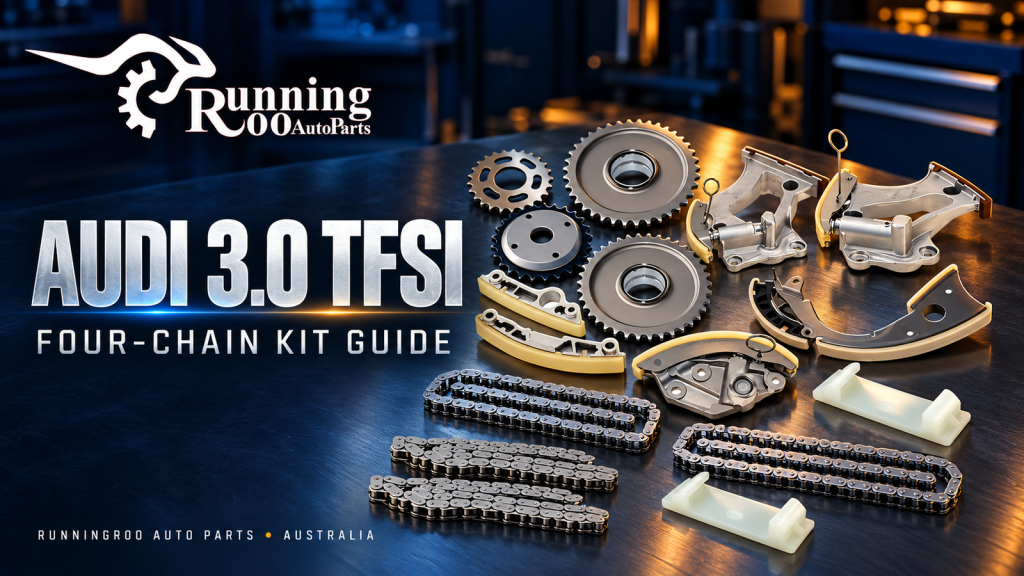
The website describes four chains, four tensioners, several guide pieces and four gears. Its chain descriptions distinguish upper left, upper right, centre and lower positions. Those are retailer inventory descriptions to confirm against the actual supplied package and workshop request. They are not an installation map, and they do not establish the revision or interchangeability of each component for every advertised vehicle.
| Advertised group | What the description establishes | What still needs confirmation |
|---|---|---|
| Four chains | Upper left, upper right, centre and lower items named | Required application and individual versions |
| Four tensioners | Four tensioners included in the description | Position, reference and revision of each |
| Guide components | Multiple guide pieces named | Exact inventory against the workshop list |
| Four gears | Four gears described by the retailer | Identity; do not assume all are VVT actuators |
| Other repair materials | Complete job contents not established | Seals, hardware, fluids and separate components |
The word gears should not be expanded into a promise of four camshaft adjusters. Ask the supplier to identify the actual components and references. Likewise, four tensioners in a package should not be described as proof of compliance with the particular bulletin above. If the workshop requires a specified updated component, that requirement belongs explicitly in the enquiry and should be confirmed before the order is approved.
Document the complaint accurately
If the enquiry began with a sound, tell the workshop when it occurs and how long it lasts as accurately as you can. Note whether it happens at the first start after standing, at later starts or under other conditions. A recording can help communicate the observation, but it cannot establish the internal condition of the engine or prove that the bulletin applies. Let the repairer determine the appropriate assessment.
Provide any diagnostic report and previous repair invoices. Keep exact fault descriptions rather than reducing them to a generic timing problem. If the vehicle has other warnings or running concerns, include those in the workshop discussion. Do not treat the bulletin's description of one limited condition as reassurance about a different or unresolved complaint. The repairer should advise whether the vehicle can be operated or needs transport for assessment.
This guide does not prescribe a test sequence, tightening values, chain alignment positions or a universal replacement interval. Those require the actual engine's current service information and proper equipment. Its purpose is to make the parts decision clearer after the workshop has established a scope, not to give an owner a shortcut around that process.
Distinguish a tensioner repair from broader chain work
Ask the workshop to describe what it has found and what that finding means for the parts list. If it recommends the bulletin-related upper-tensioner repair, request the exact required references and current applicability. A complete four-chain kit may not be the right way to obtain those particular components. The supplier should not substitute a broad package merely because it contains items with the same general name.
If inspection supports a broader chain-drive repair, ask for the reason and an itemised list. The owner should understand which components are required, which are outside the package and what additional work is conditional on access or further inspection. This helps compare estimates fairly and prevents a full kit from being presented as an automatic consequence of any cold-start sound.
The distinction also protects scheduling. An owner who orders a bundle before the workshop has finalised its recommendation may still need a separate component or revision. Conversely, an order for only selected parts may not cover a subsequently confirmed wider scope. Establish the best available repair plan first and agree how changes discovered during inspection will be authorised and supplied.
Check revision requirements explicitly
An OE reference needs to be complete, including its suffix. Ask the workshop to provide the current required reference and explain whether it comes from a catalogue, service document or the fitted component. The bulletin itself says that parts and service information can change. Do not assume an older published reference is necessarily the final current answer for the vehicle, and do not assume a retailer's general description supplies the same revision.
Where an aftermarket component is proposed, request a clear application and specification confirmation for the actual order. Avoid unsupported language such as upgraded to factory specification unless the supplier provides a basis for that claim. The article's role is to identify the verification question, not to certify engineering equivalence from a photograph. Keep any confirmed answer with the order and make it available to the workshop receiving the parts.
Build a complete quotation before the booking
A useful estimate separates diagnosis, supplied timing components, additional parts, labour and service materials. Ask the workshop which seals, hardware and fluids are needed under the applicable procedure. The current product inventory does not promise every item disturbed during access. Do not add or omit parts based on another engine's repair video; use the requirements of the actual job.
Agree what happens if further inspection changes the scope. The workshop can identify an approval point before ordering additional parts or proceeding beyond the original estimate. This is especially helpful when the car has an uncertain repair history. Keep the original findings, later discoveries and supplier confirmations together so the final work remains traceable to a reason rather than a sequence of hurried purchases.
Comparing quotes only by kit price can conceal substantial differences. One may contain selected tensioners, another a wider chain package and another additional assemblies. Ask each repairer to describe the same known condition and its recommended response. The owner can then compare the proposed work, supply and terms rather than assuming that the highest component count is automatically the best repair.
Using the RunningRoo links effectively
Review Audi 3.0 TFSI timing chain kit Australia at RunningRoo and matching RunningRoo eBay listing with the workshop's list in front of you. Ask which requested items the package covers and which remain separate. Include the engine code, VIN and any required component revision in the enquiry. If the workshop prefers direct technical clarification, coordinate that conversation so the person paying for the order receives the final confirmed inventory and terms.
Call 0425 890 125 for friendly Australian-operated support. RunningRoo can discuss stock and Melbourne local pickup in Blackburn by appointment, as well as fast dispatch for confirmed available stock. A local supplier can help coordinate the parts handover, but the workshop still determines the diagnosis and installation scope. Confirm the correct package before booking travel or telling the repairer that every required part has been secured.
Handover and delivery planning
Ask about the actual dispatch arrangements for the destination and distinguish handling time from carrier transit. If additional components are coming from another source, make sure the workshop knows when the full parts set is expected. A quickly delivered chain kit does not make an incomplete job ready to begin. For a scheduled repair, the useful date is the date all confirmed requirements can be checked by the repairer.
When collecting, arrange the appointment and order details with RunningRoo. If a third party is collecting, settle that arrangement in advance. When delivering directly to a workshop, use its agreed address and job reference. These simple administrative details are particularly helpful when several similar engine packages are being received or discussed at the same time.
Verify the supplied package before installation
Keep the invoice and labels while the workshop compares the components with the confirmed order. The tensioner references and any specifically requested revisions deserve particular attention. If an item differs, contact the supplier with a clear photograph and the relevant reference before fitting or modifying it. Do not convert an unresolved parts question into a workshop improvisation simply because the car is already dismantled.
After the repair, retain an itemised record showing which chains, tensioners, guides, gears or separate components were actually installed. Ask the workshop to record its completion checks. That documentation is more useful for future service than a broad note saying timing system replaced, and it helps distinguish the repair performed from the narrower bulletin condition discussed in this article.
Frequently asked questions
Does a brief cold-start rattle always require a full chain kit?
No. The Audi bulletin discusses a specific condition and a particular upper-tensioner repair. The workshop must verify applicability and determine the actual scope. Do not treat any sound description as an automatic order for a four-chain package or as proof that the bulletin applies.
Does Audi say every chain rattle is harmless?
No. The no-damage statement belongs to the limited condition described in that bulletin. A different, longer or unresolved complaint needs its own assessment. Ask the repairer about the actual vehicle and do not use a quotation about one condition as a universal reassurance.
Are the kit's tensioners the optimised bulletin parts?
That has not been established by the retail inventory alone. If the workshop requires a particular reference or revision, ask for explicit confirmation. A package containing four tensioners does not by itself prove that any specific manufacturer update is included.
Does four gears mean four VVT actuators?
Do not assume that. The supplier should identify the actual gears and their references. If the repair requires adjusters or other assemblies, list them separately and confirm whether they are supplied. Similar technical terminology does not expand the contents of the package.
Can I choose by Audi model and year alone?
Use the VIN, complete engine code, build details and required references. The retailer's broad model and year wording is an application lead, not a universal compatibility guarantee. Disclose replacement-engine history and keep petrol TFSI enquiries separate from other 3.0-litre engines.
How do I arrange the parts locally?
Review Audi 3.0 TFSI timing chain kit Australia at RunningRoo and matching RunningRoo eBay listing, then call 0425 890 125 with the workshop's confirmed list. Ask about Blackburn pickup by appointment or fast dispatch for available stock. RunningRoo's friendly Australian-operated support can help with supply once fitment, contents and any revision requirements are settled.
Related RunningRoo video
Timing Chain Rattle: Wear Symptoms & When to Replace | RunningRoo. General timing-chain background from RunningRoo AutoParts. This is not verified as the exact engine or package in this article, not an installation guide or a diagnosis. Follow the applicable manufacturer information for the vehicle.
Sources and evidence boundaries
Audi technical service bulletin, 3 March 2015. Manufacturer information supports only the limited context described above. Retail contents and application leads come from the linked seller offers and are not independent OEM certification. Use the applicable complete service information for the actual vehicle and repair.
Review the RunningRoo product and the corresponding eBay offer, or call 0425 890 125. Contact RunningRoo with VIN, engine code and OE details for friendly Australian-operated support. Ask about Melbourne local pickup in Blackburn by appointment and fast dispatch for confirmed available stock; confirm item-specific fulfilment before booking labour.