
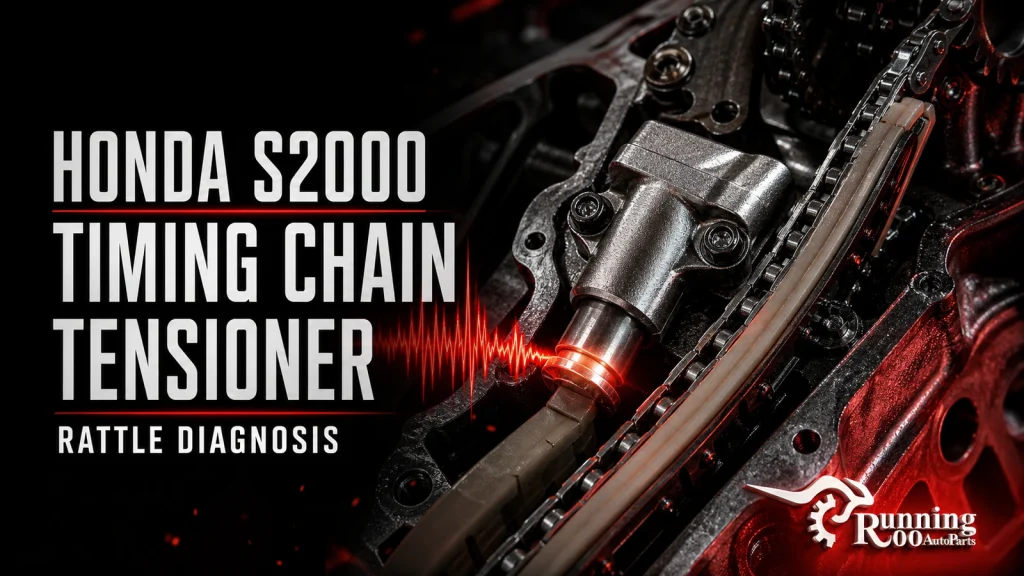
The Honda S2000’s engine is naturally mechanical-sounding, so not every tick or rattle means the timing chain tensioner has failed. Injector noise, valve-clearance noise and accessory-drive sounds can all be mistaken for timing-chain trouble. The risk is replacing a tensioner without checking the chain and guides—or ignoring a genuine timing noise until it becomes a larger repair.
Quick answer: a worn S2000 timing chain tensioner may create a rattle from the timing area during start-up, idle or particular engine-speed changes. Confirm the location and operating condition, check oil and valve-clearance history, then inspect tensioner operation, chain wear and guide condition before choosing a replacement kit.
What the timing chain tensioner does
The S2000 engine uses a chain to maintain the mechanical relationship between the crankshaft and camshafts. The tensioner keeps the controlled amount of load on the chain through its operating range, while guides support the chain path and control movement.
If effective tension is lost, the chain can oscillate and strike or load the guides. A small amount of noise can therefore be an early clue, but severe slack can allow timing to move and create a risk of internal engine damage.
Common S2000 timing-area noises
| Noise pattern | Possible source | Best next step |
|---|---|---|
| Brief rattle at start-up | Tensioner behaviour, oil drain-back or chain/guide wear | Record a true cold start and inspect the timing system |
| Rattle at hot idle or a narrow RPM range | Tensioner, chain resonance, valve train or accessory | Locate the sound and compare cold/hot conditions |
| Regular top-end ticking | Injector operation or valve-clearance issue | Check service history and valve clearances |
| Noise after recent timing work | Incorrect installation, tensioner release or timing alignment | Stop and recheck the repair before further driving |
| Noise plus poor running or timing code | Possible base-timing or sensor problem | Scan and verify mechanical timing promptly |
The pattern helps narrow the investigation, but sound alone cannot measure chain wear or prove that the tensioner is responsible.
Signs that justify prompt inspection
- A new rattle that is becoming louder or lasts longer
- Noise from the chain-cover area rather than the injectors or accessories
- Metallic debris or guide material found during an oil service
- Uncertain tensioner replacement history on a high-kilometre engine
- Hard starting, rough running or loss of performance
- Cam/crank correlation evidence or a timing-related warning light
- Noise that began immediately after engine work
A sensible diagnostic process
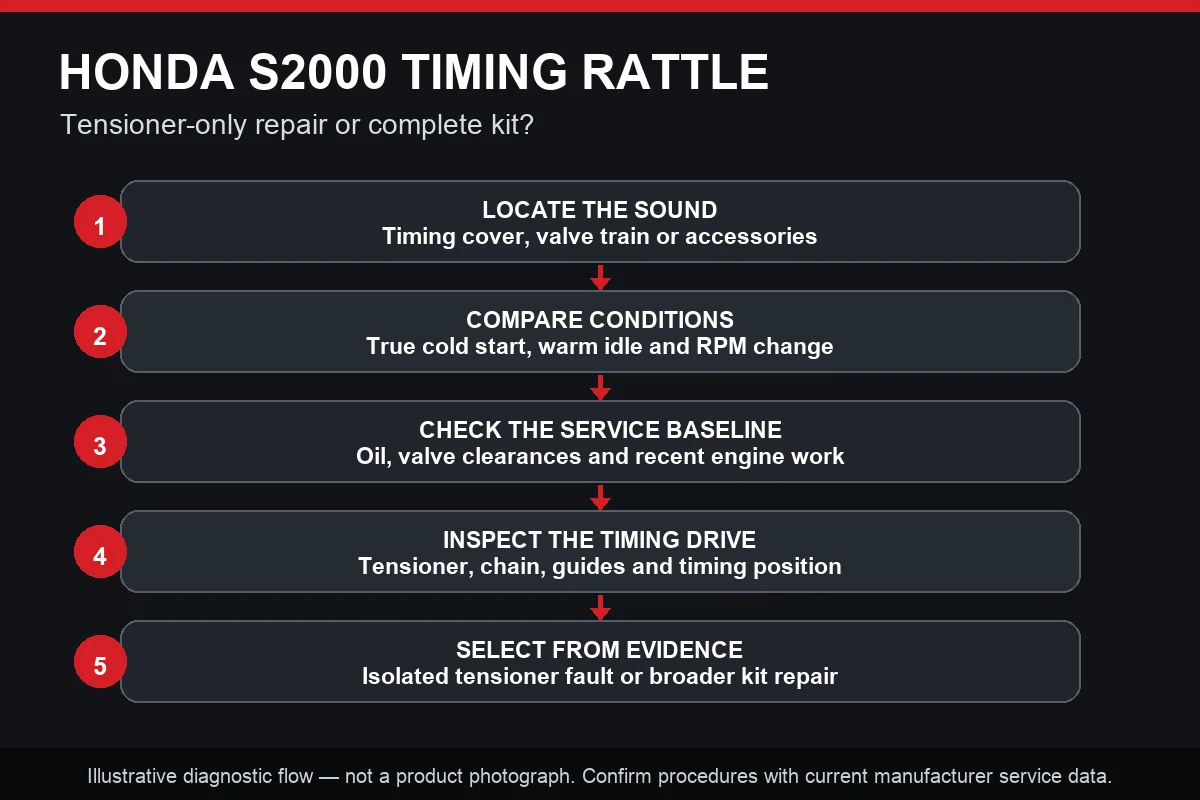
1. Identify the exact vehicle and engine
S2000 applications vary by market and production period, including 2.0-litre and 2.2-litre versions. Record the VIN, engine code and build date. Modified or engine-swapped cars require identification from the installed engine, not the body badge.
2. Document the noise before dismantling
Record a cold start and a fully warmed idle. Note engine speed, oil temperature and whether the sound changes under light load or overrun. A good recording can help a specialist distinguish intermittent tensioner noise from normal valvetrain operation.
3. Check the oil-service baseline
Verify oil level, condition, viscosity and filter quality. The tensioning system and valvetrain depend on reliable lubrication. Low or unsuitable oil can amplify noise, but changing oil is not a repair for a mechanically worn chain or guide.
4. Rule out valve-clearance and accessory noise
The F-series S2000 engine has a distinctive valvetrain sound. Review when valve clearances were last inspected and listen methodically across the engine. Accessory bearings, belt components and exhaust shields can also imitate a timing rattle.
5. Scan and inspect
Check current, pending and history engine codes before clearing anything. If symptoms or data suggest timing deviation, inspect mechanical timing, chain condition, guides and tensioner operation using Honda’s service procedure.
Tensioner only or complete timing kit?
Replacing only the tensioner may be appropriate when the chain and guides are within specification, timing is correct and the failure is isolated. A broader kit makes more sense when inspection reveals guide wear, chain damage, excessive slack or uncertain previous work.
| Repair scope | When it may be appropriate | What must be checked |
|---|---|---|
| Tensioner only | Confirmed tensioner fault with healthy chain and guides | Chain wear, guide surfaces, timing and oil condition |
| Chain, tensioner and guides | Multiple worn components or uncertain high-kilometre timing system | Sprockets, seals, fasteners and complete kit contents |
| Further engine diagnosis | Noise is not clearly from the timing system | Valve train, oil pressure, accessories and internal condition |
Parts should not determine the diagnosis. Inspection should determine which parts are needed.
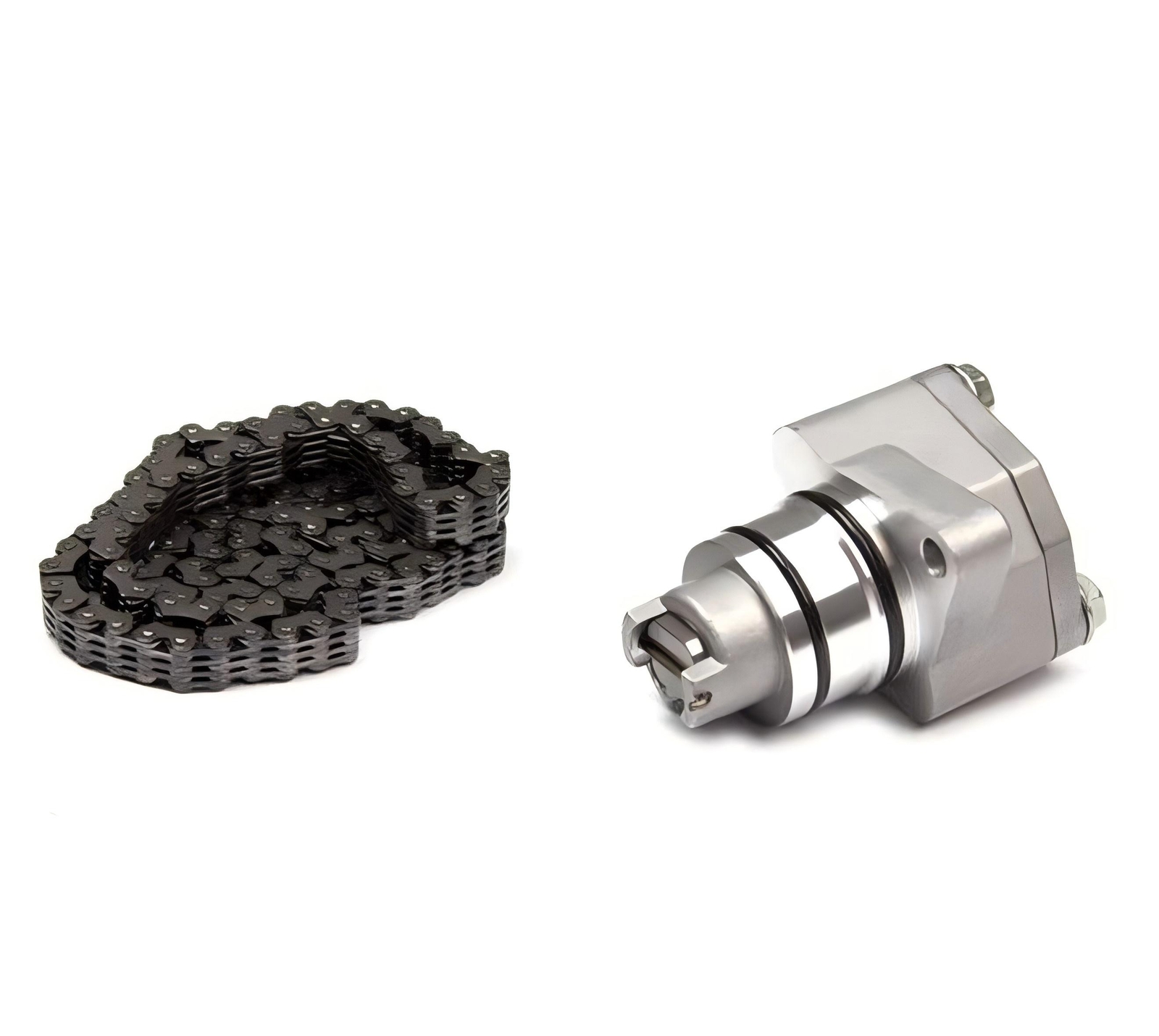
RunningRoo S2000 timing kit
RunningRoo lists a Honda S2000 2.0L/2.2L timing chain, tensioner and guide kit for selected 2000–2009 applications. Before ordering, confirm the VIN, installed engine code, production date and the exact contents required for the repair.
Do not rely on internet shorthand such as AP1 or AP2 alone. These labels are helpful, but market-specific engines and previous modifications can change the correct parts.
Installation considerations
- Use the current Honda procedure for the exact engine.
- Set and lock the engine at the specified timing position.
- Prevent the chain from dropping or jumping when tension is released.
- Inspect guide surfaces and sprocket teeth rather than reusing them automatically.
- Replace seals and single-use fasteners identified by service information.
- Release or prime the tensioner exactly as directed.
- Rotate the engine by hand and recheck all timing references.
- Verify oil level and listen through both cold and warm operation after repair.
The S2000 engine operates at high speed and has very little tolerance for incorrect cam timing. This is not a repair to improvise. Professional installation is recommended unless the technician has the correct tools and Honda service information.
Common mistakes to avoid
- Calling every normal injector tick a timing-chain fault
- Replacing a tensioner without checking the guides and chain
- Using engine oil outside the specified grade to mask noise
- Rotating camshafts and crankshaft independently with the chain released
- Starting the engine before verifying timing by hand
- Ordering by model year without confirming the installed engine
Frequently asked questions
Is the S2000 timing chain a scheduled service item?
It is generally inspected and replaced based on condition rather than a simple belt-style interval. Maintenance history, noise, tensioner operation and guide/chain inspection are more useful than age alone.
Can a noisy tensioner damage the engine?
If the tensioner cannot control the chain, wear can accelerate and mechanical timing may be at risk. The severity cannot be judged from volume alone, so a worsening rattle deserves prompt inspection.
Will an aftermarket tensioner always be quieter?
No component is automatically correct because of its brand or design claim. Fitment, manufacturing quality, installation and the condition of the chain and guides all affect the result.
Can valve adjustment cure a chain rattle?
Correct valve clearances can reduce valvetrain noise, but they do not repair a failed timing tensioner. The important step is locating the sound accurately before work begins.
Should I replace the chain at the same time?
Replace it when inspection or repair history justifies it. If the chain, guides and sprockets are healthy, a proven tensioner-only repair may be sufficient; if wear is present, a complete kit can prevent repeat labour.
Final recommendation
For an S2000 rattle, begin by respecting how noisy these engines can be. Document the condition, rule out normal valvetrain and accessory sounds, then inspect the tensioner together with the chain and guides. Once the source is proven, match the kit to the exact engine and verify timing before the first start.
This article provides general technical information. Confirm fitment and repair procedures against current Honda service data and use a qualified technician for internal timing work.