
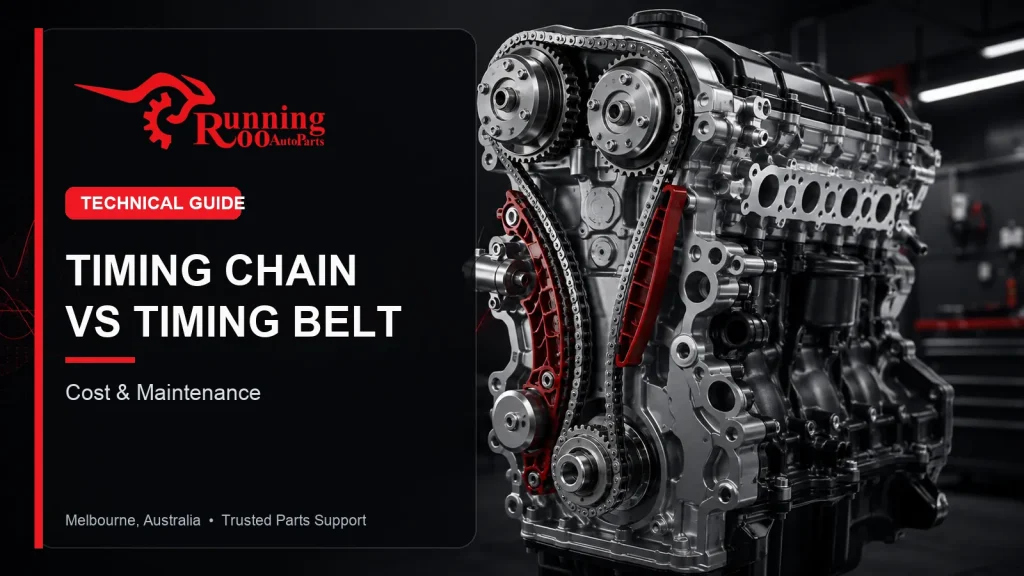
G’day everyone. I’m the Senior Product Manager here at RunningRoo Auto Parts, Australia’s trusted aftermarket automotive parts specialist. One of the questions we hear most often from owners is whether a timing chain is really better than a timing belt, and what each one costs to maintain. In this guide I’ll explain the differences in plain English, compare replacement intervals and costs, and help you understand what your own engine actually uses.
The short answer is that neither system is universally better. A timing chain is generally longer-lived but can stretch and rattle as it ages, while a timing belt is quieter and cheaper in parts but must be replaced on a strict schedule. Both do the same fundamental job: keeping the crankshaft and camshafts turning in perfect sync.
All prices below are in Australian dollars and are indicative only. If you would rather confirm which system your engine uses, our Melbourne team can check it against your make, model and engine code.
RunningRoo Auto Parts – Based in Melbourne, Australia 🇦🇺
Free 24/7 Pickup Available (by appointment)
Any questions? Call us anytime: 0425 890 125
Why Choose RunningRoo? Aussie Owned & Operated | Fast Shipping | Friendly Support
What a timing belt and a timing chain actually do
Inside every four-stroke engine the crankshaft and camshafts must be locked into a precise relationship so the valves open and close at exactly the right moment. The timing belt or timing chain is the component that drives the camshafts from the crankshaft and keeps that relationship accurate.
A timing belt is a reinforced rubber belt with moulded teeth that grip the sprockets, and it usually runs inside a protective cover. A timing chain is a metal roller chain, similar in concept to a bicycle chain but far more precisely made, and it runs in the engine’s oil system.
If the belt or chain breaks or jumps a tooth on an interference engine, the pistons can strike the valves and cause catastrophic damage. That is why servicing this system on time is so important regardless of which type your car uses.
On a non-interference engine the valves and pistons do not occupy the same space, so a broken belt or chain simply stops the engine without internal damage. However, the overwhelming majority of modern engines are interference designs, so it is safest to assume the worst and service the system on time.
Key differences at a glance
| Feature | Timing belt | Timing chain |
|---|---|---|
| Material | Reinforced rubber | Metal |
| Typical service life | 60,000 – 160,000 km | Often life of engine (but can wear) |
| Noise | Quieter | Can rattle when worn |
| Failure mode | Snaps or strips teeth | Stretches, rattles, jumps |
Which one lasts longer
In theory a timing chain lasts the life of the engine, which is why many manufacturers moved to chains in the 2000s and marketed them as maintenance-free. In practice, a chain can still wear, stretch and rattle, particularly if oil changes have been neglected or the tensioner and guides are weak by design.
A timing belt, by contrast, has a known and predictable lifespan, so it is replaced as a routine service item before it fails. This predictability is actually an advantage, because a belt is rarely allowed to reach the point of snapping if the service schedule is followed.
Both systems fail most often through neglect: a belt that is never replaced, or a chain that runs on old, dirty oil and loses tension. So the honest answer is that neither is truly maintenance-free.
There is also a middle category of engines that use a belt to drive one camshaft and a chain, or a small link chain, to connect the camshafts to each other. This is one reason the parts list and labour for a timing job can vary so much from one engine to the next.
Which engines use a chain and which use a belt
There is no simple rule, because the choice depends on the engine design, cost, packaging and noise targets. As a rough guide, many larger turbocharged petrol engines and diesel engines use chains, while many smaller petrol engines use belts for lower cost and quieter operation.
The table below gives a few well-known examples to illustrate the split, but you should always confirm your exact engine rather than assume.
| Engine example | System | Typical service approach |
|---|---|---|
| Volkswagen EA888 1.8 / 2.0 TSI | Chain | Inspect for rattle / stretch |
| Volkswagen EA211 1.2 / 1.4 TSI (some) | Belt | Scheduled replacement |
| Holden Alloytec 3.6L V6 | Chain | Watch for stretch / rattle |
| Ford 3.5 EcoBoost V6 | Chain | Watch for stretch / codes |
Replacement intervals compared
Timing belts are replaced on a distance or time basis, typically somewhere between 60,000 and 160,000 kilometres depending on the engine. The interval is always stated by the manufacturer, and it is important to follow it because a rubber belt can degrade with age even on a low-kilometre car.
Timing chains do not have a fixed replacement interval in most cases, but they can still require replacement when they stretch, rattle or the guides wear. The table below gives a general comparison of how the two are serviced.
On belt engines the water pump is frequently driven by the timing belt and is therefore replaced at the same time, because the labour is already being paid for. On many chain engines the water pump is driven separately, so it does not automatically need to be changed with the chain.
| Aspect | Timing belt | Timing chain |
|---|---|---|
| Replacement trigger | Scheduled interval | Wear / noise / fault codes |
| Water pump | Usually replaced together | Not always driven by chain |
| Parts cost | Lower | Higher |
What each costs to replace in Australia
A timing belt replacement in Australia is usually a few hundred to around a thousand dollars, because the belt and tensioner are relatively inexpensive and the job is well understood. A timing chain replacement is normally more expensive because the parts are more costly and the labour often involves more of the engine’s front end.
The chart below compares a typical timing belt replacement with a typical timing chain replacement, using indicative Australian figures.
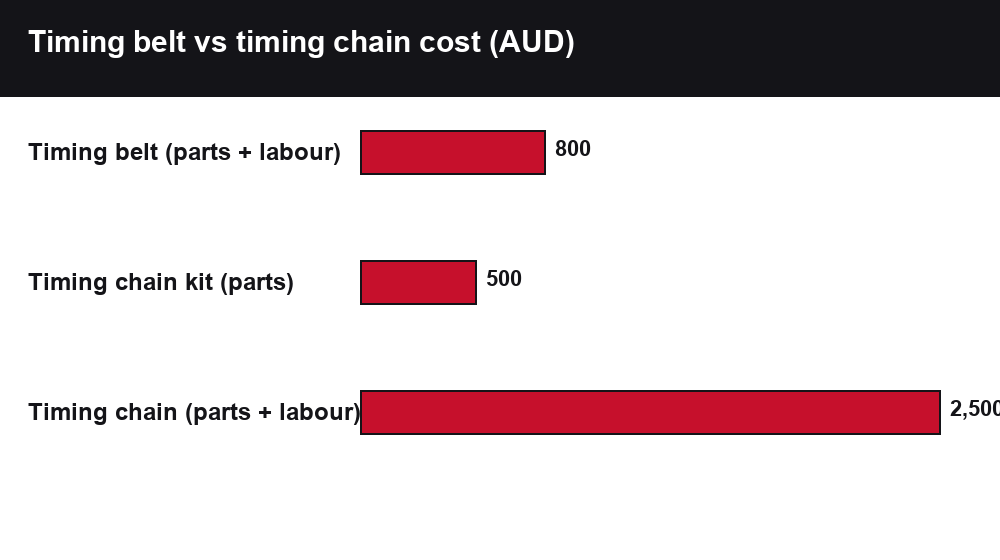
These figures are a broad guide only. The exact cost depends on the engine, whether the water pump is included, and whether you use a workshop or buy the parts yourself.
One reason the chain job is often pricier is that the front of the engine usually has to be opened further, and the chain, guides and tensioner are all replaced together. With a belt, the belt and tensioner are cheaper, and the labour is more routine.
Signs of a failing belt or chain
A timing belt rarely gives much warning, which is why the schedule matters so much. By the time a belt shows cracking, glazing or missing teeth it is already overdue, and a snapped belt on an interference engine can happen without warning.
A timing chain, on the other hand, usually warns you first. A metallic rattle on cold start, a rough idle, a loss of power or a check engine light with camshaft correlation codes are all classic signs of a stretched chain or a weak tensioner.
Any unusual engine noise from the front of the engine should be investigated promptly, because the repair bill rises sharply once a chain jumps or a belt snaps.
If you hear a rattle that disappears as the engine warms, do not assume it is harmless. On a chain engine that is one of the earliest signs of a weak tensioner, and catching it at that stage is far cheaper than repairing the damage after the chain fails.
Which is better for Australian drivers
For most Australian owners the practical answer is to service whichever system the car was built with, on time and with quality parts. A well-maintained belt engine is extremely reliable, and a well-maintained chain engine can go for very high kilometres without the chain ever being touched.
The problems we see in the trade are almost always the same two things: belts pushed well past their replacement interval, and chains that have been run on old oil or with a failing tensioner. Avoid those two situations and either system will serve you well.
If you are buying a used car with a chain engine, listen carefully for a cold-start rattle and check the service history. If it has a belt engine, confirm the belt has been replaced at the correct interval and budget for it if it has not.
Australian heat and long highway runs place real demands on engine oil and cooling, both of which affect timing system life. Clean, correct-specification oil is especially important for chain engines, because the chain and tensioner rely on oil pressure and lubrication to stay quiet and tight.
Whichever system your car uses, the cheapest insurance is simply following the factory schedule and replacing the full kit, not just the belt or chain on its own. Reusing old tensioners and guides is a false economy that often leads to a second, much more expensive failure shortly afterwards.
Where to buy timing chain kits in Australia
RunningRoo Auto Parts stocks quality timing chain kits and tensioner kits for a wide range of Volkswagen, Audi, Skoda and Seat engines, at a fraction of typical retail pricing with Melbourne pickup and Australia-wide delivery.
- 1.4 TSI Timing Kit for VW / Audi / Skoda / Seat (CAXA CAVD CTHD BWK)
- 12-Piece EA888 Timing Chain Tensioner Kit (Gen 2/3) for Audi / VW / Skoda
- 1.8 / 2.0 TFSI Timing Chain Kit for Audi / Seat
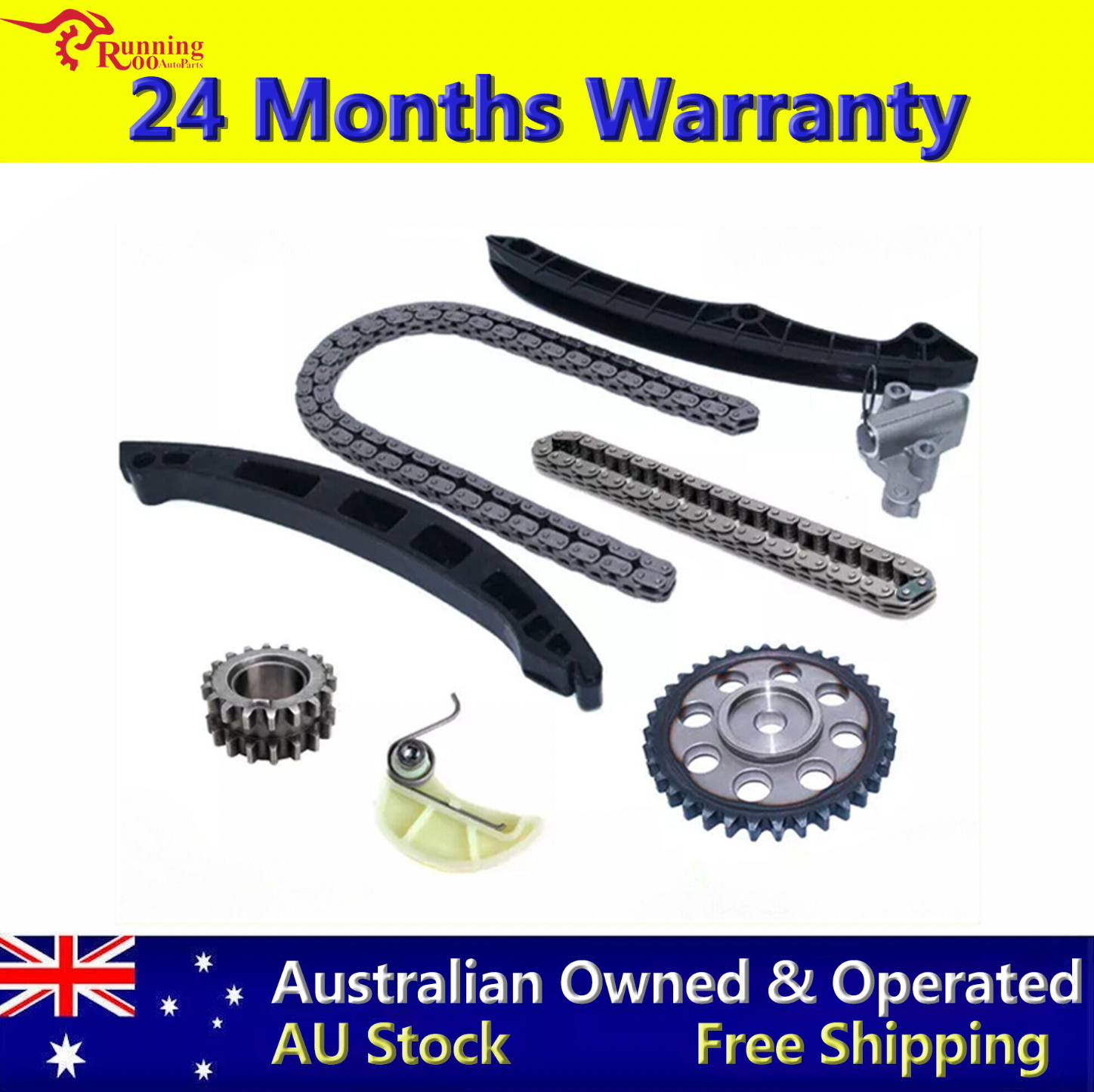
Watch a short explainer on the EA888 timing system below, then browse the complete range on our eBay store.
Watch: Do you understand the timing system of the EA888 engine?
You can also browse the full range here: RunningRoo Auto Parts on eBay Australia.
Not sure whether your car has a belt or a chain, or which kit is right? Our Aussie team can confirm it against your engine code.
RunningRoo Auto Parts – Based in Melbourne, Australia 🇦🇺
Free 24/7 Pickup Available (by appointment)
Any questions? Call us anytime: 0425 890 125
Why Choose RunningRoo? Aussie Owned & Operated | Fast Shipping | Friendly Support
Frequently asked questions
Is a timing chain better than a timing belt?
Not always. A chain is generally longer-lived, but a belt is quieter and cheaper to replace on a fixed schedule. Both are reliable when serviced correctly.
How long does a timing belt last?
Depending on the engine, a timing belt is normally replaced every 60,000 to 160,000 kilometres or a set number of years, whichever comes first.
Does a timing chain ever need replacing?
Yes. Chains can stretch, the tensioner can weaken and the guides can wear, so a chain may still need replacement if it rattles or logs camshaft correlation fault codes.
How much does a timing belt cost to replace in Australia?
A timing belt replacement is usually around a few hundred to roughly a thousand dollars, depending on the engine and whether the water pump is included.
How much does a timing chain cost to replace in Australia?
A timing chain replacement is typically more expensive than a belt, often in the low thousands once parts and labour are included.
What happens if a timing belt or chain breaks?
On an interference engine the pistons can hit the valves, which can bend valves and require a major rebuild. On a non-interference engine the engine simply stops, but this is less common on modern engines.
Can a timing chain be converted to a timing belt, or vice versa?
No. The system is engineered into the engine design, so you service whichever type the engine was built with.
Still have a question about your engine’s timing system? Call us anytime and we’ll help.
RunningRoo Auto Parts – Based in Melbourne, Australia 🇦🇺
Free 24/7 Pickup Available (by appointment)
Any questions? Call us anytime: 0425 890 125
Why Choose RunningRoo? Aussie Owned & Operated | Fast Shipping | Friendly Support
References
Key data in this article is drawn from the following official manufacturer sources:
- Volkswagen Group — EA888 and EA211 engine timing system technical documentation.
- Volkswagen Group — factory service schedules and timing belt / chain replacement interval specifications.