
G’day everyone. I’m the Senior Product Manager here at RunningRoo Auto Parts, Australia’s trusted aftermarket automotive parts specialist. If you own a Volkswagen, Audi, Skoda or Seat with the seven-speed DQ200 DSG, you have almost certainly seen the terms TCU and TCM used interchangeably in forums, workshop quotes and parts listings. In this article I’ll explain what each term actually means, how they relate to the DQ200 mechatronic unit, and why the difference matters when you are diagnosing or buying a replacement.
Understanding the terminology can save you from buying the wrong part or approving the wrong repair, so let’s break it down in plain English. All prices are in Australian dollars and are indicative.
If you’d rather talk to a real person about your own gearbox before reading further, our Melbourne-based team is always available:
RunningRoo Auto Parts – Based in Melbourne, Australia 🇦🇺
Free 24/7 Pickup Available (by appointment)
Any questions? Call us anytime: 0425 890 125
Why Choose RunningRoo? Aussie Owned & Operated | Fast Shipping | Friendly Support
What do TCU and TCM stand for?
TCM stands for transmission control module, and TCU stands for transmission control unit. In most everyday usage they mean exactly the same thing: the electronic brain that controls how and when the gearbox changes gear. The two abbreviations come from different manufacturers and different regions, which is why you see both on forums and in workshop literature.
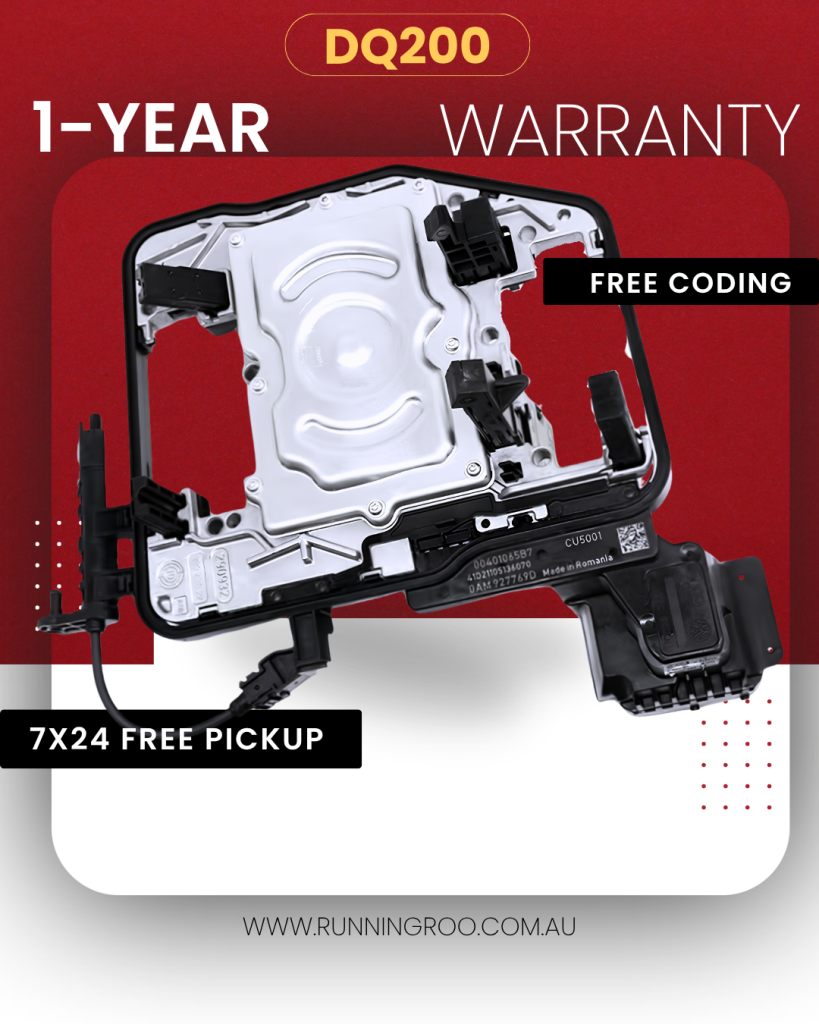
On the DQ200 specifically, the control electronics are not a separate bolt-on box. They are built into the mechatronic unit, which combines the transmission control module with the hydraulic valve body that physically operates the gear selector forks and the clutch actuators. So when someone talks about a DQ200 TCU or TCM fault, they are almost always describing a problem inside the combined mechatronic assembly.
Why the DQ200 combines the TCM and the mechatronic
The DQ200 packages its electronics, sensors and hydraulic solenoids together inside the gearbox casing. This integration saves space and weight, but it also means a fault can appear as an electrical error, a hydraulic fault or a mechanical shifting problem. The control module reads signals from sensors across the car, decides when to shift, and commands the hydraulic actuators accordingly.
The practical consequence is that a “TCU fault” on a DQ200 is rarely fixed by swapping a single small electronic box. More often the repair involves the whole mechatronic, either by repairing a known weak point such as the accumulator or a solenoid, or by replacing the mechatronic and TCU together.
| Term | Meaning | On the DQ200 |
|---|---|---|
| TCM | Transmission control module | Part of the mechatronic unit |
| TCU | Transmission control unit | Same component, different name |
| Mechatronic | Combined electronics + valve body | The full assembly inside the gearbox |
What does the DQ200 TCM actually control?
The DQ200 transmission control module is responsible for far more than just changing gear. It monitors vehicle speed, engine load, throttle position and gearbox temperatures, then uses that data to decide the best shift point and clutch engagement. It also operates the dry dual-clutch pack, which uses one clutch for the odd gears and reverse and another for the even gears.
On top of normal shifting, the control module manages clutch adaptation and basic settings, detects faults and stores diagnostic trouble codes, and can place the gearbox into limp mode if it detects a problem. That is why a scan tool is so important when these gearboxes misbehave: the fault codes stored in the TCM usually point directly at the failed component.
Common DQ200 TCM and TCU fault codes
When the control module logs a fault, the code is the fastest way to understand what is wrong. The table below lists the codes we see most often on the DQ200.
| Fault code | Meaning |
|---|---|
| U0101 | Lost communication with the transmission control module |
| 01315 | Transmission control module — no or incorrect communication |
| P173F | Valve 2 electrical malfunction in partial transmission 1 |
A communication code such as U0101 or 01315 does not automatically mean the control module is dead. The first checks should always be the wiring, connectors, fuses and power and earth circuits, because a loose or corroded connector can produce exactly the same code. A specialist who repairs these units regularly will be able to tell a board failure from a harness fault quickly.
Repair or replace: what your options look like
Because the DQ200 TCU and mechatronic are supplied and replaced together, the repair decision usually comes down to repairing the existing unit or replacing it with a new or remanufactured unit. A repair is typically cheaper and works well when the fault is a known repairable weak point such as the accumulator or a failed solenoid. A replacement is the more reliable option when the electronic control board itself has failed.
| Option | Indicative cost (AUD) | Best for |
|---|---|---|
| Mechatronic repair | $450 – $1,200 | Single known fault |
| Aftermarket TCU / mechatronic | around $1,200 | Board failure, quality replacement |
| Workshop full replacement | $3,000 – $5,000 | Repeated or multiple faults |
Not sure whether your DQ200 needs a repair or a replacement? Our Aussie team can confirm the right part against your VIN over the phone:
RunningRoo Auto Parts – Based in Melbourne, Australia 🇦🇺
Free 24/7 Pickup Available (by appointment)
Any questions? Call us anytime: 0425 890 125
Why Choose RunningRoo? Aussie Owned & Operated | Fast Shipping | Friendly Support
Where to buy DQ200 TCU and mechatronic parts
RunningRoo Auto Parts stocks quality DQ200 TCU and mechatronic components for a fraction of typical workshop retail pricing, with Melbourne pickup and Australia-wide delivery.
- DQ200 0AM 7-Speed Transmission Control Module (TCU) for Audi / VW
- 0CW DQ200 7-Speed DSG Mechatronic (Valve Body & TCU)
- Valve Body Accumulator Housing for DSG DQ200
You can also browse the full range on our eBay store: RunningRoo Auto Parts on eBay Australia.
Frequently asked questions
Is a TCU the same as a TCM?
Yes. TCU (transmission control unit) and TCM (transmission control module) are two names for the same electronic control component. On the DQ200 it is part of the mechatronic unit.
Where is the DQ200 TCM located?
On the DQ200 the transmission control module is built into the mechatronic unit inside the gearbox casing, rather than being a separate external box.
What are the symptoms of a failing DQ200 TCM?
Common symptoms include rough or delayed shifting, a judder on take-off, a flashing PRNDS indicator, limp mode, loss of drive and diagnostic tools failing to communicate with the TCM.
How much does a DQ200 TCU cost?
A quality aftermarket DQ200 TCU or mechatronic is typically around $1,200 for the part, while a workshop-fitted full replacement is usually $3,000 to $5,000.
Can I replace just the DQ200 TCU?
On the DQ200 the TCU and mechatronic are supplied and replaced together, so the job is usually a mechatronic repair or replacement rather than a small electronic swap.
What fault code means a DQ200 TCM problem?
U0101 and 01315 indicate a communication problem with the transmission control module, while P173F points to an electrical fault in the mechatronic.
Which cars use the DQ200 DSG?
The DQ200 is used across a range of Volkswagen, Skoda, Seat and Audi models, commonly with the 1.2 TSI, 1.4 TSI and 1.6 TDI engines.
References
Key data in this article is drawn from the following official manufacturer sources:
- Volkswagen Group — DQ200 7-speed dry-clutch DSG technical documentation (gearbox codes 0AM / 0CW).
- Volkswagen Australia — DSG (DQ200) voluntary safety recall announcement, June 2013.