
G’day everyone. I’m the Senior Product Manager here at RunningRoo Auto Parts, Australia’s trusted aftermarket automotive parts specialist. One of the most common DQ200 DSG problems we help owners diagnose and fix is clutch pack wear. In this guide I’ll explain what the DQ200 clutch pack is, how to recognise the symptoms, what replacement costs in Australia, and how to avoid paying for work you do not need.
The DQ200 is Volkswagen Group’s seven-speed dry-clutch DSG, and its clutches are one of the components most exposed to wear, particularly in stop-start city driving. All prices below are in Australian dollars and are indicative.
If you’d rather talk to a real person about your own car before reading further, our Melbourne-based team is always available:
RunningRoo Auto Parts – Based in Melbourne, Australia 🇦🇺
Free 24/7 Pickup Available (by appointment)
Any questions? Call us anytime: 0425 890 125
Why Choose RunningRoo?
Aussie Owned & Operated | Fast Shipping | Friendly Support
What is the DQ200 clutch pack?
The DQ200 is a dry-clutch dual-clutch gearbox, which means it uses two clutches rather than a single conventional clutch. One clutch (K1) controls the odd gears and reverse, while the other (K2) controls the even gears. The two clutches are packaged together in what is commonly called the clutch pack, along with the release mechanism and associated bearings.
Because the clutches are dry, they are not continuously cooled and lubricated by a bath of oil as they are in a wet-clutch DSG such as the DQ250. This design helps efficiency, but it also means the clutch friction surfaces wear over time and can develop judder, especially after lots of low-speed slipping and stop-start traffic.
DQ200 clutch pack failure symptoms
Worn or failing DQ200 clutches tend to produce a consistent set of symptoms. They often overlap with mechatronic symptoms, so a proper diagnostic scan is essential before any parts are ordered.
| Symptom | What you may experience |
|---|---|
| Juddering or shuddering on take-off | The car vibrates when moving off from a standstill, the most classic dry-clutch symptom. |
| Harsh or jerky gear changes | Shifts feel abrupt, particularly between first and second gear. |
| Clutch slip | The engine revs rise without a matching increase in road speed. |
| Delayed engagement | A pause between selecting Drive or Reverse and the car moving. |
| Creeping or lurching in traffic | The car shudders during slow-speed manoeuvres and stop-start driving. |
How much does a DQ200 clutch pack replacement cost in Australia?
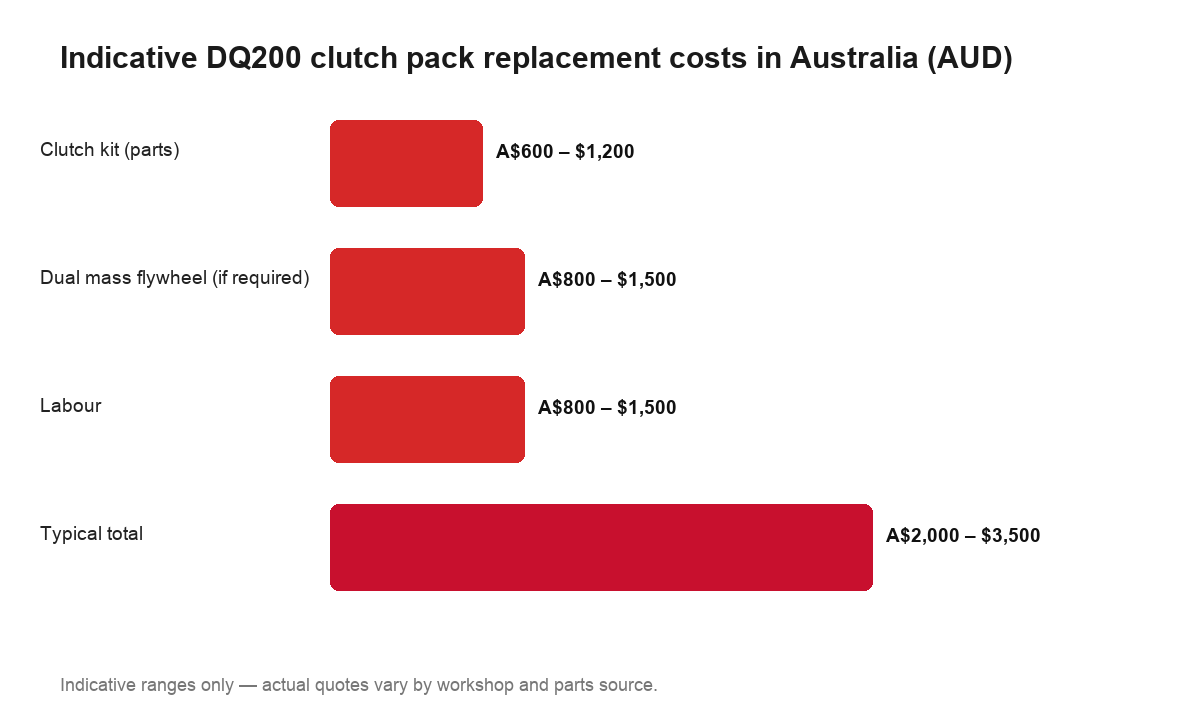
The total cost of a DQ200 clutch replacement is driven by three things: the clutch kit itself, whether the dual mass flywheel is also replaced, and the labour to remove and refit the gearbox and perform the clutch adaptation. The chart and table below summarise typical indicative figures gathered from Australian workshops.
| Job | Indicative cost (AUD) |
|---|---|
| Clutch kit (parts) | $600 – $1,200 |
| Dual mass flywheel (if required) | $800 – $1,500 |
| Labour | $800 – $1,500 |
| Typical total | $2,000 – $3,500 |
Two important points sit behind these numbers. First, a dual mass flywheel is not always required, but many specialists recommend replacing it while the gearbox is out because the labour overlap is already paid for. Second, a clutch replacement on a DQ200 must be followed by a proper clutch adaptation or basic settings procedure, otherwise the new clutch may continue to judder.
Clutch pack vs mechatronic: make sure you fix the right part
Because clutch and mechatronic symptoms overlap, it is easy to replace one when the other is actually the problem. A judder on take-off is usually clutch related, while a sudden loss of drive, a flashing PRNDS indicator or a “no communication” fault code is more likely to point at the mechatronic or TCM.
| Observation | More likely cause |
|---|---|
| Judder only when moving off | Clutch pack wear |
| Flashing PRNDS / limp mode | Mechatronic or TCM fault |
| Harsh shifting in all gears | Can be clutch or mechatronic — scan first |
| Loss of drive or stuck in gear | Mechatronic, hydraulic or electrical |
A quality diagnostic scan is the fastest way to avoid paying for the wrong repair. If the scan points at the clutch, a quality clutch kit is usually the fix. If it points at the mechatronic, replacing the clutch will not solve the problem.
Can you replace a DQ200 clutch pack yourself?
Replacing a DQ200 clutch pack is a significant job. The gearbox must be removed from the car, the old clutch pack removed, the flywheel inspected, the new clutch fitted, and then the whole assembly refitted and re-adapted using diagnostic software. For a well-equipped home mechanic it is possible, but it is not a beginner job, and getting the clutch adaptation right is essential to a smooth result.
For most owners, the best value approach is to supply a quality aftermarket clutch kit to a trusted independent workshop and pay only for labour. This keeps the parts cost down while ensuring the job is completed and adapted correctly.
Not sure which DQ200 clutch kit fits your exact car? Our Aussie team can confirm the right part against your VIN over the phone:
RunningRoo Auto Parts – Based in Melbourne, Australia 🇦🇺
Free 24/7 Pickup Available (by appointment)
Any questions? Call us anytime: 0425 890 125
Why Choose RunningRoo?
Aussie Owned & Operated | Fast Shipping | Friendly Support
Where to buy DQ200 clutch and mechatronic parts
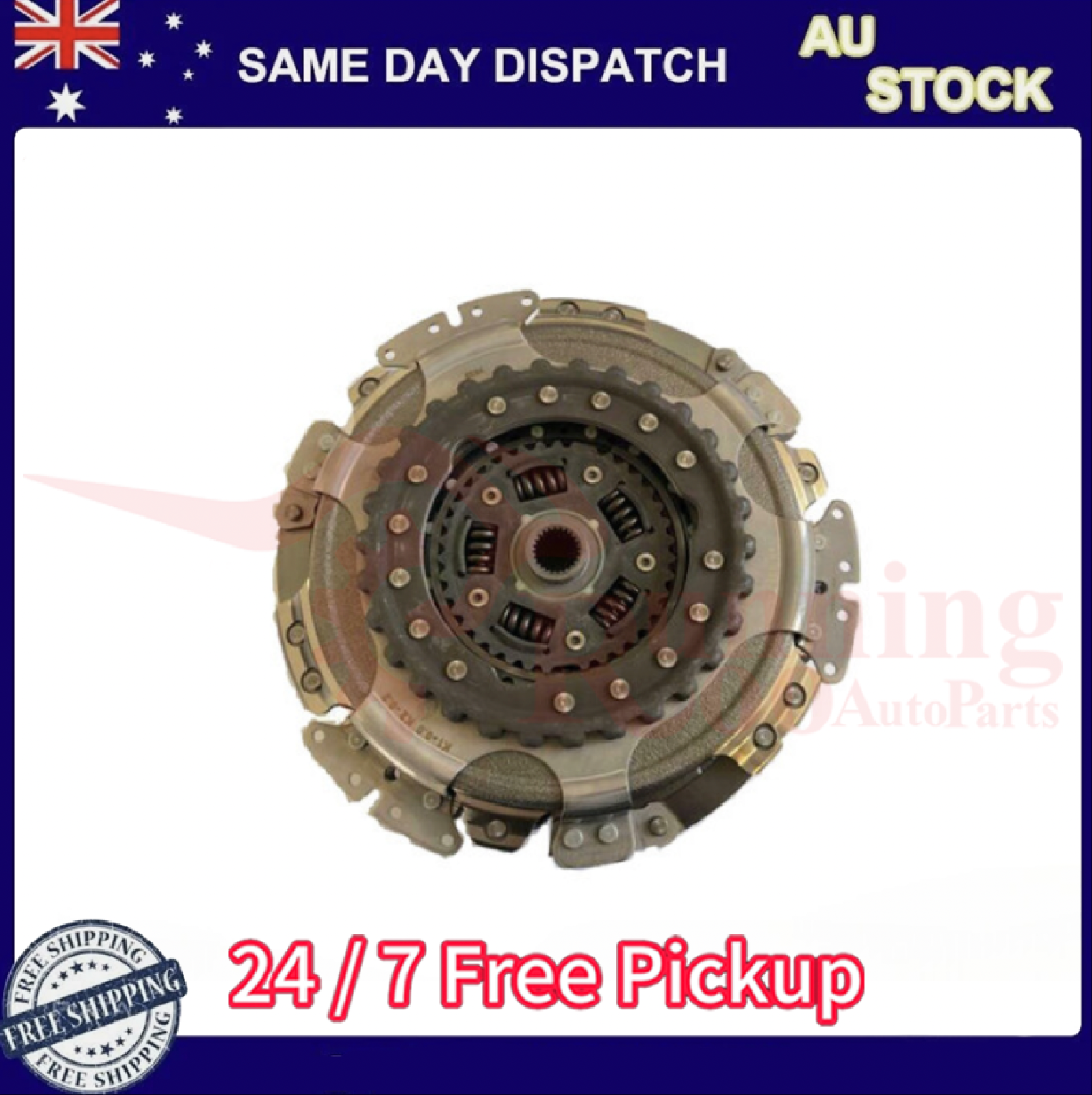
RunningRoo Auto Parts stocks DQ200 clutch, mechatronic and TCU components for a fraction of typical workshop retail pricing, with Melbourne pickup and Australia-wide delivery.
- 0AM DQ200 DSG7 Transmission Clutch Kit Gen 1 for VW / Audi
- DQ200 0AM 7-Speed Transmission Control Module (TCU) for Audi / VW
- 0CW DQ200 7-Speed DSG Mechatronic (Valve Body & TCU) for Audi / VW / Skoda
You can also browse the full range on our eBay store: RunningRoo Auto Parts on eBay Australia.
Frequently asked questions
How much does a DQ200 clutch replacement cost in Australia?
Typically between $2,000 and $3,500 for a complete clutch pack replacement including parts and labour, depending on the vehicle, the kit and whether the dual mass flywheel is replaced.
What are the symptoms of a worn DQ200 clutch?
The most common symptoms are juddering or shuddering on take-off, harsh or jerky gear changes, clutch slip, delayed engagement, and creeping or lurching in slow traffic.
How long does a DQ200 clutch pack last?
There is no fixed life. Clutch wear depends heavily on driving conditions, with heavy stop-start city driving shortening life compared with mostly highway use. Many units need attention somewhere between roughly 80,000 and 150,000 km, but this varies widely.
Is the clutch or the mechatronic more likely to fail?
Both are common on the DQ200. A judder on take-off is usually clutch related, while flashing PRNDS, limp mode or loss of drive more often points at the mechatronic or TCM. A diagnostic scan is the only reliable way to tell.
Does a DQ200 clutch need adaptation after replacement?
Yes. After a new clutch is fitted, the gearbox must be run through a clutch adaptation or basic settings procedure with suitable diagnostic software, otherwise the clutch may continue to judder.
Which cars use the DQ200 DSG?
The DQ200 seven-speed dry-clutch DSG is used across a range of Volkswagen, Skoda, Seat and Audi models, commonly with the 1.2 TSI, 1.4 TSI and 1.6 TDI engines.
How to extend your DQ200 clutch life
There is no way to make a dry clutch last forever, but your driving habits have a large influence on how long it survives. The DQ200 clutch wears fastest when it is asked to slip for long periods, which is exactly what happens when you creep forward slowly in heavy traffic or hold the car on a hill using the throttle.
To get the most life from your clutch, use the brake to hold the car at a standstill rather than letting the clutch slip against the engine, and avoid repeated harsh launches. Move off smoothly, let the gearbox complete each shift before applying full throttle, and avoid resting your foot on the brake while the car is trying to move. These habits reduce heat and friction, which are the two things that kill a dry clutch.
Regular fluid checks also help indirectly, because a healthy mechatronic controls the clutch more precisely. When the hydraulic side of the system is working correctly, the clutch engagement is smoother and wear is reduced.
Can a DQ200 clutch be adjusted?
There is no manual clutch adjustment on the DQ200 as there is on an old cable-operated clutch. Instead, the clutch is adapted electronically through the diagnostic software, which recalibrates the engagement points after a new clutch is fitted.
What is the difference between clutch and mechatronic symptoms?
A judder when moving off is usually clutch related, while a flashing PRNDS indicator, limp mode, loss of drive or a communication fault code more often points at the mechatronic or TCM. A diagnostic scan is the reliable way to tell them apart.
Dual mass flywheel: replace or reuse?
One of the most common add-ons to a DQ200 clutch quote is the dual mass flywheel (DMF). The DMF is a two-piece flywheel that dampens engine vibration before it reaches the gearbox. It is a wear item in its own right, and because the gearbox has to come out for the clutch anyway, the labour to reach it has already been paid for.
Whether you should replace the DMF comes down to its condition. If it shows excessive play, noise, scoring or heat discolouration, it should be replaced while the gearbox is out. If it measures within specification, it can often be reused. A good workshop will inspect and measure the flywheel and give you an honest recommendation rather than automatically adding it to the invoice.
The clutch adaptation process explained
Fitting a new DQ200 clutch is only half the job. After installation, the gearbox must be run through a clutch adaptation or basic settings procedure using diagnostic software such as VCDS or ODIS. This process teaches the transmission the exact engagement points of the new clutch so that it engages smoothly and does not judder.
Skipping the adaptation is one of the most common causes of a “new clutch” that still shudders after replacement. When comparing quotes, always confirm that the adaptation procedure is included in the price. If a workshop does not mention it, ask, because a clutch fitted without proper adaptation may feel almost as bad as the one you just replaced.
How to avoid the wrong diagnosis
Because clutch and mechatronic symptoms overlap, the single most valuable step you can take is to insist on a proper diagnostic scan before any parts are ordered. A scan that shows clutch-specific behaviour such as judder on take-off without communication or pressure faults points strongly at the clutch. A scan that shows mechatronic fault codes, pressure faults or a loss of communication points at the mechatronic or TCM instead.
It is also worth asking the workshop to rule out the cheaper causes first, including low fluid, wiring, connectors and basic adaptation issues. A competent DSG specialist will do this as a matter of routine, and it protects you from paying for a clutch replacement when the real problem was something much smaller.
Still have questions about your DQ200 clutch after reading this guide? We’re here to help, any time:
RunningRoo Auto Parts – Based in Melbourne, Australia 🇦🇺
Free 24/7 Pickup Available (by appointment)
Any questions? Call us anytime: 0425 890 125
Why Choose RunningRoo?
Aussie Owned & Operated | Fast Shipping | Friendly Support
Summary
A DQ200 clutch replacement is one of the more common big-ticket repairs on these cars, but it is also one of the most predictable. A judder on take-off is the classic early warning, and addressing it before the clutch fails completely is almost always cheaper. The total cost is driven by the kit, the flywheel decision and the labour, so asking for a clear breakdown and confirming the clutch adaptation is included will protect you from surprises.
Just as important as the parts is getting the diagnosis right, because clutch and mechatronic symptoms overlap. A diagnostic scan, a smooth driving style and quality parts will give you the best chance of a repair that lasts.
References
Key data in this article is drawn from the following official manufacturer sources:
- Volkswagen Group — DQ200 DSG7 dry dual-clutch technical documentation (clutch pack and clutch adaptation / basic-settings procedure).
- Volkswagen Australia — DSG (DQ200) voluntary recall notice, June 2013.