
G’day everyone. I’m the Senior Product Manager here at RunningRoo Auto Parts, Australia’s trusted aftermarket automotive parts specialist. If you own a Volkswagen, Audi, Skoda or Seat with the seven-speed DQ200 DSG gearbox and have been quoted a repair bill that made your eyes water, this guide is for you.
The DQ200’s transmission control module (TCM) is one of the most frequently discussed — and frequently misunderstood — components in the Australian used-car and workshop world. In this article I’ll explain exactly what the DQ200 TCM is, what it costs to repair or replace in Australia, why it fails, and the smartest way to get your car back on the road without overpaying. All prices are in Australian dollars and are indicative; labour rates and part prices vary between workshops and suppliers.
If you’d rather talk to a real person about your own DQ200 before reading further, our Melbourne-based team is always available:
RunningRoo Auto Parts – Based in Melbourne, Australia 🇦🇺
Free 24/7 Pickup Available (by appointment)
Any questions? Call us anytime: 0425 890 125
Why Choose RunningRoo?
Aussie Owned & Operated | Fast Shipping | Friendly Support
What is the DQ200 TCM (mechatronic unit)?
The DQ200 is Volkswagen Group’s seven-speed dry-clutch DSG (direct-shift gearbox). It is found in a wide range of smaller-engined models, including the Volkswagen Golf, Jetta, Polo, Passat and Caddy, as well as selected Skoda, Seat and Audi models fitted with engines such as the 1.2 TSI, 1.4 TSI and 1.6 TDI. The gearbox is rated for up to 250 Nm of engine torque.
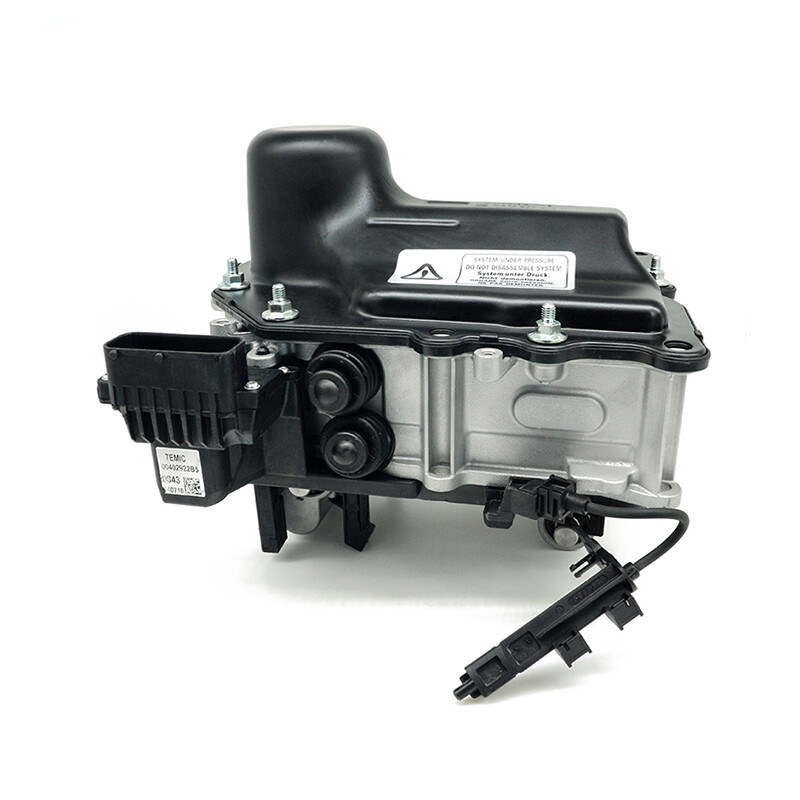
Inside the gearbox casing sits the mechatronic unit. This is the component that combines the electronic transmission control module (TCM or TCU) with the hydraulic valve body that physically selects gears and operates the clutches. The TCM reads signals from sensors across the car, decides when and how to shift, and commands the hydraulic actuators accordingly. When people refer to a “DQ200 TCM problem”, they are almost always talking about a fault within this combined mechatronic assembly.
Because the electronics, sensors and hydraulic solenoids are packaged together, a TCM fault can appear as an electrical error, a hydraulic fault, or a mechanical shifting problem. That is also why the repair conversation quickly becomes a “repair versus replace” decision.
How do you know your DQ200 TCM is failing?
The symptoms below are the most commonly reported warning signs of a faulty DQ200 mechatronic or TCM. They rarely appear in isolation, and they tend to get worse over time.
| Symptom | What you may experience |
|---|---|
| Rough or harsh gear changes | Shifts feel abrupt, especially between first and second gear. |
| Delayed engagement | A pause between selecting Drive or Reverse and the car actually moving. |
| Juddering or shuddering on take-off | The car vibrates when moving off from a standstill, a classic dry-clutch symptom. |
| Flashing PRNDS or gear indicator | The gear position display flashes on the dashboard, often with a warning light. |
| Limp mode / fail-safe mode | The gearbox locks itself into a single gear (often second) and limits performance. |
| Loss of drive | The engine revs but the car does not move, or drive is lost while moving. |
| No communication with the TCM | Diagnostic tools cannot connect to the transmission control module. |
These symptoms do not always mean the mechatronic must be replaced. A proper diagnostic scan is the first step, because low transmission fluid, a worn clutch pack, a faulty sensor or a wiring issue can produce similar complaints. Never approve a major repair without a scan report and fault codes.
How much does a DQ200 TCM repair cost in Australia?
Repair work on the DQ200 mechatronic is usually quoted as a menu of smaller jobs rather than a single fixed price. The table below summarises typical indicative ranges gathered from Australian workshops and parts listings. These are market reference figures, not official Volkswagen pricing.
| Job | Indicative cost (AUD) |
|---|---|
| Diagnostic scan | $150 |
| Mechatronic repair / refurbishment | $450 – $1,200 |
| TCU / mechatronic unit (aftermarket part only) | around $1,200 |
| Accumulator repair | around $650 |
| Clutch pack replacement (parts and labour) | $2,000 – $3,500 |
| Full mechatronic replacement (workshop fitted) | $3,000 – $5,000 |
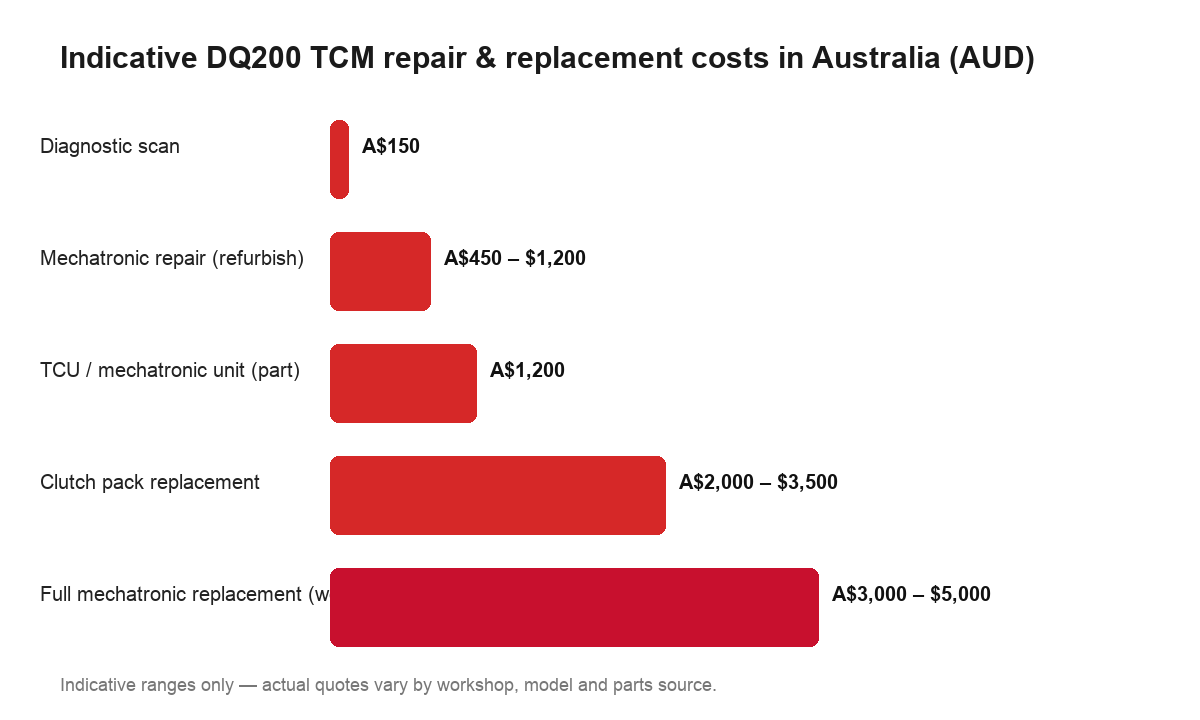
A key point to understand is that a “repair” is usually cheaper than a full replacement, but it is not always the right long-term answer. Refurbishing a mechatronic can extend its life considerably when the fault is confined to a known weak point such as the accumulator or a failed solenoid. If the electronic control board itself is damaged, however, a replacement TCU is usually the more reliable choice.
DQ200 TCM replacement cost: what a full unit actually involves
When a workshop quotes a “TCM replacement”, they are usually quoting the mechatronic assembly, because the control module and valve body are supplied and replaced together. The total is driven by three things: the cost of the unit, the labour to remove and refit it, and the coding or adaptation required to match the new unit to your vehicle.
- The unit itself: a new genuine Volkswagen mechatronic is the most expensive option. A quality aftermarket or remanufactured DQ200 mechatronic and TCU is significantly cheaper and is what most independent specialists fit.
- Labour: the mechatronic sits inside the gearbox, so the job involves draining fluid, removing the cover, disconnecting the wiring, and carefully refitting the new unit before refilling.
- Coding and adaptation: the replacement TCM must be coded to the car and run through basic settings so the clutches and shift points are learned correctly. Skipping this step is a common cause of a “failed” repair.
For many owners the deciding question is whether to pay for a full replacement or to repair the existing unit. The comparison below sets out the practical trade-offs.
Repair vs replace: which is the better value?
| Factor | Repair existing unit | Replace with new/reman unit |
|---|---|---|
| Upfront cost | Lower ($450 – $1,200 typical) | Higher ($3,000 – $5,000 workshop) |
| Typical turnaround | Longer if the unit is sent away for refurbishment | Faster once parts are in stock |
| Long-term reliability | Good when the fault is a known, repairable weak point | Generally the most reliable option |
| Warranty | Varies by repairer | Usually comes with a parts warranty |
| Best suited for | A confirmed single fault, such as accumulator or solenoid | Control board damage, multiple faults, or repeated failures |
Our advice to Australian owners is simple: get the fault codes first. If the diagnosis points to a single, well-known failure, a quality repair is often the best value. If the control module has failed electronically, or if the car has already had repeated repairs, replacing the mechatronic with a reliable unit is usually cheaper in the long run than paying for the same job twice.
Why DQ200 mechatronics fail — and the Australian recall
The DQ200 has a well-documented history in Australia. In June 2013, Volkswagen Australia issued a voluntary safety recall covering 25,928 vehicles — Golf, Jetta, Polo, Passat and Caddy models built between June 2008 and September 2011. Volkswagen stated that “in isolated cases, an electronic malfunction in the control unit inside the gearbox mechatronics may result in a power interruption.” As part of the recall, the mechatronic unit was inspected, replaced where required, and updated with the latest software at no cost to owners.
That recall highlights the core engineering reality of the DQ200: the mechatronic combines delicate electronics with hydraulic and mechanical components, and it operates under heat and vibration. Over time, solder joints on the control board, the accumulator, and the hydraulic solenoids are among the components most likely to develop faults.
Unlike the larger wet-clutch DSG gearboxes, the DQ200 uses a dry-clutch design, which means the clutch pack and mechatronic are not continuously bathed in oil for cooling and lubrication. The mechatronic still contains its own dedicated hydraulic fluid to operate the gear-selector forks and clutch actuators, but the unit is more exposed to thermal cycling than a wet-clutch system. Repeated heating and cooling can accelerate solder-joint fatigue on the electronic board and wear on the accumulator and solenoids, which is why age and kilometres matter more than raw driving style when these faults appear.
Common DQ200 fault codes and what they mean
| Fault code | Meaning |
|---|---|
| U0101 | Lost communication with the transmission control module (TCM). |
| 01315 | Transmission control module — no or incorrect communication. |
| P173F | Valve 2 electrical malfunction in partial transmission 1 (a known DQ200 mechatronic fault). |
If a scan returns U0101 or 01315, the first checks should always be the wiring, connectors, fuses and the mechatronic’s power and earth circuits, because a communication fault can sometimes be a connection problem rather than a dead control module. A specialist who repairs these units every week will usually be able to distinguish a board failure from a harness or connector issue quickly.
Can you repair or replace a DQ200 TCM yourself?
Mechanically minded owners often ask whether this is a DIY job. The honest answer is that removing and refitting a DQ200 mechatronic is possible at home with the right tools, but it is not a beginner job. You will need to safely support the vehicle, drain and refill the transmission fluid to the correct specification, disconnect and reconnect the mechatronic’s electrical connector carefully, and then carry out coding and basic settings with a suitable diagnostic tool such as VCDS or ODIS.
For most owners, the sensible approach is to supply a quality aftermarket or remanufactured mechatronic and TCU to a trusted independent workshop that has the diagnostic equipment to complete the coding and adaptation. This keeps the parts cost down while ensuring the job is finished correctly and safely.
How to avoid overpaying for a DQ200 TCM repair
A DQ200 diagnosis can be expensive, but it should never be a mystery. Following a short checklist before you approve any quote will protect you from paying for unnecessary work.
- Get the fault codes in writing. Insist on a printed or emailed scan report showing the exact DTCs before any parts are ordered.
- Rule out the cheap causes first. Ask the workshop to confirm the wiring, connectors, fuses, and power and earth circuits are sound before condemning the control module.
- Compare genuine versus quality aftermarket. A reputable aftermarket or remanufactured mechatronic can save a large amount without sacrificing reliability.
- Confirm coding and basic settings are included. A replacement TCM that is not coded and adapted will not shift correctly, so this step must be part of the quote.
- Ask about the warranty. A good specialist will stand behind the repair or the supplied unit for a defined period.
- Consider supplying your own parts. If your workshop allows it, sourcing the mechatronic or TCU yourself and paying only for labour is often the lowest-cost path.
Where to buy DQ200 TCM and mechatronic parts in Australia
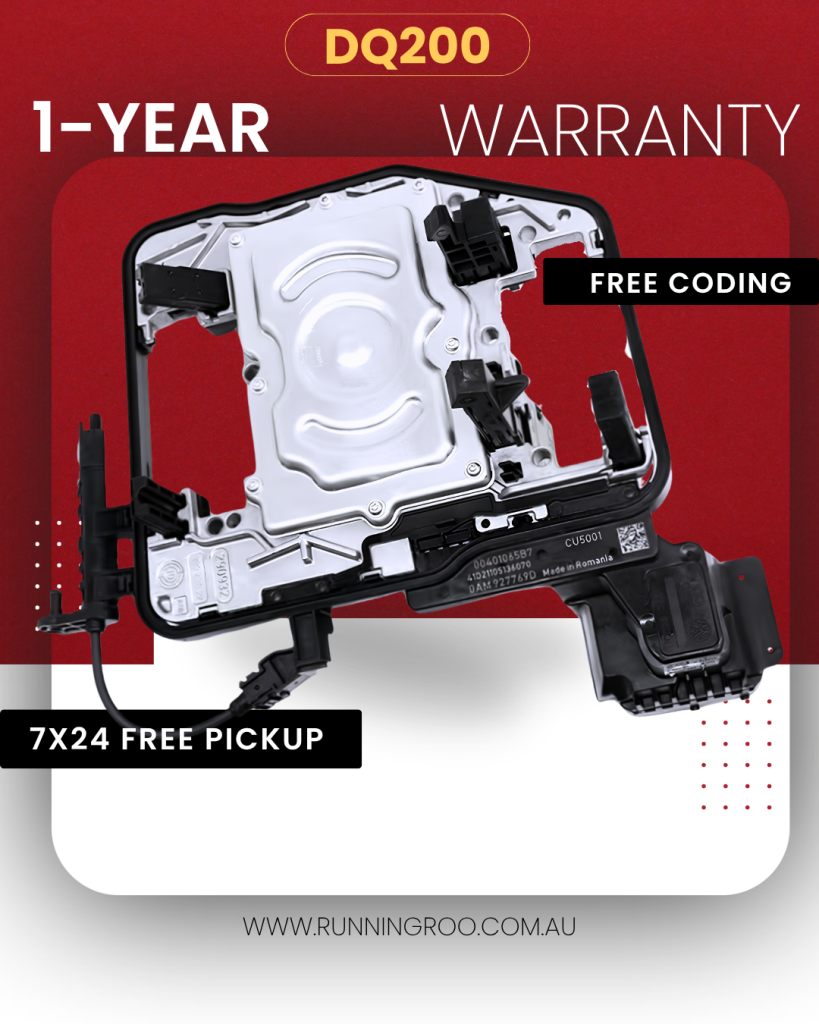
If you have been quoted a full retail price for a replacement mechatronic, it is worth comparing against quality aftermarket alternatives before you commit. RunningRoo Auto Parts stocks DQ200 mechatronic, TCU and clutch components for a fraction of the typical workshop retail price, with Melbourne pickup and Australia-wide delivery.
- DQ200 0AM 7-Speed Transmission Control Module (TCU) for Audi / VW
- 0CW DQ200 7-Speed DSG Mechatronic (Valve Body & TCU) for Audi / VW / Skoda
- 0AM DQ200 DSG7 Transmission Clutch Kit Gen 1 for VW / Audi
- Valve Body Accumulator Housing for DSG DQ200
You can also browse our full DQ200 range on our eBay store: RunningRoo Auto Parts on eBay Australia.
Not sure which DQ200 unit fits your exact car? Our Aussie team can confirm the right part against your VIN over the phone:
RunningRoo Auto Parts – Based in Melbourne, Australia 🇦🇺
Free 24/7 Pickup Available (by appointment)
Any questions? Call us anytime: 0425 890 125
Why Choose RunningRoo?
Aussie Owned & Operated | Fast Shipping | Friendly Support
Frequently asked questions
How much does it cost to replace a DQ200 TCM in Australia?
Typically between $3,000 and $5,000 for a workshop-fitted full mechatronic replacement, depending on the vehicle, the source of the unit and the workshop’s labour rate. Supplying your own quality aftermarket unit can significantly reduce the total.
Is it cheaper to repair or replace a DQ200 mechatronic?
Repairing is usually cheaper upfront, at roughly $450 to $1,200 for common faults such as an accumulator or solenoid. Replacement is more expensive but often more reliable when the electronic control board has failed.
What are the symptoms of a failing DQ200 TCM?
The most common symptoms are rough shifting, delayed engagement, juddering on take-off, a flashing PRNDS indicator, limp mode, loss of drive, and diagnostic tools failing to communicate with the TCM.
Does the DQ200 have an official transmission fluid service interval?
The DQ200 is considered a sealed-for-life gearbox by Volkswagen, so there is no official fluid change interval. Many independent specialists still recommend checking the fluid and, where appropriate, changing it around every 100,000 km to help extend mechatronic life.
Which cars use the DQ200 DSG gearbox?
The DQ200 seven-speed dry-clutch DSG is used across a range of Volkswagen, Skoda, Seat and Audi models, commonly with the 1.2 TSI, 1.4 TSI and 1.6 TDI engines, including Golf, Jetta, Polo, Passat and Caddy.
Was there a DQ200 recall in Australia?
Yes. In June 2013 Volkswagen Australia recalled 25,928 Golf, Jetta, Polo, Passat and Caddy vehicles built between June 2008 and September 2011 to inspect, and where necessary replace, the mechatronic unit free of charge.
Can I keep driving with a faulty DQ200 TCM?
It is not recommended. A failing mechatronic can trigger limp mode or a sudden loss of drive, which is a safety risk in traffic. If you experience flashing PRNDS, harsh shifting or loss of drive, have the vehicle inspected promptly and avoid unnecessary trips until it has been diagnosed.
Still have questions about your DQ200 TCM after reading this guide? We’re here to help, any time:
RunningRoo Auto Parts – Based in Melbourne, Australia 🇦🇺
Free 24/7 Pickup Available (by appointment)
Any questions? Call us anytime: 0425 890 125
Why Choose RunningRoo?
Aussie Owned & Operated | Fast Shipping | Friendly Support
References
Key data in this article is drawn from the following official manufacturer sources:
- Volkswagen Australia — DSG (DQ200) voluntary safety recall announcement, June 2013 (25,928 vehicles: Golf, Jetta, Polo, Passat and Caddy, built June 2008 – September 2011).
- Volkswagen Group — DQ200 7-speed dry-clutch DSG technical documentation (gearbox codes 0AM / 0CW).