
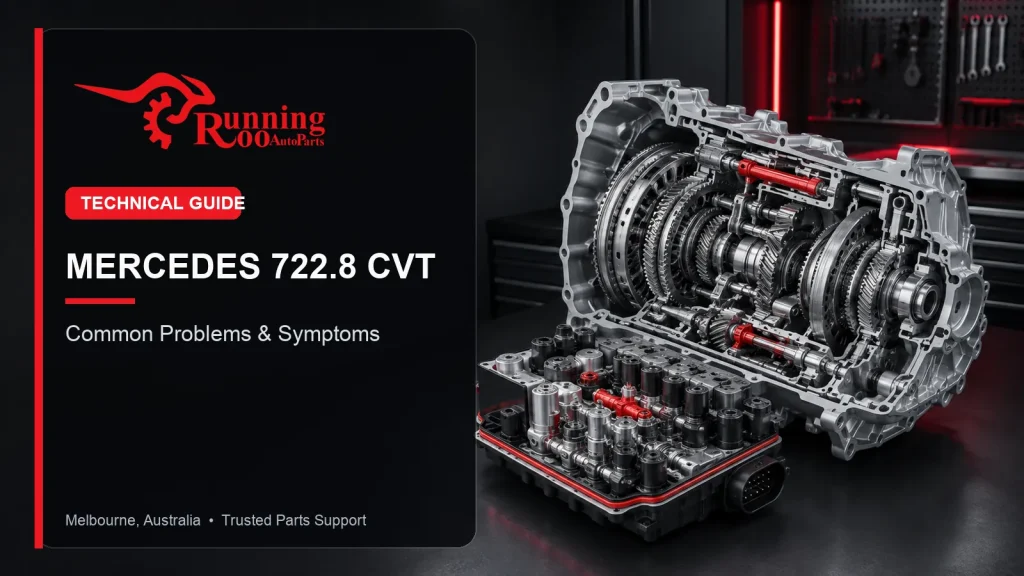
Target Vehicle: Mercedes-Benz A-Class (W169) & B-Class (W245)
Transmission Profile: Mercedes-Benz Autronic 722.8 Continuously Variable Transmission (CVT)
As product managers in the automotive remanufacturing and aftermarket parts sector, our core metric is solving real-world friction for workshops and owners. When it comes to the European hatchback market in Australia, few gearboxes present a more predictable failure curve than the Mercedes-Benz 722.8 Autronic CVT.
Introduced in the mid-2000s for the W169 A-Class and W245 B-Class, this front-wheel-drive transmission was designed to offer seamless ratio transitions and optimised engine efficiency via a dual-pulley and steel pushbelt system. However, as these vehicles cross maturity curves across Australia, systemic design vulnerabilities in both the electro-hydraulic mechatronics unit (Temic VGS) and mechanical components have turned the 722.8 into a high-frequency service event.
This teardown provides a clear product analysis of the 722.8 CVT’s structural pain points, diagnostic workflows, and systemic solutions required to get Aussie drivers back on the road safely without the exorbitant cost of a dealership crate replacement.
1. Technical Anatomy of the 722.8 CVT
To effectively diagnose the symptoms, we must understand the mechanical and electronic architecture defined by Mercedes-Benz factory service documentation:
- The Variator System: Unlike conventional planetary automatic gearboxes, the 722.8 adjusts its gear ratios continuously by altering the hydraulic pressure within the primary and secondary tapered pulleys. A high-tensile steel pushbelt moves dynamically between these pulleys to change the active radius.
- The Temic VGS Mechatronics (Autronic): The brain of the transmission is submerged directly within the CVT fluid at the base of the unit. It comprises a hydraulic labyrinth valve body that manages physical oil routing, coupled directly to an integrated Transmission Control Module (TCM/TCU) built by Temic.
- The Torque Converter Lock-up: To eliminate slip losses inherent to fluid coupling, Mercedes-Benz incorporated a solid mechanical lock-up clutch inside the torque converter.
+-------------------------------------------------------------+
|               Engine Crankshaft / Torque Converter          |
+-------------------------------------------------------------+
                              |
                              v
+-------------------------------------------------------------+
|    Temic VGS Mechatronics Unit (Submerged in CVT Fluid)     |
|   - Electronic TCU Conductor Plate (Sensors Y3/9b4, Y3/9b5)  |
|   - Hydraulic Valve Body (Fluid Control Circuits)           |
+-------------------------------------------------------------+
                              |
       +----------------------+----------------------+
       | (Hydraulic Actuation)                       | (Hydraulic Actuation)
       v                                             v
+---------------------------+                 +---------------------------+
|      Primary Pulley       |==== Pushbelt ===>     Secondary Pulley      |
|     (Engine RPM Side)     |   (Steel Band)  |    (Drive Axle Side)      |
+---------------------------+                 +---------------------------+
2. Top 3 Systemic Failure Modes and Diagnostic Symptoms
Through detailed workshop claim data and field monitoring, we have categorised 722.8 failures into three distinct product issue buckets:
A. The Conductor Plate Speed Sensor Failure (Electronic)
The single highest-volume warranty and repair failure mode is the breakdown of the bond wires within the integrated Temic TCU. Constant thermal cycling (heating and cooling of the transmission fluid) puts physical stress on the micro-connections leading to the internal speed sensors:
- Y3/9b4: Primary RPM/Secondary Speed Sensor.
- Y3/9b5: Output RPM/Driving Speed Sensor.
When these micro-wires fracture, the TCU loses its clean square-wave signal from the sensors, forcing the vehicle into an immediate protective state.
B. Valve Body Wear and Pressure Loss (Mechanical/Hydraulic)
The hydraulic valve body consists of high-precision steel valves reciprocating inside aluminum bores. Over time, fine metallic debris suspended in the oil acts like liquid sandpaper. This wears down the bore walls, causing hydraulic cross-leakage. When pressure drops below the factory threshold required to clamp the pulleys against the steel belt, slippage occurs.
C. Mechanical Structural Fracture (Hard Parts)
In high-mileage or poorly maintained units, the secondary pulley shaft locking nut can back off or fail structurally. This results in misaligned pulleys, leading to catastrophic fraying or snapping of the steel pushbelt.
3. High-Frequency Trouble Codes (DTCs) and Error Mapping
When a W169 enters a workshop with transmission failure, a standard OBD-II/Xentry diagnostic scan typically surfaces a highly predictable set of Diagnostic Trouble Codes (DTCs).
| Diagnostic Trouble Code (DTC) | Component Focus | Technical Condition Description |
| P0722 | Sensor Y3/9b5 | Output Speed Sensor Signal Unobtainable / Faulty |
| P0793 | Sensor Y3/9b4 | Intermediate Shaft Speed Sensor Circuit No Signal |
| P0896 | Hydraulic System | Impermissible Adjustment of the CVT Ratio (Slipping) |
| P0730 | Ratios | Incorrect Gear Ratio / Mechanical Slippage Detected |
| P2722 | Valve Body | Impermissible Closing of Hydraulic Brake “Reverse” Detected |
4. Driving Symptoms: What the End User Experiences
From a customer-centric viewpoint, an owner typically notices the failure via four distinct real-world driving conditions:
- The “Transmission Visit Workshop” Warning: The driver is hit with a bright warning on the multi-function instrument cluster screen. This is triggered immediately when the TCU registers irrational sensor data or an incorrect ratio.
- Limp-Home Mode Activation: The vehicle restricts its operational parameters. The engine revs freely, but the transmission locks its pulley ratio to a safe, static middle position, severely limiting acceleration and preventing top-end highway speeds.
- Severe Shuddering and “Bumping”: Mercedes-Benz actually documented a known issue where vehicles experience a pronounced “bump” or shudder right as the car comes to a complete halt. This is caused by unstable lock-up clutch engagement or failing magnets in the oil pan.
- Complete Loss of Drive: If the steel pushbelt breaks completely, the engine will run perfectly, but absolutely no torque is transmitted to the front wheels.
5. Remanufacturing & Preventative Maintenance Protocols
To extend the product lifecycle of the 722.8 and avoid a complete unit scrap, a precise multi-tiered engineering approach must be followed.
       [ 722.8 Diagnosis Event ]
                   |
         +---------+---------+
         |                   |
         v                   v
   [ DTC: P0722/P0793 ]    [ DTC: P0896/Ratio Error ]
         |                   |
         v                   v
+----------------------+ +----------------------+
| Remanufacture TCU    | | Inspect Pulley/Belt  |
| - Repair Bond Wires  | | - Check Fluid/Debris |
| - Retain SCN Coding  | | - Replace Valve Body |
+----------------------+ +----------------------+
         |                   |
         +---------+---------+
                   |
                   v
   [ Mandatory Service Refresh ]
   - Genuine Fluid (MB 236.20)
   - New Pick-up Filter & Gasket
   - Special Anti-Bump Gel Magnet
Protocol A: TCU Micro-Soldering Remanufacturing
Instead of paying thousands for a brand new blank mechatronics module from Stuttgart (which requires highly regulated online SCN coding via an authorised Mercedes portal), the optimal solution is to extract the conductor plate and remanufacture the internal speed sensor connections. By opening the sealed gel compartment of the Temic TCU, specialists can replace the fragile factory bond wires with high-fatigue copper or gold wires, retaining the vehicle’s original VIN and adaptation data.
Protocol B: The Factory Fluid Mitigation Strategy
CVT fluid undergoes severe shearing forces inside a 722.8 unit. Mercedes-Benz factory service bulletins state that a specific fluid complying with MB-Approval 236.20 must be used. Standard automatic transmission fluid (ATF) will destroy the transmission belt within kilometers due to improper static friction coefficients.
Furthermore, original parts listings show that Mercedes-Benz specifically introduced a modified oil pan magnet embedded with an Anti-Bump Gel (Part Number variant). This gel slowly dissolves into the CVT oil to change surface tension properties, curing the inherent first-gear stop-and-go shudder.
6. Frequently Asked Questions (FAQ)
Q1: Can I clear the “Transmission Visit Workshop” message with a standard OBD2 scanner to fix the car?
A: No. A basic scanner might clear the historical code and temporarily pull the vehicle out of limp mode, but as soon as the transmission fluid reaches operating temperature or the speed sensors miss a pulse, the TCU will instantly re-engage the error code and limp mode to protect the hardware. The structural wire or sensor fault must be physically repaired.
Q2: Does a remanufactured 722.8 TCU need to be coded or programmed to my specific W169?
A: If you send your vehicle’s original TCU to a specialist remanufacturer for micro-soldering, no programming is required because the memory chip containing your VIN and SCN coding is untouched. However, if you purchase a replacement or donor TCU from another vehicle, it will be locked to that donor car’s immobiliser system and will require advanced specialist adaptation software to match your vehicle’s VIN.
Q3: How often should the fluid be changed on a Mercedes 722.8 transmission?
A: Given Australia’s harsh operating temperatures, we strongly recommend a strict service interval of every 60,000 kilometres or 4 years (whichever comes first). Every service must include a fresh pick-up filter, a new oil pan gasket, and high-quality fluid meeting the MB 236.20 spec.
Q4: My W169 shudders aggressively just before coming to a stop. Is the transmission dead?
A: Not necessarily. This is a classic symptom of torque converter lock-up irregularities or degraded fluid properties. Often, executing a comprehensive fluid flush, replacing the oil pan magnet with the updated factory gel-infused magnet, and performing a TCU adaptation reset via a Star Diagnosis machine will eliminate this issue without a complete rebuild.
7. Engineering Reference Images
Fig 1. Temic VGS Conductor Plate Layout
(Note: For illustrative workshop reference, notice the vulnerable speed sensors protruding outward from the main plastic housing).
+-------------------------------------------------------+
|  [ Connector Plug ]                                    |
|         |                                             |
|         v                                             |
|   +-----------+                                       |
|   | Internal  |                                       |
|   | Processor |                                       |
|   +-----------+                                       |
|     |       |                                         |
|     |       +--------------> [ Y3/9b4 Speed Sensor ]  |
|     |                        (Primary RPM)            |
|     |                                                 |
|     +----------------------> [ Y3/9b5 Speed Sensor ]  |
|                              (Output Speed)           |
|                                                       |
|  [ Solenoid Valve Connections - Bottom Side ]         |
+-------------------------------------------------------+
Fig 2. Variator Pulley and Steel Belt Mechanical Interface
(Note: Proper fluid pressure is essential to prevent the belt from scoring the mirror-polished pulley faces).
      [Primary Pulley]                 [Secondary Pulley]
         /=========\                      /=========\
        /   O-RPM   \                    /   O-RPM   \
       |     (_)     |                  |     (_)     |
        \           /                    \           /
         \=========/                      \=========/
             ||                               ||
             ||========= [Steel Belt] ========||
             ||         (Push Element)        ||
Summary for Product Strategy
By focusing our inventory on high-quality remanufactured TCM units, specialized tools, and precise MB 236.20 compliant service kits, RunningRoo enables workshops across Australia to tackle the lucrative W169 service lifecycle efficiently. Understanding the clear boundary lines between electronic faults (P0722/P0793) and total mechanical failure saves time, lowers return rates, and maximizes shop margin.
If you have any questions regarding any Mercedes Benz A-Class W169 722.8 CVT Transmission TCM–related issues, please feel free to contact us at any time.
We are based in Blackburn South, Melbourne, and provide 24/7 free pickup service (by appointment only) for your convenience.
📞 Phone: 0425 890 125
🛒 eBay Store: https://www.ebay.com.au/itm/365664133268
At RunningRoo Auto Parts, we are here to help with any Mercedes Benz A-Class W169 722.8 CVT Transmission TCM, or technical enquiries—don’t hesitate to reach out.
A+ Seller , great service
Great product super sellers aaa +++
Cheers mate! 😊 Thanks heaps for the AAA+++ feedback! We’re stoked you’re happy with the product and service. Really appreciate your support!
— RunningRoo Auto Parts 🇦🇺
Fantastic item, great communication, fast delivery, many thanks
Great post,Thanks for sharing
(* ̄▽ ̄*)Good quality product which fit exactly . Fixed the problem at a reasonable price.good description and shipping
good thanks