
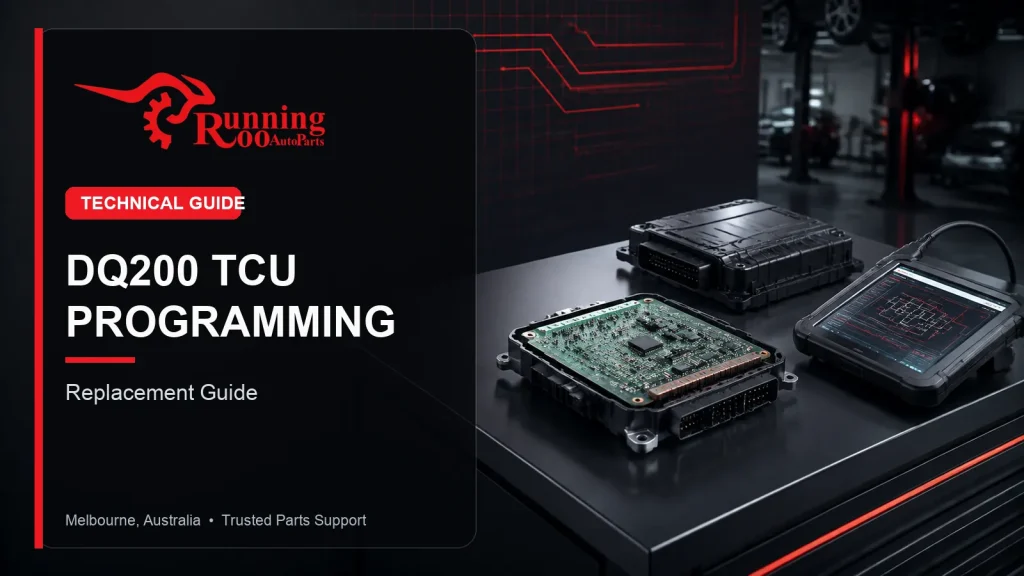
Complete Guide to DQ200 Mechatronic Unit, TCU Coding & Version Differences
The DQ200 dry dual-clutch transmission (commonly known as 0AM / 0CW DSG) is widely used across Volkswagen Group vehicles, including VW, Audi, Skoda and SEAT models. In Australia—especially in cities like Melbourne—this gearbox is extremely common, making DQ200 TCU replacement and mechatronic repair one of the most in-demand DSG services.
At the core of this transmission system is the TCU (Transmission Control Unit), which controls gear shifting, clutch engagement, and overall driving performance. As vehicles age, failures in the DQ200 mechatronic unit become increasingly common, with the TCU being one of the most critical components affecting repair outcomes.
This guide provides a practical, experience-based overview of:
- DQ200 TCU function
- Programming and coding methods
- VIN vs diagnostic matching
- Version differences (D / E / G / K)
- Real-world repair insights
1. What is a DQ200 TCU and Mechatronic Unit?
The DQ200 transmission uses an integrated mechatronic system, which combines electronic and hydraulic control.
- Mechatronic Unit: Includes hydraulic circuits, solenoids, pump, and TCU
- TCU (Transmission Control Unit): The electronic “brain” controlling shift logic and clutch behaviour
In simple terms:
The TCU is the brain, while the mechatronic unit is the execution system.
Common DQ200 Fault Symptoms
In Melbourne DSG repair cases, the most common symptoms include:
- Flashing spanner light on dashboard
- Delayed or failed gear engagement
- Vehicle entering limp mode
- Fault codes such as P17BF, P189C
These issues are often linked to the DQ200 mechatronic unit or TCU failure.
2. DQ200 TCU Replacement – Why Programming Matters
Replacing a DQ200 TCU is not plug-and-play.
Correct programming and coding are essential to ensure compatibility with:
- Engine ECU
- Gearbox hardware
- Vehicle software configuration
Without proper programming, the vehicle may:
- Fail to start
- Not engage gears
- Display fault codes
- Enter limp mode
VIN-Based Programming (Most Common Method)
For most customers in Australia, we provide TCU programming based on the vehicle VIN (Vehicle Identification Number).
This process includes:
- Accessing factory-based software data
- Matching correct TCU software version
- Writing coding and adaptation values
Our team is supported by technicians with Volkswagen system experience, allowing us to achieve a high level of programming accuracy.
VIN Matching Accuracy
While VIN-based programming is efficient, it is not 100% perfect.
| Matching Method | Data Source | Accuracy | Recommended For |
|---|---|---|---|
| VIN Programming | Factory database + experience | ~97% | Private vehicle owners |
| Diagnostic Reading | Live gearbox data | 100% | Workshops & mechanics |
VIN matching is highly effective—but not absolute.
3. Best Practice: Reading Gearbox Software Version
For maximum accuracy, the recommended method is:
Reading the actual DQ200 gearbox software version using diagnostic tools.
Common tools used in Australia include:
- VCDS (VAG-COM)
- ODIS
- Professional scan tools
Key data includes:
- Software Number (SW)
- Hardware Number (HW)
- Current coding
Why This Method is 100% Accurate
- Reflects real vehicle condition
- Eliminates VIN mismatch issues
- Accounts for previous repairs or updates
Customer Recommendation
| Customer Type | Recommended Approach | Reason |
|---|---|---|
| Private Owners | VIN matching | Simple, cost-effective |
| Workshops / Mechanics | Diagnostic reading | Maximum accuracy, no rework |
4. DQ200 TCU Versions Explained (D / E / G / K)
DQ200 TCU part numbers often end with a letter, such as:
- 0AM927769D
- 0AM927769E
- 0AM927769G
- 0AM927769K
These suffixes represent different software and hardware revisions.
Version Comparison Table
| Version | Stage | Key Features | Notes |
|---|---|---|---|
| D | Early version | Basic design, lower stability | Older vehicles |
| E | Improved version | Better shift logic | Common replacement |
| G | Mid upgrade | Enhanced compatibility | Widely used |
| K | Latest version | Improved reliability | Recommended option |
Key Differences
- Shift strategy optimisation
- Clutch control algorithms
- Heat resistance and electronics stability
- Compatibility across engine variants
Are These Versions Interchangeable?
Yes—but only with correct programming.
Without proper coding, issues may include:
- No communication
- Gear selection failure
- Warning lights
5. Real-World DSG Repair Experience (Melbourne Market)
Based on extensive DSG repair and parts supply experience in Melbourne, we’ve identified key insights:
1. Avoid Blind TCU Replacement
Many failures are not caused by the TCU itself, but by:
- Hydraulic system faults
- Clutch wear
2. Software Matters More Than Hardware
A correct TCU with incorrect programming will not function.
3. VIN Matching Works for Most Customers
- Cost-effective
- Fast turnaround
- ~97% success rate
4. Workshops Should Always Read Data
- Eliminates guesswork
- Reduces rework
- Improves efficiency
6. Why VIN Matching is Not 100% Accurate
Even with factory data, mismatches can occur due to:
- Previous gearbox replacement
- Software updates or tuning
- Imported vehicles (EU vs AU spec)
- Incomplete service history
A 97% success rate is considered very high in the aftermarket industry.
7. Conclusion
DQ200 TCU replacement is not just a parts swap—it is a software-driven repair process.
Key takeaways:
- TCU is the core control unit of the DQ200 DSG
- VIN-based programming achieves ~97% accuracy
- Diagnostic reading ensures 100% accuracy
- Versions D / E / G / K reflect technical evolution
- Correct coding is more important than the part itself
For Melbourne vehicle owners, VIN matching is typically sufficient. For professional workshops, diagnostic-based matching remains the most reliable solution.
FAQ – DQ200 TCU & Mechatronic (Australia)
Can I install a DQ200 TCU without programming?
No. Programming is mandatory for proper operation.
Is VIN-based programming reliable?
Yes, with approximately 97% accuracy based on real-world data.
What is the most accurate method?
Reading the gearbox software version using diagnostic tools.
Which TCU version is best?
Version K is generally the most refined, but correct matching is more important than version.
Do I need basic settings after installation?
Yes. Clutch adaptation and calibration are required.
Can I replace different letter versions (D/E/G/K)?
Yes, but only with proper programming.
If you have any questions regarding any DQ200 gearbox-related issues, please feel free to contact us at any time.
We are based in Blackburn South, Melbourne, and provide 24/7 free pickup service (by appointment only) for your convenience.
📞 Phone: 0425 890 125
🛒 eBay Store: https://www.ebay.com.au/itm/365819799559?_skw=dq200&itmmeta=01KTGWC00ZCHGVEPKYYAZ4QXV0&hash=item552c8f2807:g:np8AAeSwNI1pRHw3
At RunningRoo Auto Parts, we are here to help with any DQ200 diagnostics, parts, or technical enquiries—don’t hesitate to reach out.
Item received in good time
Cheers mate! 😊 Great to hear it arrived in good time. Thanks heaps for your support!
— RunningRoo Auto Parts 🇦🇺
Excellent communication, packaging and fast postage. Part works as described
Cheers mate! 😊 Great to hear the quality and condition were spot on. Thanks heaps for your support!
— RunningRoo Auto Parts 🇦🇺